
 By admin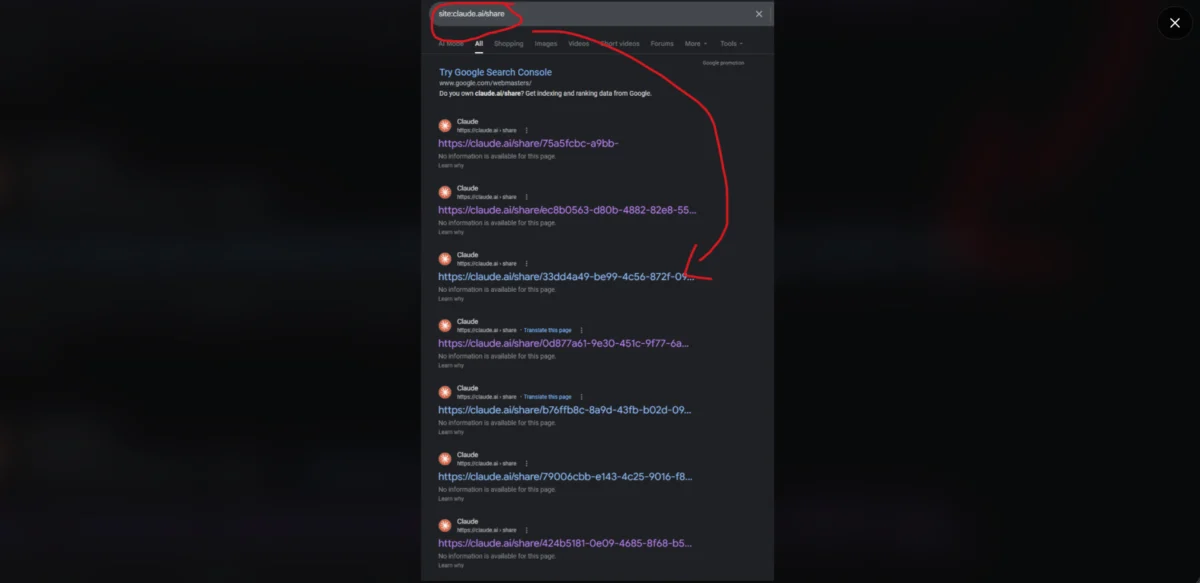
Over the weekend, a startling discovery made by Reddit user -void1 on the r/ClaudeAI subreddit sent ripples of concern through the AI community. The user revealed that certain conversations, which users had opted to make "shareable" via a direct link through Anthropic’s Claude AI chatbot, were being indexed by Google Search, rendering them accessible to virtually anyone. This revelation quickly ignited a firestorm of discussion across social networks, particularly on X (formerly Twitter) and Reddit, where the original post garnered thousands of upvotes and a multitude of comments. The core of the concern revolved around user privacy and the security of sensitive information shared with the AI. Compounding the issue, further investigation by users revealed that "Claude Artifacts" – the interactive applications, dashboards, documents, and other AI-generated work products that can be created and shared through Claude – were also appearing in Google Search results. VentureBeat independently verified these claims, confirming that some shared Claude Artifacts, which were not directly provided to the publication, were indeed discoverable and accessible via Google searches. However, the publication could not access any shared conversations. By Sunday morning, many of the problematic Google search results for shared Claude conversations had either vanished or become significantly harder to locate, suggesting a swift response from Google, Anthropic, or the users who originally shared the content. This incident carries significant implications, especially for enterprise users, as Anthropic has been increasingly marketing its sharing features as a collaborative workspace for developing and distributing business assets, not merely chatbot responses.
When approached by VentureBeat for comment, an Anthropic spokesperson issued a statement emphasizing user control over sharing and adhering to privacy principles. "We give people control over sharing their Claude conversations publicly, and in keeping with our privacy principles, we do not share chat directories or sitemaps with search engines like Google," the spokesperson stated. "These shareable links are not guessable or discoverable unless people choose to share them themselves. When someone shares a conversation, they are making that content publicly accessible, and like other public web content, it may be archived by third-party services." This statement, while reassuring about Anthropic’s intent, underscores the critical distinction between a user’s intention to share a link and the technical reality of how web content is indexed.
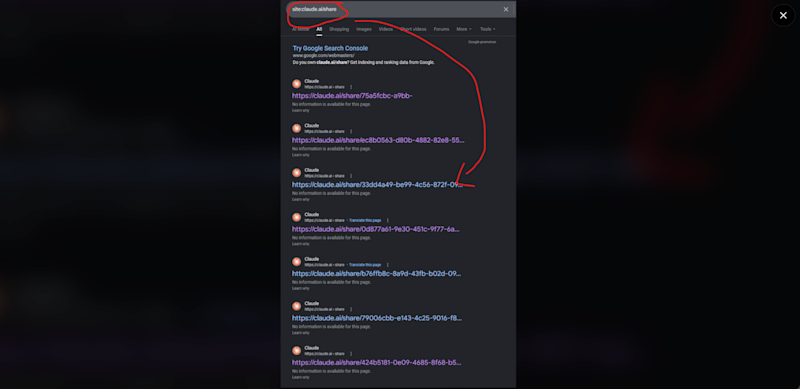
The initial discovery was made by Reddit user -void1 on July 25, 2026, who demonstrated in a post to r/ClaudeAI that a simple Google query using site:claude.ai/share yielded numerous publicly accessible Claude conversations. Screenshots circulating across social media platforms vividly illustrated Google returning pages hosted on Claude’s /share URLs. Other users reported stumbling upon conversations containing highly sensitive information, ranging from cryptocurrency wallet creation details to legal queries, personal résumés, and even internal business discussions. While a significant portion of users expressed alarm that conversations they believed were effectively "unlisted" could be surfaced through public search engines, a counterargument emerged: that this behavior was a predictable consequence of creating publicly accessible share links, rather than a fundamental software vulnerability.
Indeed, Anthropic’s design necessitates explicit user action to make a conversation or Artifact shareable. Users must navigate through Claude’s options and actively select the "shareable" setting, often encountering multiple dialog boxes that warn them about the public accessibility of the content. This process is analogous to sharing a document in platforms like Google Docs, where users must consciously opt-in to shareability, and it is not enabled by default. The user interface for sharing conversations and the options for Artifacts clearly indicate that selecting these features makes the content accessible to anyone possessing the link.
The exposure of Claude Artifacts, in particular, may be even more concerning due to their nature as dynamic and interactive work products. On July 26, X user Om Patel, founder of the research firm BigIdeasDB, highlighted that searches such as site:claude.ai/public/artifacts were surfacing publicly shared applications, dashboards, reports, and documents. The screenshots that gained traction online appeared to showcase search results referencing internal-looking proposal documents and other business-critical materials. A widely circulated post cautioned that many users interpret "Anyone with the link" as equivalent to an unlisted YouTube video – accessible only to those with the direct URL – and not necessarily as content eligible for indexing by public search engines.
VentureBeat’s independent verification corroborated these claims. Using the query site:claude.ai/public/artifactslaunch, the publication found multiple third-party Claude Artifacts indexed by Google and accessible without authentication, despite the reporter not having prior knowledge of these specific URLs. While VentureBeat could not confirm the sheer volume or representativeness of all examples circulating on social media, the independent verification of some instances underscores the reality of the situation.
These reports are particularly significant because Artifacts has rapidly become one of Anthropic’s flagship product initiatives. Introduced alongside Claude 3.5 Sonnet in June 2024, Artifacts transformed Claude from a conventional chatbot into a sophisticated collaborative workspace. It enabled users to generate interactive web applications, dynamic dashboards, insightful visualizations, comprehensive documents, games, and other live software directly within a conversational context. VentureBeat had previously posited that this launch could signal the beginning of an "interface war" among AI companies, shifting competitive focus from raw model performance to the development of collaborative AI workspaces. Anthropic subsequently expanded Artifacts to all Claude users, reporting that tens of millions had already been created. The concept was further enhanced with the introduction of Claude Code, allowing engineering teams to publish live HTML dashboards and interactive project workspaces directly from coding sessions, solidifying Artifacts’ role in Anthropic’s enterprise strategy.
This expanded functionality amplifies the potential stakes if publicly shared Artifacts are indeed being indexed. Unlike standard chat transcripts, Artifacts can encapsulate interactive software prototypes, critical engineering dashboards, strategic planning documents, product mockups, and detailed data visualizations – assets that organizations increasingly rely on for collaboration between technical and business teams. The public discoverability of these pages through search engines could lead to exposure far beyond conversational text.
It is crucial to emphasize that, based on current information, there is no indication that attackers have gained unauthorized access to private Claude accounts or conversations. The controversy centers squarely on conversations and Artifacts that users explicitly chose to share publicly through Claude’s sharing tools. The core of the dispute lies in whether users reasonably understood that these shared pages could become discoverable through public search engines, beyond merely being accessible to those who possess the direct link.
From a technical standpoint, web pages that are publicly accessible without authentication are generally indexable by search engines unless publishers actively prevent crawling through mechanisms like noindex directives or other indexing controls. Many Reddit commenters pointed out that Claude’s share URLs are long and randomly generated, making them practically impossible to guess. Search engines typically discover such links only when they appear on publicly crawlable surfaces, such as websites, forums, or social media posts. This raises questions about how Google initially encountered and indexed such a large number of Claude share URLs.
The incident highlights a growing challenge for AI companies as chatbots evolve into sophisticated collaborative workspaces for software development, document creation, dashboard management, and business application building. Features initially designed to facilitate the sharing of AI-generated work are now inadvertently exposing assets that can hold significant business value, often exceeding that of a simple conversation transcript. As enterprises increasingly adopt AI as a platform for building internal tools and workflows, the distinction between content "shared by link" and "publicly discoverable through search" becomes critically important.
Anthropic is not the first AI company to grapple with the nuanced difference between "shared" and "searchable." OpenAI previously faced similar criticism when publicly shared ChatGPT conversations became discoverable via Google, sparking analogous debates about whether "share by link" should imply a publicly indexed webpage or a more private, unlisted document. The situation with Claude also echoes an incident involving Google’s pre-Gemini AI assistant, Bard, in September 2023. SEO consultant Gagan Ghotra discovered that Google Search had begun indexing shared Bard conversation links, warning that users might mistakenly believe they were sharing conversations only with intended recipients, rather than making them discoverable through search. Google subsequently responded that it had not intended for shared Bard chats to be indexed and was working to block them from Google Search, clarifying that only explicitly shared conversations were affected.
These recurring episodes involving Bard, ChatGPT, and now Claude suggest that AI companies are still navigating the complex boundary between content that is technically public on the web and users’ expectations that "share with a link" functions more like an unlisted Google Doc or YouTube video than a webpage eligible for indexing by search engines.
For organizations that have broadly deployed generative AI across their workforces, the distinction between content "shared with a link" and content "publicly discoverable through search" transcends mere semantics. It can determine whether an internal engineering dashboard, a financial model, a product roadmap, a customer-facing prototype, or an AI-generated application remains effectively private or becomes visible to anyone with a search engine. Whether this situation ultimately proves to be a technical indexing oversight, a fundamental mismatch between product design and user expectations, or a combination of both, it serves as a stark reminder that AI products are increasingly functioning less like simple chatbots and more like comprehensive collaborative operating systems for knowledge work. As these platforms begin to host internal dashboards, software prototypes, financial analyses, business planning documents, and increasingly sophisticated enterprise applications, seemingly minor decisions regarding the behavior of shared links can have profound consequences for enterprise security, product design, and user trust.
Enterprise leaders should consider several practical steps to mitigate risks and ensure robust privacy and security protocols. First, they should conduct a thorough audit of all existing shared Claude conversations and Artifacts. This involves identifying what has been shared, with whom, and the sensitivity of the information contained within. Second, it is imperative to revisit and reinforce internal policies and user training regarding the use of AI sharing features. Employees must be explicitly educated on the implications of making content shareable, emphasizing that "shared by link" does not inherently equate to privacy from search engines. Third, organizations should explore and implement technical safeguards where available. This might include leveraging any enterprise-grade controls offered by AI providers or, if necessary, exploring alternative solutions that offer more granular control over content indexing. Finally, maintaining open communication channels with AI vendors is crucial. Companies should actively engage with providers like Anthropic to understand their indexing policies, advocate for enhanced privacy features, and stay informed about any updates or changes to their services.
In summation, enterprises that have relied on Claude’s sharing features may find it prudent to review their existing shared conversations and Artifacts at this juncture. This proactive measure is essential to safeguard sensitive information and maintain confidence in the security of AI-assisted workflows. The evolving landscape of AI tools necessitates a heightened awareness of their functionalities and potential implications, particularly concerning data privacy and information security in an increasingly interconnected digital world.
