
 By admin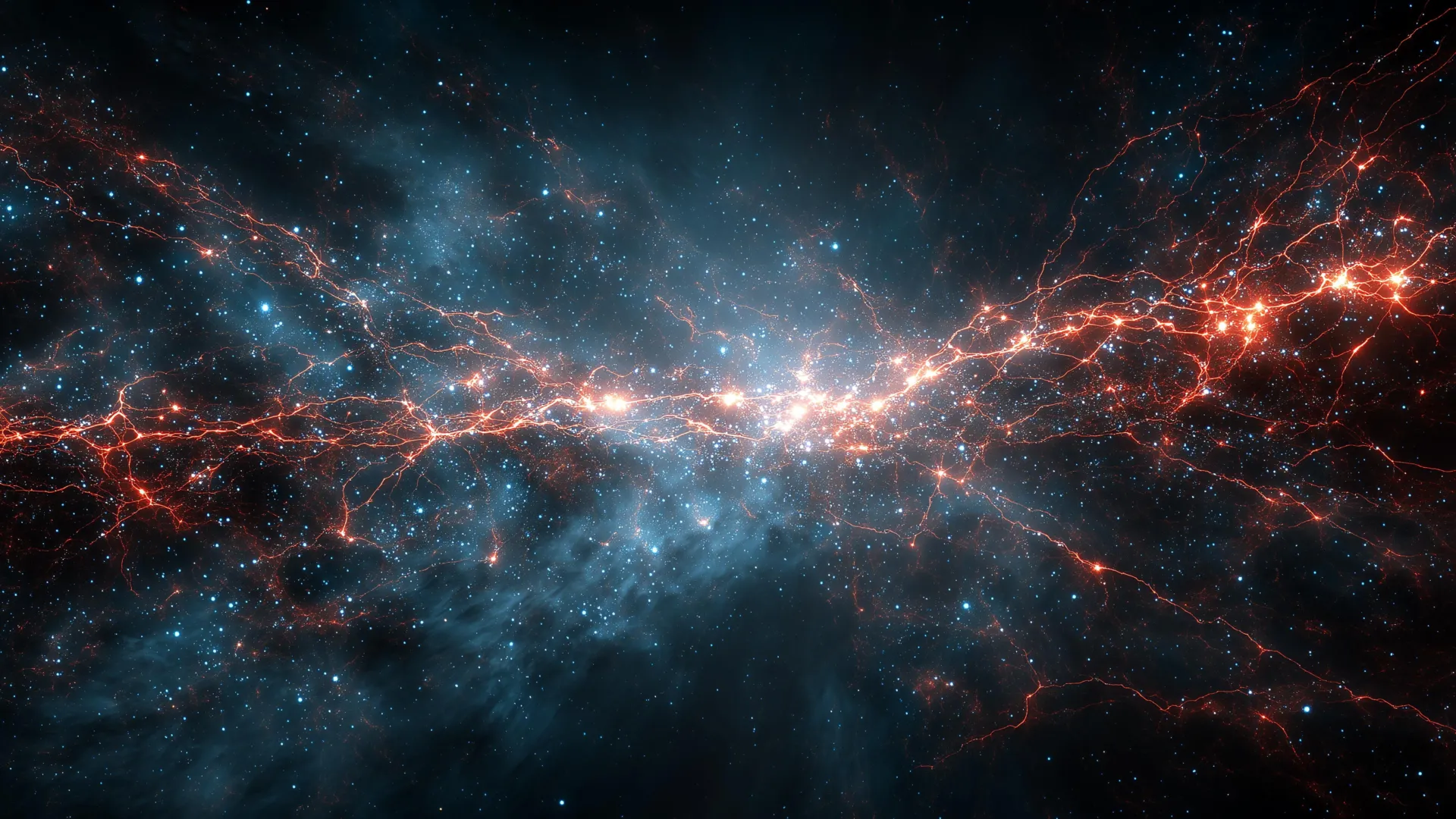
A groundbreaking new study published in the Journal of Cosmology and Astroparticle Physics (JCAP), a highly respected peer-reviewed journal specializing in the interface of cosmology and particle physics, delves into the unexpected consequences of such a dark force. The research examined a scenario where dark matter experiences an additional attractive force, distinct from gravity. The findings were remarkably counterintuitive: while one might instinctively assume that an extra attractive force would accelerate the aggregation of dark matter, and thus the growth of cosmic structure, the study revealed the opposite. Instead of fostering rapid growth, this hidden interaction tends to significantly slow down the very process of cosmic structure formation.
Why Scientists Are Considering a Dark Force: Unraveling Cosmic Tensions
The heightened interest in a possible "dark force" stems directly from a series of highly precise astrophysical observations that, despite their unprecedented accuracy, have produced results that do not always align perfectly with the prevailing theoretical framework: the Lambda-Cold Dark Matter (ΛCDM) model, or the Standard Model of Cosmology. While ΛCDM has been incredibly successful at describing the universe’s evolution from the Big Bang to the present day, especially in explaining the cosmic microwave background (CMB) and the formation of large-scale structures, persistent tensions have emerged.
One of the most significant of these discrepancies is the "Hubble tension." Measurements of the universe’s expansion rate, the Hubble constant (H₀), vary depending on whether they are derived from the early universe or the local, late-time universe. Observations of the distant universe, particularly from the cosmic microwave background by missions like the Planck satellite, suggest a slower expansion rate in the past, leading to a lower value for H₀. Conversely, direct measurements in the nearby universe, using standard candles like Type Ia supernovae and Cepheid variables by collaborations like SH0ES (Supernovae and H0 for the Equation of State of dark energy), consistently yield a higher value for H₀. This difference, currently around 8-9%, is statistically significant, exceeding typical observational uncertainties, and hints at a potential flaw or missing component in our standard cosmological model.
Concurrently, another intriguing discrepancy, often referred to as the "S8 tension" or "large-scale structure tension," concerns the "clumpiness" or distribution of matter in the universe. Studies of the cosmic microwave background have long indicated that matter should be more tightly clustered across the largest scales of the universe than what is observed today through weak gravitational lensing surveys (like KiDS, DES, HSC) and galaxy clustering measurements. The S8 parameter quantifies this level of matter clustering, and early-universe probes consistently predict a higher value than late-universe probes. These differences, while relatively small, are persistent and have encouraged scientists to seriously question whether the standard model of cosmology may be missing an important ingredient, or perhaps even a whole "dark sector" of physics.
The Concept of a Dark Sector and Dark Force
One compelling possibility to address these cosmological tensions is that dark matter particles might not be entirely inert except for gravity. Instead, they could feel an additional, non-gravitational force—a "dark force"—that ordinary matter cannot detect. Because this interaction would operate exclusively within the realm of dark matter particles, without direct interaction with protons, neutrons, or electrons, researchers refer to it as a "dark force" or an interaction within a "dark sector." Such an interaction could potentially affect both the universe’s expansion history and the formation of galaxies and larger cosmic structures, offering a potential bridge between the conflicting observational datasets.
"What we really know about dark matter has so far been learned only through its gravitational effects," explains Zachary Weiner, a researcher at the Perimeter Institute for Theoretical Physics and the corresponding author for the study. "That leaves open the possibility that dark matter might have additional interactions that are hidden from ordinary matter. The Standard Model of particle physics describes only about 5% of the universe; the remaining 95% is dark matter and dark energy, and we have very little understanding of their fundamental properties beyond their gravitational influence." This perspective emphasizes that our current understanding of fundamental forces (strong, weak, electromagnetic, gravitational) is complete only for the visible matter, leaving a vast unexplored territory for dark matter.
Testing a Force Beyond Gravity: A Theoretical Framework
To explore this uncharted territory, Weiner and his research team investigated a group of theoretical models in which dark matter particles interact through a long-range force in addition to gravity. Unlike short-range forces that act only over minuscule distances (like the strong and weak nuclear forces), a long-range force would exert its influence across vast cosmic scales, similar to gravity or electromagnetism. Such a force would be mediated by a hypothetical "dark photon" or a "dark scalar" particle, analogous to the photon that mediates the electromagnetic force or the hypothetical graviton for gravity.
Using a sophisticated combination of theoretical calculations and state-of-the-art cosmological data, the scientists meticulously studied how this hidden interaction would influence two critical aspects of cosmic evolution: the history of cosmic expansion and the growth of large-scale structure. Their methodology involved simulating the universe’s evolution under various parameters for this dark force, then comparing these simulations to observational data from the CMB, galaxy surveys, and supernovae.
At first glance, the expected result seems straightforward and intuitive. If dark matter particles attract each other through an additional force beyond gravity, they should assemble into denser clumps more quickly. This stronger clustering might then appear to naturally explain observations suggesting that the universe contains denser structures than predicted by the standard ΛCDM model, potentially alleviating the S8 tension. It’s a hypothesis that seems to solve one problem while introducing a new, albeit hidden, fundamental interaction.
"The first thing you would expect is that giving dark matter an additional attractive force should make structures grow faster," says Weiner, articulating the common initial intuition. "But another effect comes into play at the same time, one that complicates this seemingly straightforward picture significantly."
A Surprising Effect on Cosmic Growth: The Self-Interaction Feedback Loop
This "other effect" uncovered by the researchers is what makes their findings so counterintuitive and pivotal. In the theoretical models examined, the extra attractive force indeed causes dark matter to cluster more effectively on smaller scales, as expected. However, this enhanced clustering is not the only consequence of the hidden interaction. The same process, the self-interaction of dark matter particles through this dark force, also causes dark matter particles to effectively lose mass over time as the universe expands and cools.
To understand this, imagine the dark force as mediated by a field. As dark matter particles interact with this field, they exchange energy. Over cosmic timescales, as the universe expands and the energy density of this dark field changes, it can alter the effective gravitational coupling of the dark matter particles. It’s not that individual dark matter particles are physically shedding mass in the traditional sense, but rather that their gravitational influence, their effective "weight" in the cosmic tug-of-war, diminishes. This reduction in their effective mass weakens their overall gravitational pull, directly offsetting the stronger attraction produced by the hidden force.
As a result of this intricate interplay, the enhanced clustering on small scales due to the direct dark force does not translate into a stronger gravitational imprint on the cosmic microwave background, nor does it necessarily lead to more robust large-scale structure formation. In fact, in most of the cases studied, the combined effect of the stronger direct attraction and the diminishing effective gravitational mass actually suppresses the growth of cosmic structure. The universe, in these scenarios, becomes smoother than it would be without the dark force, or even smoother than the standard model predicts, potentially exacerbating the S8 tension rather than resolving it. This unexpected feedback mechanism highlights the complexity of physics beyond the Standard Model and the need for rigorous theoretical modeling.
Implications for DESI and Dark Energy Models: A Broader Impact
The profound findings from this study extend beyond the immediate question of dark matter self-interactions and hold significant implications for a broader range of cosmological theories. Notably, they could matter for models that attempt to explain recent measurements from the Dark Energy Spectroscopic Instrument (DESI). DESI is a next-generation instrument designed to map the universe in 3D over an unprecedented volume, gathering spectroscopic data from millions of galaxies and quasars. Its primary goal is to shed light on the mysterious nature of dark energy and to precisely measure the history of cosmic expansion and structure growth. Some theoretical explanations proposed for early DESI measurements, or for future potential discrepancies, involve similar types of interactions among dark matter particles or even between dark matter and dark energy.
According to the researchers, the newly identified mechanism—the effective mass loss of dark matter due to its own hidden interactions—is likely to influence many of those more complicated models as well. Any theory that proposes a hidden attractive force within the dark sector, whether it’s designed to solve the Hubble tension, the S8 tension, or to explore new dynamics of dark energy, may need to explicitly account for the possibility that dark matter becomes effectively lighter as the universe evolves. Ignoring this counterintuitive effect could lead to inaccurate predictions and misinterpretations of observational data.
The path forward for scientists involves an ongoing dialogue between theoretical predictions and increasingly precise observational data. Upcoming observatories and cosmic surveys, such as the European Space Agency’s Euclid mission, the Vera C. Rubin Observatory’s Legacy Survey of Space and Time (LSST), and NASA’s Roman Space Telescope, promise to deliver unprecedented statistical power and resolution. These missions will provide more precise measurements of cosmic expansion, the distribution of dark matter, and the growth of large-scale structure across vast cosmic epochs. Such high-fidelity data will be crucial for helping scientists determine which hidden interactions dark matter might truly possess, and which intriguing theoretical possibilities can be definitively ruled out.
"The universe is often more subtle than our intuition suggests," remarks Weiner, encapsulating the essence of this discovery. "That’s exactly why we have to keep testing these ideas, pushing the boundaries of our understanding with both theoretical rigor and observational precision. It is through these explorations of the unexpected that we truly advance our knowledge of the cosmos." The quest for dark matter’s true nature continues, revealing a universe far more complex and fascinating than initially imagined.
