
 By admin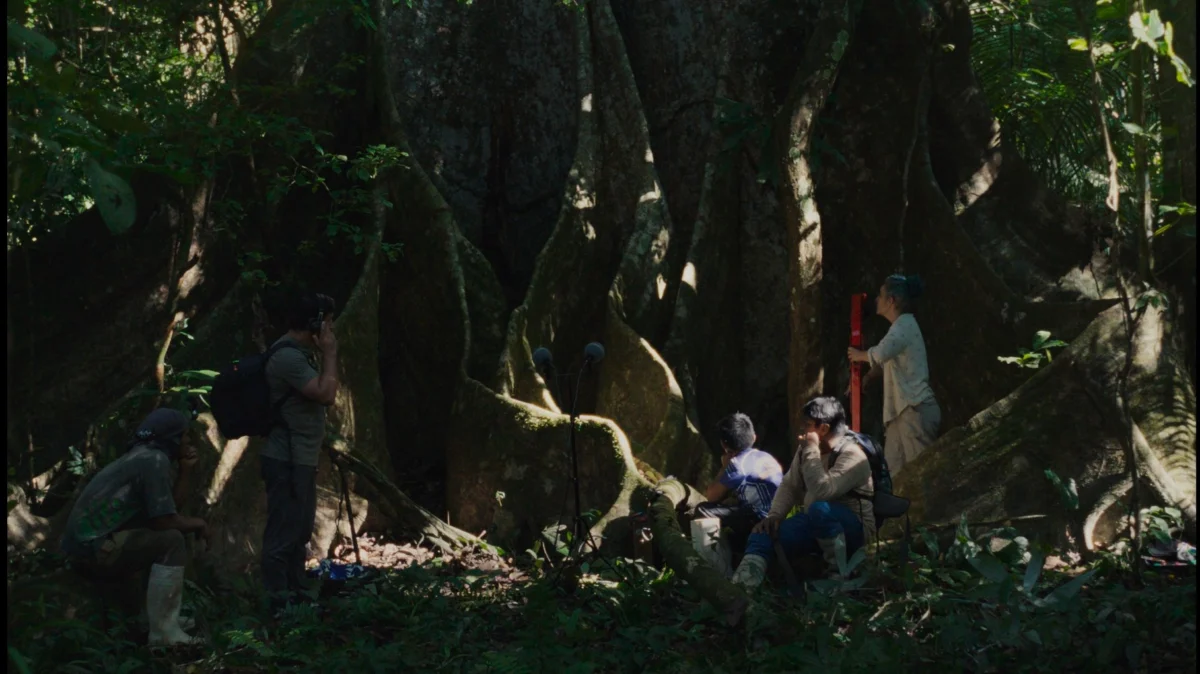
Meritxell Colell Aparicio’s deeply personal and contemplative drama, "Far From the Trees," masterfully weaves a tapestry of memory, where language and evocative sounds act as potent catalysts for idyllic childhood recollections. This handsome reverie, a testament to Aparicio’s directorial vision, artfully blends 4K, Super16mm, and archival footage, each format contributing a distinct texture to the film’s exploration of memory’s multifaceted nature. The narrative follows Adela, a Mexican sound artist, and her assistant-guide, Lucho, on a journey through the Peruvian Amazon. Their mission: to meticulously record the fading echoes of indigenous languages and the subtle symphony of the natural world. This expedition transcends a mere geographical traversal, transforming into a profound sensorial road trip, a meandering voyage of both physical and mental landscapes that critically examines life choices, the enduring power of parental ties, and the lingering shadows of generational trauma. Aparicio consciously eschews definitive conclusions, instead championing an experiential approach that embraces its own deliberate rhythms. The film, ambitious in its thematic scope yet remarkably intimate in its focus, possesses all the hallmarks of an arthouse sleeper, poised to captivate discerning audiences.
Aparicio’s previous work, "Facing the Wind," which premiered in the Berlinale’s Forum, already signaled her keen interest in the complex emotional terrain of adult children grappling with the realities of aging parents. That film, like "Far From the Trees," delved into interior struggles intrinsically linked to place and environment. With "Far From the Trees," premiering in competition at the prestigious Locarno Film Festival, Aparicio ventures even deeper into the labyrinthine depths of the psyche, skillfully navigating the mind’s intricate associations with both cherished and painful memories. While the film may only subtly allude to the profound ways in which languages shape distinct aural and visual conceptualizations, Aparicio’s exceptionally attuned sensibility for sound design imbues the film with a powerful, almost palpable, impact, resonating long after the credits roll.
The protagonist, Adela, a middle-aged sound artist portrayed with compelling gravitas by Angélica Castelló – herself a distinguished sound artist and composer – embarks on her expedition through the verdant, yet increasingly vulnerable, forests of southeastern Peru. Her endeavor is twofold: to capture the ephemeral sounds of rapidly dying indigenous languages and, in a perhaps more symbolic act, to record the very essence of the trees themselves. Adela exhibits an earnest desire to connect with local populations and to absorb the wisdom of her multilingual guide, Lucho, played by José Luis López Cama. Adela carries a certain solitary aura, a quiet dignity that is particularly striking when she is first introduced in the hushed, grey-blue light of early morning. She stands at the edge of a river, her gaze fixed across its expanse towards a restricted territory, a place inhabited by uncontacted tribes, a stark reminder of the world’s remaining frontiers. Although the film establishes Adela as a sound artist based in Vienna, her ultimate purpose for these recordings remains intentionally vague, suggesting that this particular aspect of her inner journey lies in the future. The film’s focus, however, is firmly rooted in the exploration of her past and present experiences.
Flashbacks, when employed in filmmaking, can be notoriously delicate devices, particularly when they evoke an almost idealized past. However, Aparicio, demonstrating her considerable skill as an editor alongside Ana Pfaff, masterfully employs this technique. Her deliberate choice to shoot these past sequences on Super16mm film lends them a distinct subjectivity, a nostalgic hue that suffuses Adela’s entire consciousness with a profound sense of resonance. Adela, born in Mexico to a politically engaged, left-wing Catalan family, found her spiritual and intellectual foundations shaped by her grandparents. Yet, it was Paula, the housekeeper and nanny, who provided her with her primary emotional nourishment. The initial depiction of an eight-year-old Adela nestled intimately with Paula creates a powerful impression of maternal connection, leading the viewer to initially assume Paula is her mother. It is only gradually that the more distant, though clearly loving, figures of grandmother Toni and grandfather Emili emerge. These grandparents, both researchers with a deep interest in sound, bore the indelible scars of the Spanish Civil War, a historical trauma that subtly informs their interactions and Adela’s upbringing.
Adela maintains contact with Paula and the now 98-year-old Toni through the digital medium of Zoom. However, the inherent instability of internet connections becomes a recurring motif, mirroring Adela’s own fragmented engagement with her loved ones. She is so consumed by her work and her introspective journey into the past that she often fails to perceive the immediate needs and concerns of those closest to her back in Mexico. Aparicio refrains from casting a judgmental eye on Adela’s "deafness" to these needs, perhaps acknowledging the deeply personal parallels between the character and the director’s own life experiences. As a single foreign woman residing in Vienna, Adela has undoubtedly made significant sacrifices in pursuit of her artistic aspirations. Her present is sustained by the warmly lit recollections of a childhood imbued with quiet affection, yet the film subtly questions the inherent power imbalance that existed between her Spanish grandparents and their indigenous housekeeper. This dynamic, despite Paula’s integral role within the family unit, raises poignant questions about social hierarchies and unspoken privileges.
It remains an open question whether Adela will ever achieve a profound epiphany regarding these deeply ingrained dynamics, or the more immediate one that separates her from Lucho. Aparicio’s deliberate withholding of such a clear-cut transformation avoids a potentially facile resolution, a too-tidy conclusion. Adela’s silences, her introspective nature, render her somewhat enigmatic, yet paradoxically, this inscrutability imbues her with a profound sense of authenticity. As the daughter of an exiled family, she carries the historical burdens of her lineage, a residue that subtly colors her own identity as a Mexican woman living in Austria, further distanced from her ancestral roots. The film culminates in a dreamlike montage, whose overall efficacy might be debatable, yet it is punctuated by stunning, almost surreal, images of Toni and a young Adela on a bed adorned with vines and grasses. These visuals are so captivating, so mesmerizing, that the viewer’s eye is compelled to linger, to absorb the potent symbolism within.
The contribution of production designer Anna Auquer deserves significant commendation, not only for her exquisite creation of that memorable montage sequence but also for the meticulous detail with which she has rendered Adela’s familial home. This space, characterized by its abundance of objects, each radiating a unique and often personal meaning known only to its inhabitants, becomes a character in itself. Cinematographer Julián Elizalde brings an artist’s discerning eye to his lighting, demonstrating an equal command of both digital and Super16mm formats, expertly capturing their diverse tonal qualities. Adding another compelling layer to the film’s rich texture is the inclusion of archival footage depicting anti-Franco exiles departing Spain. These silent witnesses to a profound rupture, a historical schism, serve as potent reminders that the echoes of such momentous events continue to reverberate through subsequent generations, shaping individual lives and collective identities in ways that are both visible and deeply felt. The film’s exploration of memory, identity, and the enduring impact of history, all rendered through a sophisticated visual and auditory language, solidifies "Far From the Trees" as a significant contribution to contemporary cinema, inviting audiences into a deeply personal yet universally resonant experience.
