
 By admin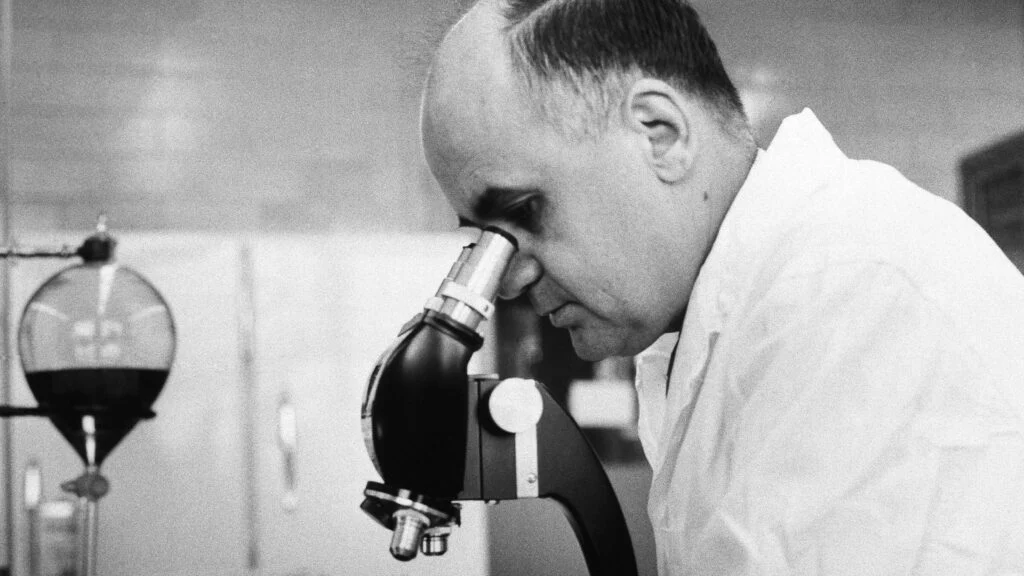
That night, a five-year-old girl named Jeryl Lynn woke up with a sore throat. Her father, Maurice Hilleman, was a man who knew the stakes of human health better than most. A six-foot-one scientist at the pharmaceutical giant Merck, Hilleman was a widower who had lost his wife to breast cancer only four months earlier. When he felt the lumps on his daughter’s neck and consulted "The Merck Manual," his diagnosis was immediate and chilling: "Oh my God," he said, "You’ve got the mumps."
In that era, mumps was an unavoidable rite of passage, but Hilleman refused to accept it as such. He drove to his lab, gathered cotton swabs and a vial of nutrient broth, and returned to swab his daughter’s throat. He spent the following years meticulously cultivating that specific strain of the virus—now known globally as the Jeryl Lynn strain—passing it through chicken eggs and chick-cell cultures until it was weakened enough to trigger immunity without causing disease. This work led to the licensing of the mumps vaccine in 1967. Not content with a single success, Hilleman eventually combined the mumps vaccine with existing shots for measles and rubella, creating the MMR vaccine in 1971. Every dose administered today is a testament to a father’s resolve to protect his daughter and, by extension, every child in the world.
Maurice Hilleman was a formidable figure, a Montana farm boy who grew up cleaning chicken coops and rose to become the developer of more than 40 vaccines, including those for meningococcus and pneumococcus. He was known for a prickly temperament and a relentless drive; he famously kept a collection of shrunken heads carved from apples by his daughter Kirsten to represent employees he had fired. His biography, penned by vaccine developer Paul Offit, paints a picture of a man who viewed viruses as personal enemies. The MMR vaccine was his ultimate victory, a "three-in-one" shield that simplified the pediatric schedule and ensured high compliance.
The diseases Hilleman fought were not the "mild childhood illnesses" often depicted in revisionist history. Before the measles vaccine became a standard of care, the virus caused approximately 48,000 hospitalizations, 1,000 cases of encephalitis (brain swelling), and 500 deaths annually in the United States alone. Measles is one of the most contagious pathogens known to science; it lingers in the air for hours after an infected person has left a room. Beyond the immediate infection, recent research published in the journal Science has revealed a phenomenon called "immune amnesia." Measles wipes out the body’s "memory" of other pathogens, leaving children significantly more vulnerable to other infectious diseases for years after they recover from the initial rash.
Rubella, or German measles, presented a different kind of horror. While often mild in children, it was catastrophic for pregnant women. During the U.S. epidemic of 1964 and 1965, an estimated 20,000 infants were born with Congenital Rubella Syndrome (CRS). The results were devastating: 11,000 children were born deaf, 3,500 were blind, and 1,800 suffered from profound intellectual disabilities. Mumps, meanwhile, was the leading cause of acquired deafness in children and could cause painful inflammation of the brain, pancreas, and testicles.
The tragic reality of these diseases is best captured in the words of those who lost the most. Author Roald Dahl famously wrote a heartbreaking account of the death of his seven-year-old daughter, Olivia, from measles encephalitis in 1962. He described her transition from a lethargic child to one who was unconscious within an hour and dead within twelve. "It is not yet a generally accepted fact that measles can be a dangerous illness," Dahl wrote in a plea for vaccination. "Believe me, it is."

Despite the overwhelming evidence of the MMR vaccine’s benefits, it has been the target of relentless misinformation. The primary driver of vaccine hesitancy over the last quarter-century has been the debunked claim that the combination shot causes autism. This theory, popularized by the fraudulent 1998 study by Andrew Wakefield, suggested that either the combination of the three viruses or the presence of the preservative thimerosal was to blame. Decades of follow-up research involving millions of children across multiple continents have definitively proven that there is no link between the MMR vaccine and autism spectrum disorder. Furthermore, thimerosal was never even an ingredient in the MMR vaccine, as it is a live-virus vaccine and the preservative would kill the active components.
The push to "split" the vaccine is often framed as a "common sense" compromise to address parental anxiety. However, history provides a stark warning of what happens when this compromise is put into practice. In 1989, Japan introduced an MMR vaccine using a different strain of the mumps virus (the Urabe strain). After the vaccine appeared to increase the risk of non-bacterial meningitis, the Japanese government suspended the MMR shot in 1993, leaving only individual vaccines available.
The result was a public health disaster. Without the convenience and unified schedule of the MMR, vaccination rates plummeted. By 2001, measles vaccination rates in Japan had fallen to 83%. That same year, a massive measles outbreak affected an estimated 265,000 children. Japan also suffered a rubella epidemic in 2012 and 2013, which led to dozens of cases of Congenital Rubella Syndrome—a condition that had been nearly eradicated in other developed nations. Even today, mumps remains endemic in Japan; a survey from 2015-2016 identified over 300 cases of mumps-induced hearing loss. Crucially, the withdrawal of the combination MMR vaccine in Japan had absolutely no effect on the rising rates of autism diagnoses, proving that the vaccine was never the cause.
Japan eventually learned its lesson, introducing a measles-rubella combination in 2006 and recently clearing a new MMR shot for use. The country was verified as having eliminated measles in 2015 and rubella in 2025. President Trump’s executive order threatens to force the United States to repeat Japan’s failed experiment.
The logistical hurdles of splitting the vaccine are equally daunting. Currently, there are no single-dose measles, mumps, or rubella vaccines marketed in the U.S. Forcing manufacturers like Merck to re-engineer their production lines to create individual components would take years and cost billions. More importantly, it would increase the "pain barrier" for parents and children. Instead of two appointments to achieve full MMR immunity, parents would be required to schedule six separate visits. In a country already struggling with "vaccine fatigue" and healthcare access, the likelihood of children missing doses is nearly 100%.
The impact on herd immunity would be catastrophic. A modeling study from Stanford University estimated that even a 10% decrease in MMR vaccination rates could lead to 11 million cases of measles over 25 years. We are already seeing the cracks in our defenses; ongoing measles outbreaks in various states have shown how quickly the virus finds "pockets" of unvaccinated individuals. If measles becomes endemic again, it will not just be a failure of policy—it will be a betrayal of the children who depend on society for protection.
The executive order may be intended to appease a vocal minority of vaccine skeptics, but it ignores the hard-won lessons of the 20th century. Science does not operate on political whims, and viruses do not care about executive mandates. Maurice Hilleman understood this. He spent his life turning the grief of a sick daughter into a shield for the world. To dismantle that shield now, based on debunked fears and a disregard for historical data, is to invite the "angry ghost" of Hilleman—and the very real diseases he defeated—back into our homes. The cost of this policy will not be paid in paperwork or political capital, but in the health and lives of the next generation.
