
 By admin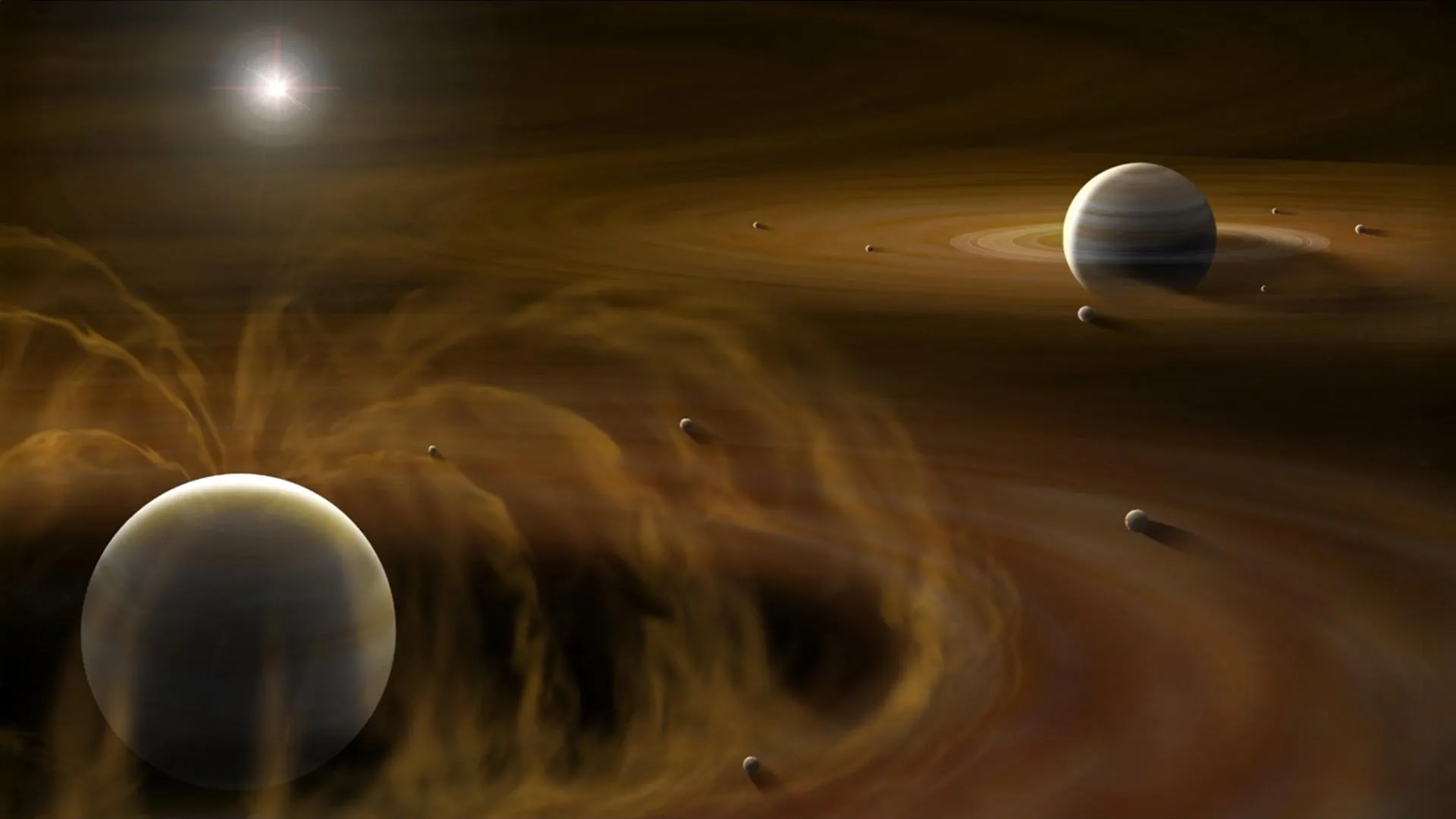
The majestic gas giants, Jupiter and Saturn, stand as the two most massive planets in our Solar System, each presiding over an astonishing retinue of natural satellites. Jupiter, a colossal world, is currently known to host over 100 reported moons, a number that continues to grow with advancements in observational technology. Its ring system, though faint, is a testament to its gravitational influence. Saturn, renowned for its dazzling, extensive ring system, eclipses even Jupiter in moon count, with more than 280 confirmed satellites, making it the reigning champion of lunar families in our cosmic neighborhood.
Despite their shared status as gas giants and their comparable positions in the outer Solar System, the architectures of their respective moon systems present a stark and long-standing astrophysical puzzle. Jupiter’s system is characterized by its four immensely large Galilean moons – Io, Europa, Ganymede, and Callisto – discovered by Galileo Galilei in 1610. These four worlds are substantial enough to be considered planets in their own right, with Ganymede, larger than the planet Mercury, holding the distinction of being the biggest moon in the entire Solar System. Their proximity to Jupiter and their resonant orbits speak to a common, perhaps violent, formation history within a compact region.
Saturn, in contrast, is dominated by a single titan of a moon: Titan. This enigmatic satellite is the Solar System’s second-largest moon and the only one known to possess a dense, nitrogen-rich atmosphere, complete with methane clouds, rain, rivers, lakes, and seas. While Saturn hosts numerous other moons, such as the geologically active Enceladus with its subsurface ocean and plumes, and the two-toned Iapetus, none approach the sheer mass or atmospheric complexity of Titan. The overwhelming dominance of one giant moon, alongside a multitude of smaller, ice-rich bodies, creates a dramatically different system compared to Jupiter’s quartet of colossal worlds.
A Longstanding Moon Formation Mystery
For decades, astronomers have grappled with the profound question of why these two behemoth gas giants, believed to have formed under similar conditions in the early Solar System, developed such disparate major moon systems. Both Jupiter and Saturn are primarily composed of hydrogen and helium, formed from the vast primordial disk of gas and dust that surrounded the young Sun. Conventional theories of satellite formation suggest that large moons primarily coalesce within a circumplanetary disk – a rotating, flattened cloud of gas and dust that surrounds a young planet, analogous to a miniature protoplanetary disk. Yet, existing theoretical models have struggled to provide a single, consistent framework capable of explaining the distinct outcomes observed around Jupiter and Saturn.
The complexity intensifies when considering the intricate interplay of forces within these formative disks. One particularly vexing unresolved question revolves around the role of magnetic accretion and the potential for an "empty inner region" within Jupiter’s circumplanetary disk. Magnetic accretion describes the process by which gas and dust can be drawn onto a central body (in this case, the nascent planet) or influenced by magnetic fields. Researchers have hotly debated whether Jupiter’s disk could have harbored such an inner void, a region devoid of significant material, which could have profoundly impacted the migration and survival of forming moons. Understanding this magnetic interaction is critical, as a circumplanetary disk is not merely a static collection of material but a dynamic environment where gas pressure, gravity, and magnetic fields continuously sculpt the fate of nascent satellites.
The quest for a unified theory capable of elucidating the formation of both Jupiter’s and Saturn’s moon systems extends far beyond our immediate cosmic neighborhood. Such a theory would serve as a powerful Rosetta Stone, offering invaluable insights into the diverse array of planets and moons now being discovered outside our Solar System – the exoplanets and hypothetical exomoons. This potential for universal applicability galvanized a team of researchers from prominent institutions in Japan and China, including Kyoto University, to embark on a groundbreaking endeavor: the creation of a sophisticated new model.
"Testing planet formation theory is somewhat difficult because we have only our Solar System for reference, but there are multiple satellite systems close to us whose detailed characteristics we can observe," explains first author Yuri I. Fujii, highlighting the unique advantage offered by our Solar System’s rich array of planetary and lunar environments. While we cannot observe the birth of planets directly, the diversity and accessibility of our own moon systems provide crucial empirical data points to calibrate and validate theoretical models, acting as a crucial bridge between theory and observation.
Simulating Young Jupiter and Saturn: A Computational Odyssey
To unravel this enduring mystery, the research team employed a battery of advanced numerical simulations, pushing the boundaries of computational astrophysics. Their methodology involved a multi-pronged approach, beginning with detailed examinations of the internal structures and thermal evolution of Jupiter and Saturn during their formative years. This critical first step allowed them to infer how the planets’ powerful, internally generated magnetic fields might have changed and developed over astronomical timescales, from their nascent states to their present configurations. The dynamo effect, driven by the convection of electrically conductive fluid deep within the planets’ interiors, is responsible for generating these magnetic fields, and its strength is highly dependent on the planet’s internal composition, temperature, and rotation rate.
Complementing this, the researchers meticulously modeled the circumplanetary disks that once enveloped both worlds. These simulations captured the complex dynamics of gas and dust within these disks, including density gradients, temperature profiles, and viscous forces, all of which dictate where and how moons might form. Furthermore, the team conducted N-body simulations, a computational technique used to model the gravitational interactions of multiple celestial bodies. These simulations were essential for tracking the entire lifecycle of moons, from their initial accretion within the disk to their subsequent orbital migration – a phenomenon where moons gradually move inward or outward due to gravitational interactions with the surrounding disk material. This inward migration is particularly hazardous, as it can lead to moons spiraling into the central planet and being absorbed.
The sheer scale and complexity of these calculations necessitated significant computational power, which was provided by the advanced PC cluster at the Center for Computational Astrophysics, National Astronomical Observatory of Japan. These powerful supercomputers enabled the researchers to process vast datasets and execute intricate algorithms, simulating processes that unfold over millions of years within dynamic and evolving environments.
Jupiter’s Magnetic Field Created a Safe Zone
The culmination of these extensive simulations yielded a profound insight: the contrasting moon systems of Jupiter and Saturn appear to have emerged primarily from fundamental differences in the structures of their circumplanetary disks. And critically, these differences, in turn, were directly controlled by the inherent strength of each planet’s nascent magnetic field.
The simulations indicated that young Jupiter possessed an exceptionally powerful magnetic field. This formidable field exerted a profound influence on its surrounding circumplanetary disk, effectively carving out a substantial magnetospheric cavity within its inner regions. A magnetospheric cavity is a region where the planet’s magnetic field is strong enough to channel or sweep away the ionized gas and dust of the disk, creating a relatively empty zone. This "safe zone" or gap acted as a crucial barrier. As nascent moons formed further out in Jupiter’s disk and began their inevitable inward migration due to gravitational drag from the disk gas, this magnetospheric cavity provided a stable, protected region. Io, Europa, and Ganymede, instead of continuing their perilous inward spiral towards Jupiter, were effectively captured and preserved within or at the edge of this cavity, allowing them to grow to their immense sizes and settle into their current compact, resonant orbits. The more distant Callisto, less affected by the inner disk dynamics, likely formed in a slightly different manner or at a later stage, outside the primary influence of this magnetic "trap."
In stark contrast, the simulations revealed that young Saturn’s magnetic field was considerably weaker than Jupiter’s. This critical difference meant that Saturn’s magnetic field was insufficient to create a similar, robust magnetospheric cavity within its circumplanetary disk. Without such a protected region, the relentless inward migration of forming moons within Saturn’s disk continued largely unimpeded. Any potential major satellites that began to form would have been subject to the gravitational drag of the surrounding gas, leading them to spiral inward towards the planet, eventually being absorbed. This scenario explains the scarcity of multiple large moons around Saturn and highlights the unique circumstances that must have led to the formation and survival of Titan. Titan, being the lone giant, may have formed rapidly, perhaps in a region less affected by migration, or grown quickly enough to open its own gap in the disk, thereby staving off inward migration, or it might be the sole survivor of a system that once had more large moons.
Predicting Moon Systems Beyond the Solar System
The implications of these groundbreaking findings extend far beyond our Solar System, offering a powerful new framework to guide future observations and interpretations of exomoons and the circumplanetary disks surrounding young gas giants across the galaxy. The model provides a predictive tool, suggesting a correlation between the size of a gas giant and the characteristics of its moon system.
According to this new paradigm, planets as massive as Jupiter or even larger should, as a general rule, tend to develop compact systems containing several substantial moons. Their immense mass likely correlates with a more powerful internal dynamo and thus a stronger magnetic field, capable of carving out the protective magnetospheric cavities necessary for multiple large moons to survive and thrive. This insight could revolutionize the search for exomoons, which are exceedingly difficult to detect due to their small size and the vast distances involved. By focusing on exoplanets with characteristics similar to Jupiter, astronomers might prioritize targets more likely to harbor detectable multiple exomoon systems.
Conversely, gas planets closer to Saturn’s size, with their comparatively weaker magnetic fields, may typically end up with only one or two large moons, if any. Their disks would lack the magnetic ‘safety net,’ allowing most forming moons to be lost to inward migration. This offers a valuable filter for exomoon searches, suggesting that smaller gas giants might be less promising candidates for systems with a multitude of large, easily detectable moons.
The researchers are now poised to apply their sophisticated theory to an even broader array of celestial bodies. This includes investigating the formation of additional, smaller moons within our own Solar System, such as the diverse irregular satellites of Jupiter and Saturn, and critically, exploring the potential for exomoon systems around distant planets. By testing this model against a wider range of observed systems, both within and beyond our Solar System, scientists aim to refine our understanding of planetary system formation as a whole, moving closer to a comprehensive theory that can explain the cosmic diversity we observe. This research not only solves a long-standing mystery within our Solar System but also opens new avenues for understanding the prevalence and characteristics of moon systems across the universe.
