
 By admin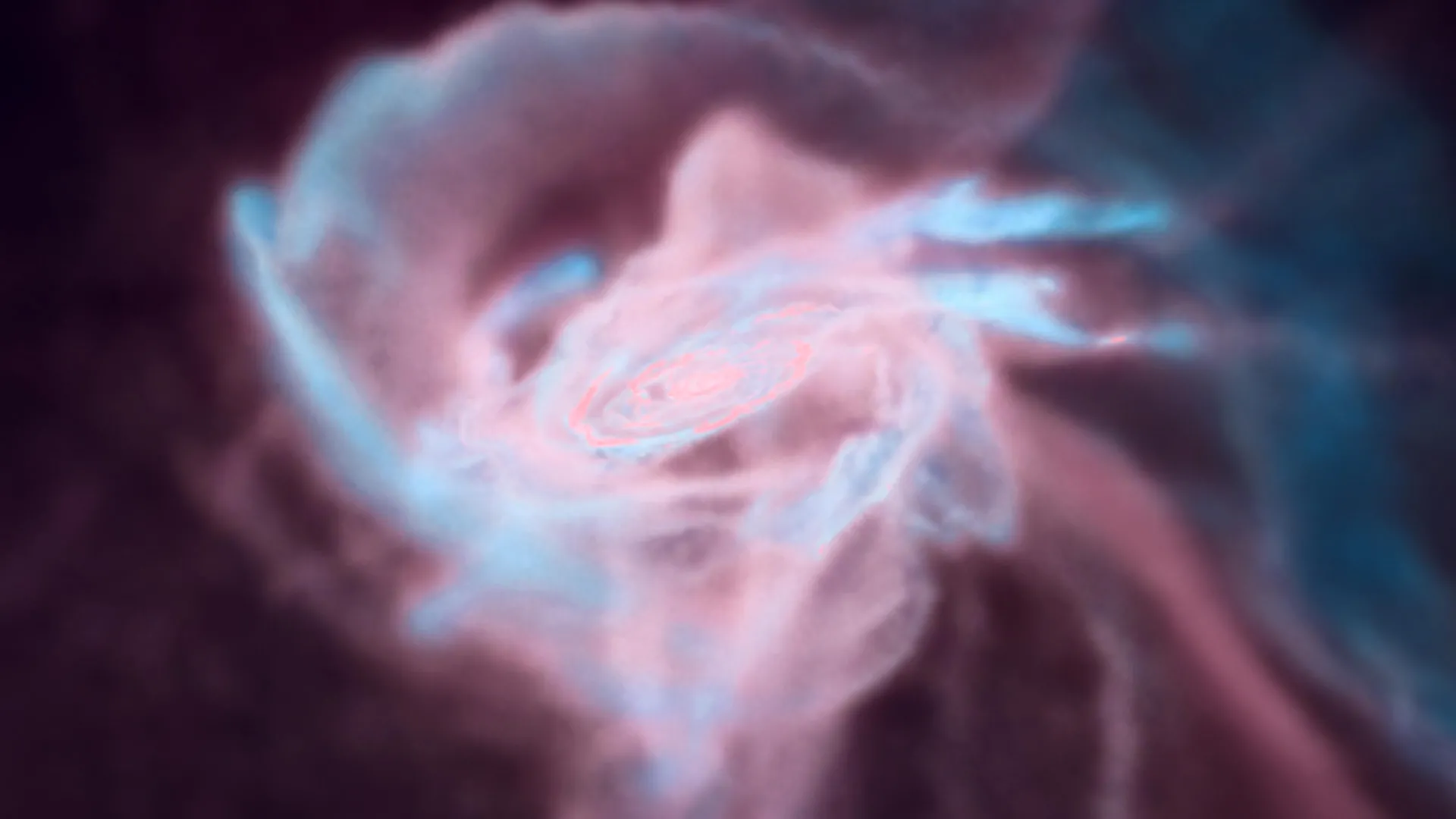
The findings do not require unusual physics or highly unlikely events. Instead, the simulations indicate that Little Red Dots could arise naturally from the environment of the young cosmos, where black holes were able to grow at extraordinary rates. This simplicity in explanation, rooted in the known physics of accretion and stellar evolution under extreme conditions, strengthens the hypothesis and provides a robust framework for understanding these enigmatic objects.
The Cosmic Enigma of Early Supermassive Black Holes
For decades, astronomers have grappled with the perplexing existence of supermassive black holes (SMBHs) that appear to have formed incredibly quickly after the Big Bang. Some of these cosmic behemoths, weighing millions or even billions of times the mass of our Sun, are observed in quasars that shone brightly less than 600 million years after the Universe’s birth. This timeline presents a significant challenge to conventional theories of black hole growth.
Standard models suggest that black holes grow by accreting matter from their surroundings, a process often limited by the Eddington limit – the maximum rate at which a black hole can accrete without the outward pressure of its own radiation blowing away incoming gas. While black holes can exceed this limit in certain scenarios, growing a seed black hole (perhaps a few tens or hundreds of solar masses, typically formed from the collapse of a massive star) into a billion-solar-mass monster in such a short cosmological timescale requires sustained, hyper-efficient accretion that seemed difficult to achieve. Theoretical avenues explored to bridge this gap included:
- Primordial Black Holes: Hypothetical black holes formed directly from density fluctuations in the very early Universe, bypassing stellar formation entirely. However, evidence for their abundance remains elusive.
- Population III Star Remnants: The first generation of stars (Population III stars), composed purely of hydrogen and helium, are predicted to have been much more massive than modern stars, potentially leaving behind black holes of several hundred solar masses. Even these larger seeds would struggle to grow fast enough.
- Direct Collapse Black Holes (DCBHs): A more favored theory posits that under specific conditions in the early Universe, large gas clouds could collapse directly into black holes of tens of thousands to hundreds of thousands of solar masses, bypassing the intermediate stellar phase. These larger seeds would have a head start, but the exact conditions for their formation remained a subject of intense debate and observational verification.
The James Webb Space Telescope (JWST) was specifically designed to peer back into these earliest epochs, detecting the faint light from the first galaxies and quasars, and was expected to provide crucial insights into this long-standing puzzle.
JWST’s Unprecedented Gaze into the Dawn of Time
Launched in December 2021, the JWST is the most powerful space telescope ever built, capable of observing the Universe in infrared light with unprecedented sensitivity and resolution. Because light travels at a finite speed, observing distant objects is akin to looking back in time. The further away an object is, the older the light we receive from it, showing us the object as it appeared billions of years ago.
For instance, light from a galaxy 11 billion light-years away has traveled for 11 billion years to reach Earth, meaning we see that galaxy as it was 11 billion years ago. JWST’s ability to detect extremely faint infrared light allows it to observe galaxies and quasars with redshifts (a measure of how much the light has been stretched by the Universe’s expansion) up to z~15 or even higher, corresponding to less than 300 million years after the Big Bang. This capability provides astronomers with an unprecedented window into the young Universe, offering direct observations of the conditions and objects that existed during the cosmic dawn.
However, instead of immediately resolving the mystery of early black hole growth in a straightforward manner, JWST revealed something entirely unexpected: a large population of tiny, extremely red objects that researchers began calling Little Red Dots (LRDs). These objects appeared ubiquitous in deep JWST fields, their intense redness suggesting significant dust obscuration or specific emission mechanisms, but their true nature remained elusive. Were they compact star-forming galaxies, heavily dust-obscured quasars, or something else entirely? The initial discovery deepened the mystery rather than immediately solving it.
Unveiling the "Little Red Dots": A New Hypothesis
The Little Red Dots are characterized by their compactness and their pronounced redness in the infrared spectrum. This "redness" can stem from several factors: the presence of significant amounts of dust that absorb shorter (bluer) wavelengths and re-emit in longer (redder) wavelengths, or the intrinsic spectral characteristics of very distant, highly redshifted objects whose ultraviolet and visible light has been stretched into the infrared by the expansion of the Universe. Initial analyses struggled to definitively classify them, leading to a variety of speculative theories. Some proposed they were extremely compact, dusty starburst galaxies, while others considered them to be active galactic nuclei (AGN) – rapidly accreting black holes – shrouded in gas and dust. The sheer number of them, however, pointed towards a common and fundamental process occurring in the early Universe.
Now, the new simulations led by Sunmyon Chon of the Max Planck Institute for Astrophysics, leveraging the power of Japan’s ATERUI III supercomputer, suggest that these objects may actually be the missing piece of the supermassive black hole puzzle.
Simulating the Universe’s Infancy with ATERUI III
To unravel the enigma of the Little Red Dots, the research team employed the ATERUI III supercomputer, located at the National Astronomical Observatory of Japan (NAOJ). ATERUI III is one of the world’s most powerful supercomputers dedicated to astronomical simulations, capable of performing complex calculations that model the intricate physics of cosmic evolution. Its high-resolution computing power was crucial for this ambitious project, allowing for an unprecedented level of detail in cosmological simulations of the early Universe.
The team adopted a demanding multi-scale approach, starting their simulations on the grand scale of a young galaxy and then progressively zooming in on smaller regions, eventually reaching the fine-grained level of individual clouds of gas. This hierarchical method is essential for capturing the interplay between large-scale cosmic structures and the microphysics governing star and black hole formation within dense gas environments. Simulating the early Universe is particularly challenging due to the extreme conditions: higher gas densities, different radiation fields, and a cosmic environment far more dynamic and chaotic than today.
The Recipe for Rapid Black Hole Seeds
The simulations yielded a crucial insight: intense far-ultraviolet (FUV) radiation from nearby, newly formed galaxies played a pivotal role in shaping the conditions for black hole formation. In the early Universe, massive stars in nascent galaxies would have emitted copious amounts of FUV radiation. This radiation can have a profound impact on surrounding gas clouds. Instead of allowing the gas to cool efficiently and fragment into many smaller clumps that would typically form ordinary stars (like our Sun), the FUV radiation heats the gas, preventing its collapse and fragmentation. It also photo-dissociates hydrogen molecules, which are crucial coolants in metal-poor gas.
Under these specific conditions, where molecular hydrogen cooling is suppressed and the gas cannot fragment, an entire gas cloud can collapse gravitationally as a single, monolithic entity. This direct collapse leads to the formation of a "supermassive star" – a theoretical object that could be hundreds of thousands to millions of times the mass of the Sun. These exotic, short-lived giants are incredibly unstable and quickly exhaust their nuclear fuel.
Once these supermassive stars exhaust their fuel, or if their initial collapse is sufficiently rapid, they can undergo a catastrophic gravitational collapse. Unlike typical stellar collapses that form neutron stars or smaller black holes, the collapse of such a gargantuan star can directly form a black hole seed of significant mass – potentially tens of thousands to hundreds of thousands of solar masses – without the intermediate supernova explosion that would otherwise disperse much of the surrounding gas.
Unleashing Unprecedented Growth: The Early Universe Advantage
Once these massive black hole seeds form, the simulations show that they are immediately surrounded by incredibly thick disks of dense gas. This gas-rich environment is a critical ingredient for their rapid growth. In the modern Universe, black holes typically accrete gas at rates limited by the Eddington luminosity, where the outward radiation pressure from the accreting material balances the inward gravitational pull. This effectively puts a brake on how fast a black hole can grow.
However, in the extremely dense gas disks surrounding these early black hole seeds, the situation is different. The gas is so thick and opaque that it can effectively trap the radiation emitted by the accreting material. This "trapped radiation" allows the black hole to consume material much more efficiently, overcoming the usual Eddington limit. The outward pressure of radiation is less effective at expelling incoming gas because the photons are repeatedly absorbed and re-emitted within the dense disk, losing energy and momentum before they can escape. This allows for super-Eddington accretion rates, where the black hole can gorge itself on vast quantities of gas.
Under these optimal conditions, the simulations demonstrate that these black holes can grow dozens of times faster than would be possible for black holes in the modern Universe. This hyper-efficient accretion mechanism provides the crucial boost needed to explain the rapid emergence of supermassive black holes.
Connecting the Dots: From Simulation to Observation
The properties of these simulated, rapidly growing black holes closely resemble the Little Red Dots (LRDs) observed by the James Webb Space Telescope. The simulations predict that such objects would be compact, extremely luminous due to their intense accretion, and heavily enshrouded in dust and gas. This dust and gas would absorb the high-energy radiation from the accretion disk and re-emit it in the infrared, making them appear "intensely red" to JWST’s instruments. The high luminosity at infrared wavelengths, coupled with their compact nature, perfectly matches the observational characteristics of the LRDs.
This striking similarity suggests that the mysterious red objects could represent an early, extremely rapid stage of black hole growth – the crucial link between the initial black hole seeds and the fully fledged supermassive black holes observed later in cosmic history. The simulations thus provide a concrete physical mechanism for the formation and early growth of these elusive objects.
Solving the Supermassive Black Hole Puzzle
The new model offers an elegant and comprehensive solution to the longstanding puzzle of early supermassive black hole formation. According to the model, the conditions needed to create and rapidly grow these black holes developed naturally in the early Universe. No exotic assumptions, such as extremely massive primordial black holes or highly improbable coincidences, were necessary. The interplay of intense FUV radiation, the suppression of normal star formation, the direct collapse into supermassive stars, and subsequent super-Eddington accretion within dense gas disks provides a coherent pathway.
This natural origin also helps explain why Little Red Dots appear to be so common in JWST observations. If these conditions were prevalent across the young cosmos, then the formation of these rapidly growing black hole seeds would be a relatively common phenomenon, consistent with their observed abundance. The LRDs are not anomalies but rather expected features of the Universe’s formative years. They represent the "missing link" that bridges the theoretical gap between the first black hole seeds and the massive quasars observed at high redshifts.
Implications for Cosmic Evolution
The implications of this discovery extend far beyond merely explaining the existence of early SMBHs. These rapidly growing black holes would have played a significant role in shaping the evolution of the early cosmos. The intense radiation and powerful outflows (known as feedback) emanating from these accreting black holes could have:
- Regulated Star Formation: Blasted away gas from nascent galaxies, preventing further star formation or triggering it in other regions.
- Contributed to Reionization: Their extreme luminosity could have contributed to the reionization of the Universe, the process by which neutral hydrogen gas was stripped of its electrons, making the Universe transparent to light.
- Influenced Galaxy Evolution: The co-evolution of black holes and their host galaxies is a fundamental aspect of modern cosmology. These early, rapidly growing black holes would have established the initial conditions for this intricate relationship, influencing the morphology, star formation history, and chemical enrichment of the first galaxies.
As JWST continues finding more LRDs and future telescopes look even deeper into cosmic history, this model could give astronomers a valuable framework for understanding how some of the Universe’s earliest black holes formed, grew, and helped shape the evolution of the cosmos into the complex structure we observe today. It paints a picture of a dynamic and extreme early Universe, where conditions were ripe for the rapid assembly of some of the most powerful objects known.
The Road Ahead: Future Research and Observations
The journey to fully understand Little Red Dots and their role in cosmic evolution is far from over. Future observations with JWST, particularly deeper spectroscopic surveys, will be crucial to confirm the black hole nature of more LRDs and to characterize their properties in greater detail. Measuring their masses, accretion rates, and the composition of their surrounding gas will provide critical tests for the simulation’s predictions.
Furthermore, upcoming telescopes and missions, such as the Nancy Grace Roman Space Telescope and Euclid, will complement JWST’s observations by surveying wider areas of the sky, potentially discovering even more of these early, rapidly growing black holes and providing a more complete statistical sample. As our observational capabilities continue to advance, coupled with increasingly sophisticated simulations, we are poised to gain an even more profound understanding of the Universe’s earliest and most enigmatic inhabitants. The Little Red Dots, once a puzzling anomaly, now stand as beacons, illuminating the extraordinary processes that unfolded at the very dawn of time.
