
 By admin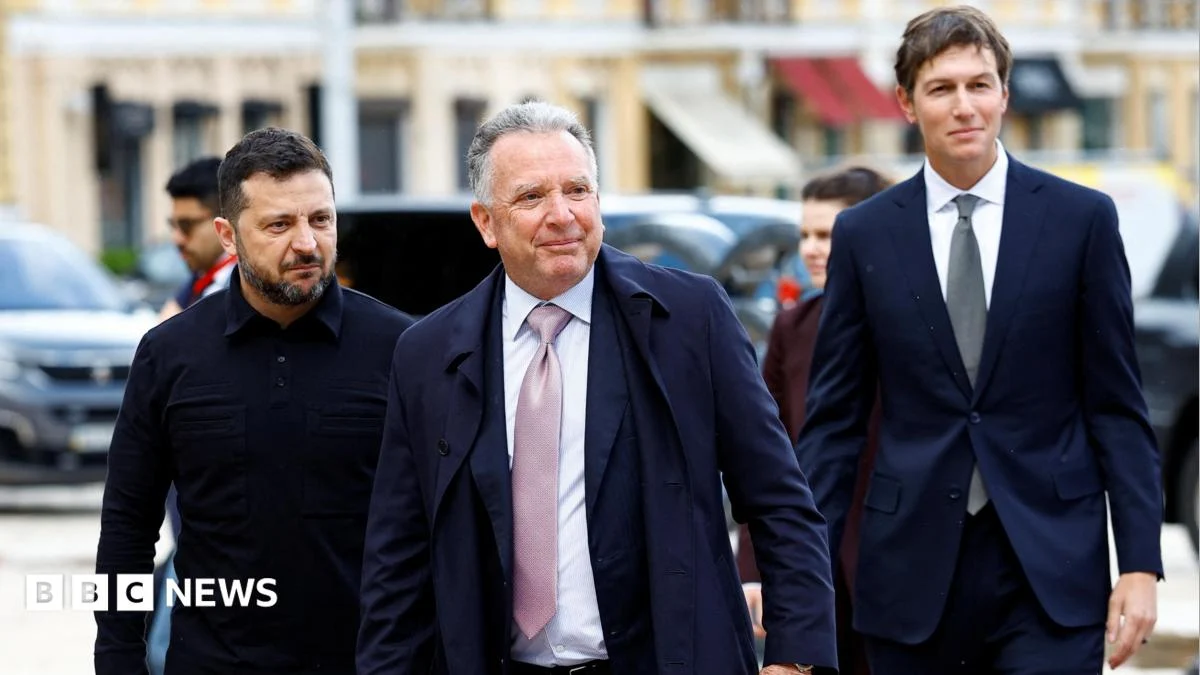
In a diplomatic maneuver of significant consequence, Jared Kushner, former Senior Advisor to the U.S. President, and real estate magnate Steve Witkoff, engaged in high-stakes negotiations at the Kremlin, simultaneously, Ukrainian President Volodymyr Zelensky conveyed his team’s readiness for dialogue and their unwavering commitment to accelerating the cessation of hostilities. Speaking from Kyiv, President Zelensky articulated the critical need for robust peace and security guarantees, emphasizing the imperative for a "coordinated, substantive, and realistic manner" of engagement. This dual track of diplomacy, one unfolding within the gilded halls of the Kremlin and the other resonating from the besieged capital of Ukraine, underscores the complex and precarious geopolitical landscape.
The backdrop to these diplomatic overtures was a stark intensification of military engagements across the Ukrainian theatre. Overnight, Russian and Ukrainian forces continued to unleash a barrage of strikes, with Ukraine confirming significant hits on a strategically vital oil refinery, an airfield, and two critical air defense systems. The Ukrainian Ministry of Defense provided specific details, identifying the Ryazan oil refinery, a key supplier to the Russian army, and an airfield in Rostov-on-Don as prime targets. This strategic targeting by Ukraine signals a deliberate effort to disrupt Russian logistical capabilities and diminish its offensive potential, particularly its ability to sustain its forces on the front lines.
This Ukrainian offensive action followed a substantial aerial assault by Russia. Ukraine’s Air Force reported that Russia launched a coordinated attack employing 108 long-range drones and small cruise missiles. The efficacy of Ukrainian air defenses was highlighted, with reports indicating that 82 drones and six missiles were successfully intercepted. However, despite these interceptions, the onslaught resulted in direct impacts on 11 locations, with debris from downed projectiles causing further damage at an additional seven sites. This continuous cycle of aerial bombardment and counter-strikes paints a grim picture of the escalating conflict, where civilian infrastructure and military assets are increasingly becoming targets.
The Moscow talks, which commenced on Saturday, reportedly spanned three hours and were conducted in a closed-door session within the confines of Vladimir Putin’s official residence, a location steeped in the history and power of the Russian state. While detailed specifics of the negotiations remain under wraps, initial pronouncements from both sides have offered broadly positive, albeit non-specific, remarks. This reticence to disclose granular details is not uncommon in high-level diplomatic engagements, often serving to preserve negotiating leverage and avoid prematurely publicizing sensitive information that could complicate future discussions.
Yuri Ushakov, a prominent advisor to President Putin, characterized the discussions as "constructive, extremely frank." His statement provided a glimpse into the scope of the conversations, revealing that they transcended a mere exchange of views on resolving the Ukrainian crisis. Ushakov indicated that "economic issues and potential major, mutually beneficial Russian-American projects were discussed in considerable detail." This assertion suggests a broader agenda than initially anticipated, hinting at a potential exploration of avenues for economic cooperation and strategic partnerships, even amidst the ongoing conflict. The mention of "mutually beneficial Russian-American projects" could be interpreted as an attempt to identify common ground or areas of shared interest that might serve as a foundation for de-escalation or a recalibration of bilateral relations.
Furthermore, Ushakov noted the acknowledgement of "tangible advances in the combat zone" by the Russian army. This statement, while potentially a reflection of Russian claims, also suggests that the reality on the ground was a significant component of the discussions. He also underscored the recognition that any resolution must address "the root causes of the conflict." This phrase is particularly significant, implying a willingness, at least from the Russian perspective, to delve into the historical, political, and security grievances that have fueled the protracted conflict. For Ukraine, identifying and addressing these root causes, particularly concerning its sovereignty and territorial integrity, remains paramount.
The juxtaposition of Ushakov’s remarks with the ground realities on the battlefield presents a complex narrative. Despite the persistent and often devastating escalation of Russian missile and drone strikes targeting Ukrainian cities, including the capital Kyiv, Russian ground forces have, for the most part of the conflict, achieved only very slow advances. This sluggish progress has come at a tremendous cost in terms of human casualties and military resources. Russia currently maintains control over approximately one-fifth of Ukrainian territory, territories it seized in 2022 following its full-scale invasion. This territorial control, while significant, represents a fraction of its initial objectives and highlights the resilience and effectiveness of Ukrainian resistance.
The logistical arrangements for Kushner and Witkoff’s travel to Kyiv from Moscow present an intriguing logistical challenge, given the closure of Ukrainian airspace since Russia’s full-scale invasion commenced in February 2022. This situation underscores the ongoing severe disruption to normal travel and the heightened security measures in place across the region. Their repeated visits to Russia, prior to the airspace closure, suggest established channels of communication and a degree of familiarity with Russian officials and the intricacies of navigating the country. However, the current geopolitical climate necessitates extraordinary measures for any cross-border movement.
The timing of these high-level talks is particularly noteworthy, occurring as Russia and Ukraine have significantly intensified their aerial attacks in recent months. Ukraine has publicly acknowledged its struggles in repelling ballistic missile attacks, citing a critical shortage of interceptor missiles. This deficiency poses a direct threat to its cities and critical infrastructure, placing immense pressure on its air defense capabilities. In response, Kyiv has strategically focused its offensive operations on Russian economic infrastructure targets, with a particular emphasis on oil installations. This strategy aims to cripple Russia’s war-fighting capacity by targeting its revenue streams and its ability to fund the prolonged conflict.
The engagement of figures like Jared Kushner in such diplomatic efforts raises questions about the nature of their mandate and the potential for their involvement to influence outcomes. Kushner, a prominent figure during the Trump administration, has been involved in Middle East peace initiatives, and his participation in discussions concerning the Ukraine conflict suggests a potential for exploring unconventional diplomatic pathways or leveraging his established connections. Similarly, Steve Witkoff’s involvement, likely in a capacity related to potential economic or reconstruction initiatives, could signal an interest in the long-term stabilization and rebuilding of Ukraine, should a resolution be achieved.
The broader context of international relations adds another layer of complexity. The conflict in Ukraine has deeply divided the global community, leading to a significant realignment of alliances and a renewed focus on collective security. The United States and its European allies have been staunch supporters of Ukraine, providing substantial military and financial aid. Russia, conversely, has faced widespread international condemnation and extensive sanctions. Within this polarized environment, any direct engagement between American private citizens and senior Russian officials, especially within the Kremlin, carries a significant symbolic weight and could be interpreted in various ways by different international actors.
The emphasis on "mutually beneficial Russian-American projects" by Ushakov, while vague, could be interpreted as a potential opening for dialogue on issues of mutual concern, such as arms control, nuclear non-proliferation, or even climate change, areas where cooperation, however strained, has historically existed. However, the feasibility of such cooperation in the current climate remains highly uncertain, given the deep mistrust and animosity that pervades the bilateral relationship.
From a strategic perspective, Ukraine’s persistent strikes on Russian oil infrastructure serve a dual purpose: to degrade Russia’s economic capacity and to demonstrate Ukraine’s ability to project power deep into Russian territory. This not only aims to inflict damage but also to send a clear message of defiance and resolve. The effectiveness of these strikes, coupled with the ongoing resistance on the ground, has demonstrably complicated Russia’s military objectives and contributed to the protracted nature of the conflict.
The discussions at the Kremlin, therefore, occur at a critical juncture. The military stalemate, the escalating aerial bombardments, and the economic pressures on both sides create an environment where diplomatic solutions, however difficult to achieve, become increasingly necessary. The presence of figures like Kushner and Witkoff, operating outside traditional diplomatic channels, could signal a desire for more informal or pragmatic approaches to de-escalation and conflict resolution. However, the ultimate success of any such initiatives will hinge on the willingness of both Russia and Ukraine to engage in genuine compromise and to address the fundamental issues that lie at the heart of this devastating war. The coming days and weeks will likely reveal more about the substance and potential impact of these high-level engagements, and whether they represent a genuine step towards peace or merely another episode in the ongoing diplomatic maneuvering of a protracted and bloody conflict. The world watches with a mixture of hope and apprehension, keenly aware of the immense human cost of continued hostilities and the profound implications of any shifts in the geopolitical landscape.
