
 By admin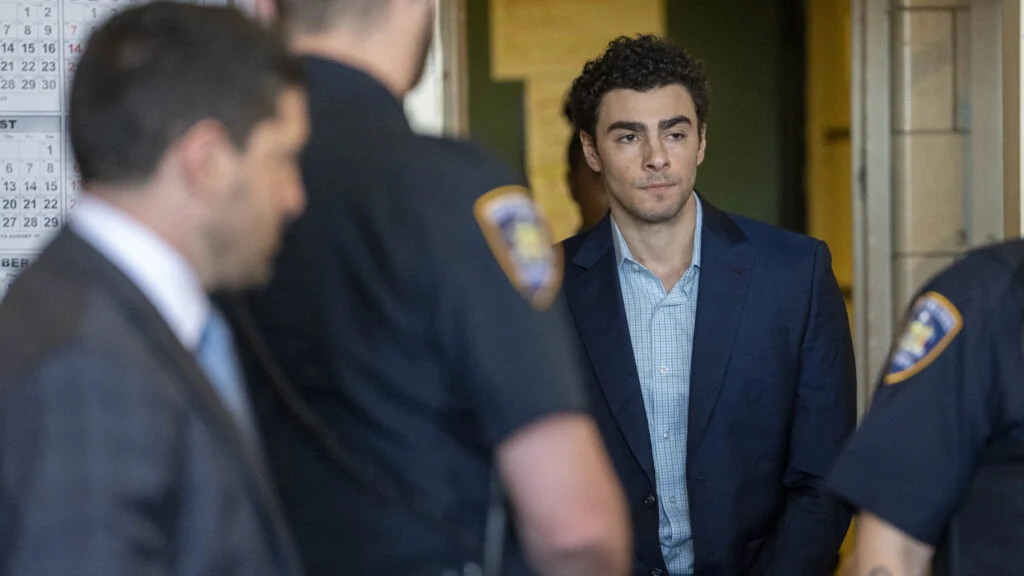
Mangione, dressed in a beige jail uniform with his feet shackled, exhibited a calm, almost detached demeanor as he detailed the logistics of the killing. He admitted to fabricating a lethal weapon using a 3D printer—a detail that highlights the evolving technological challenges facing modern law enforcement—and traveling to New York City with the singular purpose of eliminating Thompson. To facilitate his proximity to the high-level executive, Mangione revealed that he employed a sophisticated ruse, posing as a prospective investor from a multibillion-dollar firm to solicit specific scheduling details from UnitedHealthcare regarding the investor conference held at the New York Hilton Midtown.
“On the morning of Dec. 4, 2024, I shot Mr. Thompson in Manhattan, and he died,” Mangione told the court, his voice steady. The admission sent a ripple through the gallery, where Thompson’s widow, Paulette, sat surrounded by family. Throughout the proceedings, she was seen taking deep, labored breaths, frequently wiping tears from her eyes as the man who ended her husband’s life recounted the cold mechanics of the ambush.
The federal stalking charge to which Mangione pleaded guilty carries a maximum sentence of life in prison. When Judge Garnett inquired if he understood that he could spend the remainder of his natural life behind bars without the possibility of parole, Mangione replied with a singular, neutral “Yes.” Sentencing has been scheduled for December 18, where federal prosecutors have already signaled their intent to seek the maximum penalty.
The case has become a lightning rod for national debate, transcending the boundaries of a standard criminal prosecution. It has shone a harsh, uncomfortable spotlight on the pervasive frustrations many Americans feel toward the private health insurance industry. UnitedHealthcare, the insurance arm of UnitedHealth Group, is the largest private health insurer in the United States, managing the benefits of tens of millions of people and reporting annual revenues that exceed the GDP of many small nations. In 2023, the parent company reported a staggering $371.6 billion in revenue, a figure that critics often cite when discussing the disparity between corporate profits and patient care.
Mangione’s defense team, led by attorney Karen Friedman Agnifilo, has leaned heavily into this narrative of systemic failure. Outside the courthouse, Agnifilo argued that Mangione was a man driven to the brink by a "broken" system. She stated that her client had endured years of debilitating back pain and felt that the insurance industry had not only failed to provide relief but had actively obstructed his path to recovery. “Mr. Mangione has accepted full responsibility for the death of Brian Thompson,” Agnifilo said, while simultaneously launching a strategic legal maneuver to protect him from further prosecution.
Immediately following the federal plea, Mangione’s lawyers moved to have the New York state murder case against him dismissed on the grounds of double jeopardy. New York’s Criminal Procedure Law Section 40.20 offers some of the strongest double jeopardy protections in the country, often preventing the state from prosecuting an individual for the same act that has already been adjudicated in federal court. By pleading guilty to the federal stalking charge, which resulted in Thompson’s death, the defense argues that the "act" has been legally resolved. However, the Manhattan District Attorney’s Office, led by Alvin Bragg, remains steadfast. A spokesperson for the DA’s office asserted that they would vigorously contest the motion, arguing that the state’s interest in prosecuting a premeditated murder remains paramount and distinct from the federal stalking statutes.
The investigation into Thompson’s death revealed a trail of evidence that painted Mangione as a meticulous, if radicalized, actor. Following the shooting, which was captured on high-definition surveillance video showing a masked gunman firing at Thompson’s back from close range, police discovered shell casings with the words “delay,” “deny,” and “depose” inscribed on them. These words are a direct reference to a 2010 book by Jay Feinman titled Delay, Deny, Defend, which critiques the tactics used by insurance companies to avoid paying out claims. This ideological branding of the crime transformed Mangione into a "cause célèbre" for some online communities, where he was sporadically characterized as a vigilante against corporate greed.
Law enforcement officials have been quick to condemn any glorification of the act. New York Police Commissioner Jessica Tisch delivered a stern rebuke outside the court, stating, “To those who idolize Luigi Mangione, I say this: Violence is not a cause. Murder is not a message. And a killer is certainly not a hero.” U.S. Attorney Jamie McDonald echoed this sentiment, emphasizing that “there can be no celebrity in assassination.”
The data surrounding the search for Mangione provides a glimpse into the scale of the manhunt. For five days, Mangione eluded a massive dragnet by using fake IDs and staying in hostels. He was eventually apprehended at a McDonald’s in Altoona, Pennsylvania, nearly 230 miles from the crime scene, after an observant citizen noticed his resemblance to the photos released by the NYPD. At the time of his arrest, Mangione was in possession of a backpack containing a 3D-printed firearm, a silencer, and a notebook.
The notebook, which has become a central piece of evidence, reportedly contained a manifesto-like screed against the "parasitic" nature of the insurance industry. Despite his stated grievances, investigators and UnitedHealthcare officials have clarified that Mangione was never a customer of the company, suggesting his anger was directed at the industry as a symbol rather than a specific personal denial of coverage. This has led some analysts to view the killing as a form of domestic terrorism, though the specific "terrorism" charges in the state case were recently dismissed by a judge.
The victim, Brian Thompson, was a 50-year-old executive who had climbed the ranks of UnitedHealth Group over two decades. An accountant by training, he was described by colleagues as a disciplined leader who took over the top spot at UnitedHealthcare in 2021. He lived in Minnesota with his wife and two high-school-aged sons. The company’s statement on Friday reflected the profound grief within the organization, noting that Thompson’s death had “devastated everyone who knew and loved him.”
The legal battle ahead will likely focus on the intersection of state and federal law. While the federal plea secures a conviction, the state’s murder charge carries the weight of a different symbolic and legal gravity. If the double jeopardy motion fails, Mangione could face a state trial as early as September. Legal experts suggest that the defense’s decision to plead guilty federally was a calculated gamble—a "preemptive strike" to trigger the double jeopardy clause and potentially avoid the state’s more traditional murder statutes, which often carry more rigid sentencing guidelines in the New York system.
The use of a 3D-printed gun in the assassination has also sparked renewed calls for stricter regulation of "ghost guns"—firearms that lack serial numbers and can be manufactured at home using increasingly affordable technology. Experts note that 3D-printed firearms were once considered unreliable novelties, but the weapon used in Thompson’s death functioned with lethal efficiency, proving that the barrier to entry for high-stakes violence has been lowered by digital manufacturing.
As the December sentencing date approaches, the court will have to weigh Mangione’s admission of guilt against the calculated, cold-blooded nature of the crime. While Mangione attempted to frame his actions as a desperate response to physical and systemic pain, the prosecution is expected to present a portrait of a privileged young man—a graduate of the University of Pennsylvania’s prestigious engineering school—who chose a path of extreme violence over legal or social advocacy.
The legacy of the Brian Thompson killing will likely persist in the halls of corporate America and within the legislative chambers where healthcare reform is debated. For the insurance industry, it serves as a grim reminder of the intense public animosity that can be directed at its leaders. For the legal system, it represents a complex test of jurisdiction and the limits of double jeopardy. And for the Thompson family, the guilty plea marks only a partial closure to a tragedy that has permanently altered their lives.
In the final moments of the hearing, as Mangione was led away, the stark reality of the case remained: a high-profile executive was dead, a young man with a bright future had confessed to being a killer, and the systemic issues that Mangione claimed drove him to violence remain as contentious and unresolved as ever. The December 18 sentencing will likely be the final federal chapter in a saga that has exposed the deepest rifts in American society—between the sick and the insurers, between the law and the lawless, and between the desire for reform and the sanctity of life.
