
 By admin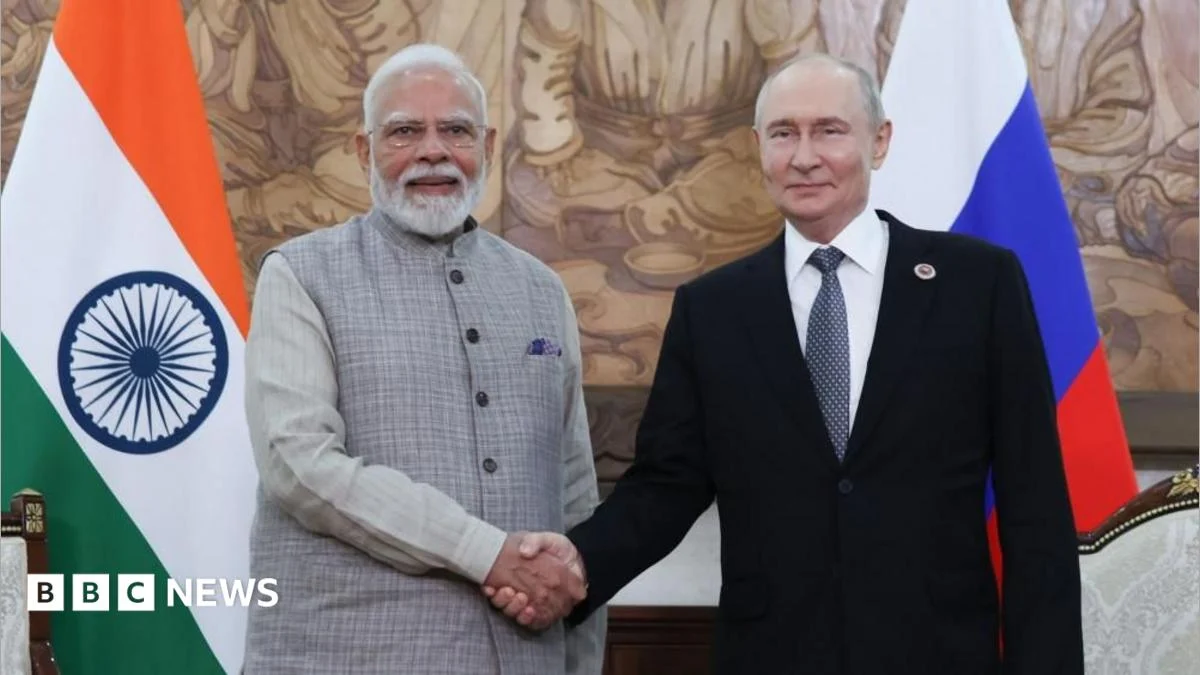
In a move that has drawn significant international attention, Indian Prime Minister Narendra Modi recently made a public appeal to Russian President Vladimir Putin to end the war in Ukraine, urging a path towards peace and dialogue. This public pronouncement, rather than being an isolated diplomatic maneuver, is deeply embedded within India’s long-standing foreign policy of strategic autonomy. It begs the question: why would Modi choose such a public platform to address such a sensitive geopolitical issue? The answer, analysts suggest, lies in the complex and enduring relationship between India and Russia, a partnership that has consistently found a way to navigate geopolitical divergences.
For decades, Russia has remained one of India’s most steadfast allies, a relationship that has weathered significant shifts in the global landscape. Even as India has deepened its strategic partnerships with Western nations, particularly the United States and European countries, over the past three decades, its ties with Moscow have remained remarkably robust. This enduring alliance is underscored by shared historical bonds, extensive defense cooperation, and mutual strategic interests. India’s commitment to this multifaceted relationship is further evident in its active participation in multilateral groupings that include Russia. As a founding member of the BRICS bloc, alongside Russia and China, India has consistently sought to foster a multipolar world order. Furthermore, its membership in the Shanghai Cooperation Organisation (SCO) with both Russia and China signifies a continued engagement with Eurasian security and economic frameworks.
However, India’s diplomatic landscape is not monolithic. The nation also concurrently participates in the Quadrilateral Security Dialogue (Quad) with Australia, Japan, and the United States. This association has been a point of contention for Moscow, which has expressed reservations about the Quad’s perceived strategic intent. Despite these differing perspectives and the geopolitical complexities that arise from India’s simultaneous engagement with both Western and Eurasian blocs, Delhi and Moscow have historically managed to compartmentalize and work through these differences. This ability to maintain dialogue and cooperation across various geopolitical fault lines is a testament to the depth and resilience of the India-Russia relationship.
The practical implications of this relationship remain substantial. Russia continues to be a critical supplier for India’s defense modernization, accounting for approximately 40% of the country’s defense imports. This reliance is a legacy of decades of cooperation and joint development in the defense sector, providing India with crucial military hardware and technology. Beyond defense, Russia has also been a steady and significant supplier of energy to India, a partnership that has gained even more importance in recent years as India seeks to diversify its energy sources and ensure its energy security. These economic and strategic dependencies create a powerful incentive for both nations to maintain a stable and cooperative relationship.
Therefore, Prime Minister Modi’s recent public statement is not expected to precipitate a significant rift in Moscow-Delhi relations. According to seasoned analysts, it is highly unlikely that the sentiment expressed by Modi would have come as a surprise to President Putin or his diplomatic corps. India’s policy of strategic autonomy, which allows it to pursue its national interests independently and forge relationships based on mutual benefit, is a cornerstone of its foreign policy. Modi’s public appeal, in this context, can be seen as an articulation of this policy – advocating for peace and de-escalation while maintaining India’s independent stance. For Western observers and critics of Modi within India, however, the prime minister’s statement may be perceived as lacking the directness and forceful condemnation they would have preferred. They might argue that a stronger, more unequivocal stance against the war would have been more appropriate given the humanitarian crisis and the violation of international law.
This is not the first instance of a foreign leader publicly urging President Putin to cease hostilities in Ukraine. Just five weeks prior to Modi’s statement, Kazakhstan’s President Kassym-Jomart Tokayev had similarly suggested that Putin freeze the conflict and return to the negotiating table. However, these public calls have, thus far, failed to alter Putin’s strategic calculations or his approach to the conflict. The Russian President has shown little inclination to halt the military operations, and his responses to such appeals have often been characterized by a polite but non-committal demeanor.
When Prime Minister Modi conveyed his call for a cessation of hostilities, President Putin’s reply was characteristically measured: "Thank you very much, prime minister. We are moving forward along this path." While seemingly acknowledging the sentiment, the response was deliberately vague. The phrase "moving forward along this path" offers little clarity on the pace, direction, or ultimate destination of such a path. Is it a short path, or an exceedingly long one? At what speed is progress being made? And, most critically, which path is being referred to?
All available evidence suggests that the Russian leadership remains resolute in its conviction that it is on a trajectory towards military victory in Ukraine. From their perspective, any talk of peace is intrinsically linked to achieving this military success and dictating the terms of de-escalation based on their battlefield gains. This stance implies that the fighting is likely to continue, at least in the short to medium term, as Russia seeks to consolidate its military objectives.
This determination persists despite the significant challenges and setbacks Russia has encountered. After more than four-and-a-half years of conflict and considerable military losses, Russia has yet to achieve a decisive victory that aligns with its initial objectives. Furthermore, Ukraine has demonstrated remarkable resilience and has effectively brought the war back to Russian soil. Strikes by long-range drones on Russian oil refineries, for instance, have had a tangible impact, leading to fuel shortages and queues at petrol stations across the country. These incidents underscore the evolving nature of the conflict and the growing cost to Russia, both economically and psychologically.
The strategic calculus for India in this complex geopolitical environment is one of balancing its long-standing ties with Russia with its evolving relationships with the West. Modi’s public call, therefore, is not a repudiation of the India-Russia partnership but rather a demonstration of India’s agency on the global stage. It signals to both Moscow and the West that India is an independent actor with its own set of interests and a commitment to peace and stability. While the immediate impact on the war’s trajectory may be negligible, Modi’s statement serves to reinforce India’s principled stance and its dedication to diplomatic solutions, even as it navigates the intricate web of international relations. The enduring nature of the Russia-India relationship, built on decades of trust and mutual strategic understanding, provides a buffer against any significant fallout from such public pronouncements, allowing India to pursue its policy of strategic autonomy without jeopardizing its core partnerships. The international community will continue to watch closely how these dynamics unfold, particularly in the context of a protracted conflict with far-reaching global implications.
