
 By admin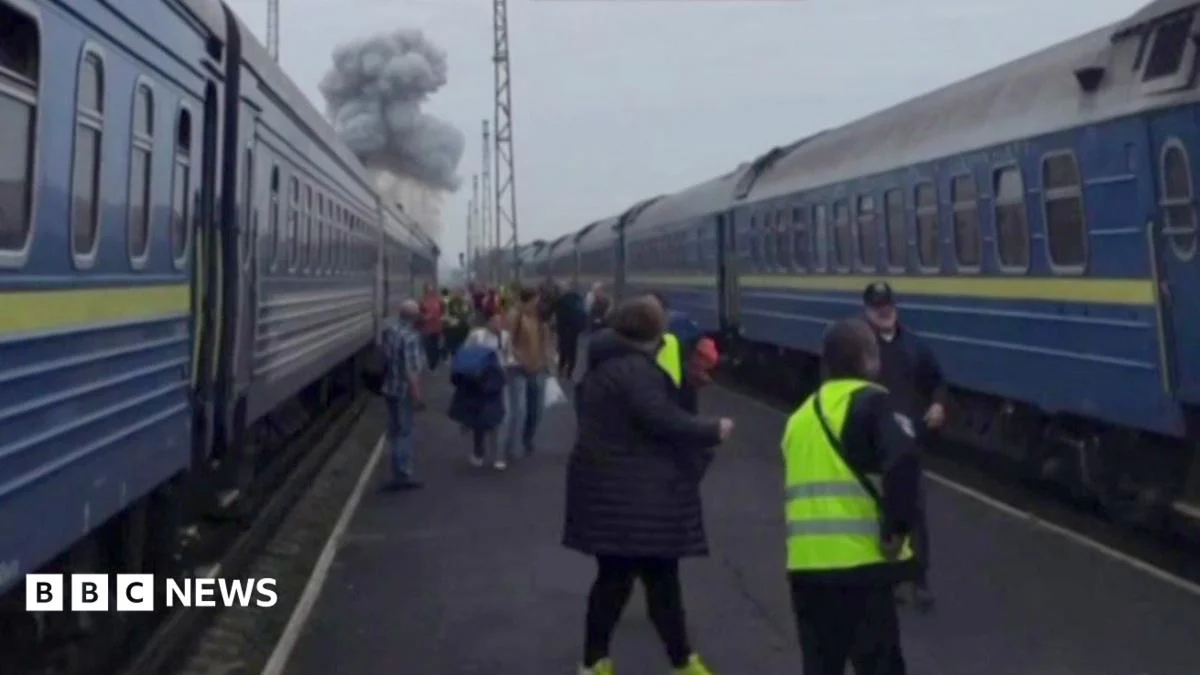
A Russian drone launched a targeted attack on a train near the Ukraine-Poland border, striking the engine of a railway vehicle just moments after former UK Prime Minister Boris Johnson and a delegation of senior European security officials had passed through the same area. The incident, which occurred at the Yahodyn crossing, has heightened concerns about Russia’s escalating aggression and its willingness to target critical infrastructure, even in proximity to NATO borders. While no casualties were reported due to the swift actions of Ukrainian authorities who had evacuated all passengers, the attack underscores the perilous nature of travel within Ukraine and the pervasive threat of Russian aerial assaults.
The targeted train, identified by Ukrainian authorities, was reportedly struck by a jet-propelled drone. According to Ukrzaliznytsia, Ukraine’s state railway company, the train had departed the station earlier than its scheduled time due to a pre-emptive timetable adjustment driven by ongoing threats of Russian strikes. This last-minute change in schedule may have been instrumental in preventing a potential catastrophe. An evacuation order for the passengers on the struck train was issued a mere 15 minutes before the drone attack, a testament to the heightened state of alert within Ukraine’s transportation network.
Among the prominent figures who had recently traversed the same railway line were former UK Prime Minister Boris Johnson and a group of European national security advisers, including the UK’s Jonathan Powell. They were returning from a conference in the Ukrainian capital, Kyiv. The presence of such high-ranking international officials in the vicinity of a Russian strike raises significant questions about the precision and intent of the attack. While Russia has claimed to have struck "railway infrastructure" in western Ukraine, Ukraine’s state railway company strongly suggests that the diplomatic train itself was the intended target.
Adding to the high-profile nature of the incident, former CIA chief David Petraeus was also reportedly on board another train at Yahodyn station at the time of the drone strike. This confluence of international dignitaries and security figures underscores the potential implications of the attack, not just for Ukraine but for its international partners. Both Ukrainian and Polish authorities confirmed that the Russian drone struck approximately two kilometers from the Polish border, placing the incident uncomfortably close to NATO territory.
Former Swedish Prime Minister Carl Bildt, who had also attended the conference in Kyiv, shared his harrowing experience with the BBC. He recounted how passengers on his train were initially instructed to prepare for an evacuation after their train came to a halt. However, after a tense period, they were informed that the immediate threat had passed and were allowed to continue their journey. Bildt’s train eventually arrived safely at Poland’s border station in Dorohusk. While some reports suggested Bildt was on the same train as Boris Johnson, the former UK Prime Minister has not confirmed these details.
In the aftermath, Boris Johnson took to the social media platform X (formerly Twitter) to condemn the attack. He questioned the "warped logic" behind Putin’s decision to strike a stationary Ukrainian locomotive near the Polish border. Johnson characterized the incident as representative of the "random and senseless attack Ukrainians are enduring every day – even on civilian railways," and reiterated his urgent plea for Ukraine’s allies to provide the country with the air defense systems it desperately needs.
Ukraine has consistently appealed to its international partners, particularly the United States, for increased provision of interceptors and advanced air defense systems. These pleas are driven by the daily onslaught of Russian attacks, which increasingly involve sophisticated and fast-moving ballistic missiles and jet-propelled drones. The Yahodyn strike serves as a stark reminder of the effectiveness of these weapons and the vulnerabilities that remain in Ukraine’s air defenses.
The recent incident at Yahodyn appears to be part of a broader pattern of Russian escalation in its war against Ukraine. Moscow has demonstrably intensified its targeting of critical infrastructure, with trains, railway depots, petrol stations, and border crossings becoming increasingly frequent targets. This strategic shift suggests a deliberate attempt by Russia to cripple Ukraine’s logistical capabilities, disrupt civilian life, and sow widespread fear and uncertainty.
Earlier in the week, Ukrainian President Volodymyr Zelensky reported that two individuals had been killed when Russian drones struck a border crossing between Ukraine and Moldova. This incident further highlights the trans-border nature of the conflict and the potential for spillover effects. Additionally, a female train conductor tragically lost her life in a Russian drone attack on a passenger train in southern Ukraine. The beginning of the month also saw the deaths of six Ukrzaliznytsia employees when a depot in Kyiv was struck.
These attacks on the railway system are particularly devastating for Ukraine. The country’s extensive train network is a vital artery for millions of Ukrainians, serving as the primary mode of transportation since all air travel has been suspended following Russia’s full-scale invasion in February 2022. The systematic damage to this infrastructure not only impedes civilian movement but also severely hampers military logistics and the delivery of essential humanitarian aid.
The implications of these attacks extend beyond Ukraine’s borders, as European countries have also begun to attribute suspicious incidents on their own territories to Russia. Germany, for instance, recently stated that Russia was responsible for a drone attack at Leipzig’s airport in August, a claim vehemently denied by Moscow as "absurd." Furthermore, a series of unexplained fires have occurred at defense facilities across Europe, from Italy to Estonia, with several affected nations pointing fingers at Russia. These incidents suggest a potential broadening of Russian hybrid warfare tactics, aimed at destabilizing and intimidating NATO and EU member states.
The strike at Yahodyn, occurring so close to the Polish border and involving a train that had recently carried prominent international figures, carries significant diplomatic and security implications. It raises questions about the adequacy of security measures for high-profile individuals traveling in conflict zones and the potential for miscalculation or deliberate escalation by Russia. The incident will undoubtedly fuel further calls for increased military aid to Ukraine, particularly in the realm of air defense, and may prompt a re-evaluation of security protocols for diplomatic and official travel in the region. The international community will be closely watching for Ukraine’s response and the broader geopolitical ramifications of this brazen attack.
