
 By admin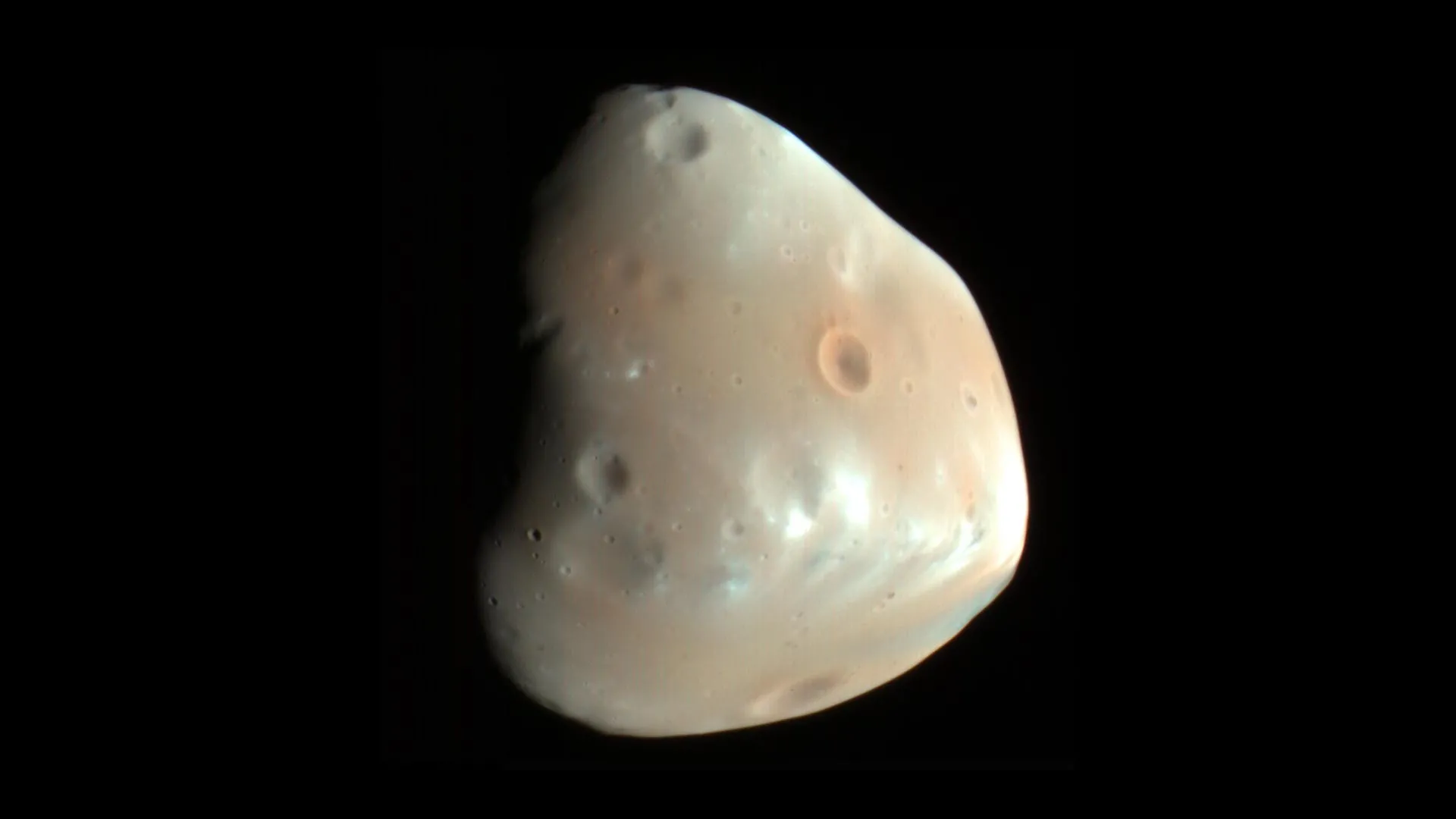
An international research team, spearheaded by the University of Bern, has unearthed compelling evidence suggesting that a singular, colossal asteroid collision may have fundamentally altered the geological landscape of Deimos, the smaller and more enigmatic of Mars’ two natural satellites. By meticulously integrating cutting-edge computer simulations with unprecedented imaging data recently acquired by ESA’s Hera spacecraft, the scientists have put forth a cohesive explanation. Their findings indicate that a solitary, powerful impact could be responsible for both the moon’s distinctive large southern depression and its unusually smooth, dust-covered surface, a long-standing mystery in planetary science.
This landmark research holds significant weight as it represents the first scientific study to leverage observations gathered during Hera’s recent flyby of Deimos. The insights gleaned from this work are not merely academic; they are poised to play a crucial role in guiding and refining the objectives of forthcoming space missions, most notably the Japan Aerospace Exploration Agency’s (JAXA) Martian Moons eXploration (MMX) mission, which aims to provide an in-depth understanding of Mars’ satellites and even return samples from Phobos.
The Enduring Mystery of Deimos’ Smooth Surface and Peculiar Topography
Deimos, a celestial body of roughly oval shape, is the smaller and more distant of Mars’ two moons, orbiting the Red Planet approximately 23,460 kilometers away, completing an orbit in about 30.3 hours. Unlike its sibling, Phobos, which is closer to Mars and heavily scarred by countless impact craters, Deimos presents a strikingly different appearance. Its surface, for decades, has perplexed scientists due to its apparent smoothness, attributed to a widespread blanket of loose dust and rocky debris, known as regolith, obscuring many of its underlying features. Adding to this enigma is a prominent depression situated near its south pole, whose origin has remained elusive.
For decades, spacecraft have provided progressively detailed photographs of Deimos, gradually improving our understanding of its overall morphology. However, the precise mechanisms responsible for the formation of both the southern depression and the pervasive layer of regolith have remained subjects of intense scientific debate. Various hypotheses have been proposed, ranging from multiple smaller impacts gradually eroding and covering the surface, to internal geological processes, or even a past encounter with a larger Martian impact ejecta plume. Yet, none had provided a unified explanation for these two dominant characteristics.
The new study, spearheaded by Dr. Sabina Raducan, sought to address this fundamental question: could these two distinct features – the southern depression and the widespread regolith – share a common origin? This ambitious international collaboration drew together expertise from a consortium of institutions, including the Observatoire de la Côte d’Azur, the University of Arizona, and the University of Tokyo, among others, demonstrating the global nature of contemporary space research. Dr. Raducan, a former researcher in the Division of Space Research and Planetary Sciences (WP) at the Physics Institute at the University of Bern until October 2025, now serves as the Science Program Manager at the International Space Science Institute and a Senior Fellow at the Vrije Universiteit Brussel, bringing a wealth of experience in impact physics to this project.
The team employed high-resolution simulations, powered by the sophisticated "Bern Smoothed Particle Hydrodynamics (SPH)" code, to model various impact scenarios. Their rigorous analysis led them to a compelling conclusion: the distinctive depression near the south pole was most likely created by a single, powerful asteroid impact. Crucially, this impact was potent enough to dramatically alter Deimos’ surface but not so catastrophic as to shatter the moon entirely. Furthermore, the simulations revealed that this very same collision could also have generated the vast quantities of regolith that now uniformly blanket much of the moon’s surface, effectively providing a single, elegant solution to two long-standing mysteries. This groundbreaking research, published in the prestigious journal Nature Astronomy, marks a significant milestone as it is the first scientific publication to integrate observations gathered during ESA’s Hera spacecraft’s recent flyby of Deimos. Hera, though primarily en route to its main destination, the asteroid moon Dimorphos, seized a unique opportunity to observe Mars’ smaller moon.
Simulating a Cataclysmic Asteroid Collision with Unprecedented Detail
To reconstruct the potential sequence of events that reshaped Deimos, the scientists relied on the "Bern SPH" code, a numerical tool that has been meticulously developed and refined at the University of Bern over approximately two decades. This highly specialized software is explicitly designed for modeling complex, high-energy collisions involving a wide array of celestial bodies, from asteroids and comets to planets, offering unparalleled insights into the dynamics of impact events across the solar system.
Within the framework of the Bern SPH simulations, colliding objects are represented not as solid, indivisible masses, but as millions of individual particles. This granular approach allows researchers to simulate the intricate ways in which material deforms, fractures, melts, and flows under extreme pressures and temperatures generated during an impact. Researchers possess the capability to finely tune a multitude of physical parameters, including gravitational forces, material density, and internal strength, enabling them to explore a vast parameter space and observe how different types of impacts unfold with astonishing fidelity. This level of detail is crucial for accurately capturing the complex physics of hypervelocity collisions, where conventional solid mechanics models often fall short.
The University of Bern boasts extensive, world-renowned expertise in the field of numerical impact modeling. This very same computational approach was previously employed with remarkable success to simulate the dramatic collision of NASA’s DART (Double Asteroid Redirection Test) spacecraft with the asteroid moon Dimorphos in September 2022. The DART mission, a planetary defense test, provided invaluable real-world data against which the Bern SPH code’s predictions could be validated, bolstering confidence in its accuracy and predictive power.
"The code runs on a high-performance computing cluster here at the University of Bern and is one of the few codes capable of performing this type of simulation with the necessary resolution and physical fidelity," explains study leader Sabina Raducan, who also holds the critical role of co-chair of the Hera Impact Physics Working Group for ESA’s Hera mission. Her dual role underscores the deep integration of this research with ongoing and future space endeavors.
The research team undertook an exhaustive computational campaign, testing an extensive array of possible impact scenarios. This involved systematically varying key parameters such as the size, speed, and angle of the hypothetical impactor, while also exploring different assumptions about the internal structure and material properties of Deimos itself. This iterative process allowed them to converge on the most probable scenario. "We carried out about a hundred simulations – each one took about a week to complete, demanding significant computational resources and time," Raducan elaborated, highlighting the sheer scale of the scientific endeavor. The results of these hundreds of simulations were then rigorously compared against the invaluable observational data collected by ESA’s Hera spacecraft during its close encounter with Deimos.
Hera’s primary mission, while focused on Dimorphos, involves a detailed examination of the aftermath of NASA’s DART impact. These observations are paramount for scientists to thoroughly evaluate the effectiveness of kinetic impactors as a potential method to deflect hazardous asteroids, thereby safeguarding Earth from future cosmic threats. In March 2025, Hera executed a critical maneuver, passing Mars and utilizing the planet’s immense gravitational pull to slingshot itself and alter its trajectory precisely toward Dimorphos. This orbital dance not only set Hera on its ultimate course but also provided the spacecraft with a rare and fortuitous opportunity to observe Deimos from an unprecedented close range, capturing the crucial images that fueled this groundbreaking study.
A Single Impact: Unifying Two Major Features of Deimos
The exhaustive simulations performed by Raducan’s team ultimately converged on a specific and compelling collision scenario. According to their detailed models, an asteroid approximately 320 meters in diameter, striking Deimos at an oblique angle of 45 degrees, could have precisely produced the observed size and characteristic shape of the prominent depression now visible near the moon’s south pole. This precise alignment between simulation and observation lends strong credence to the hypothesis.
Crucially, the same impact event could also elegantly explain the widespread distribution of regolith across the entire moon. The simulations demonstrated that an enormous quantity of surface material would have been violently ejected outwards during such a powerful collision. This material would then have been redistributed across Deimos, settling back down to form a pervasive blanket that buried many older surface features and filled in craters, effectively smoothing out the moon’s appearance. In some locations, the sheer depth of this newly deposited material may exceed a remarkable 200 meters, fundamentally reshaping the moon’s topography.
"Our simulation thus shows that a single impact was sufficient to decisively shape the current landscape of Deimos, providing a unified explanation for its most prominent features," explains co-author Martin Jutzi from the Division of Space Research and Planetary Sciences (WP) at the University of Bern, who also serves as co-chair of the Hera Impact Physics Working Group alongside Dr. Raducan. "The impact was violent enough to redistribute material globally and create the large depression, but crucially, it was not so strong that it would have shattered the moon entirely, allowing Deimos to retain its overall integrity."
The meticulous comparison between the simulated outcomes and the actual spacecraft observations also yielded invaluable clues about the intrinsic physical makeup of Deimos. The models suggest that its uppermost layers appear to be exceptionally weak, indicating a loosely consolidated structure. Furthermore, the moon’s interior seems to be highly porous. This porous internal structure would have played a critical role during the impact, effectively absorbing and dissipating a significant portion of the collision’s immense energy, thereby helping Deimos survive the cataclysmic event rather than disintegrating.
"In terms of its physical properties, Deimos more closely resembles the so-called rubble-pile asteroids – aggregates of loosely bound rocks and dust – than our Earth’s Moon, which is a much more solid, differentiated body," says Raducan. "But that doesn’t necessarily mean that Deimos is actually an asteroid captured by Mars. It could also have formed from material ejected during massive impacts on Mars itself, which then coalesced into a porous body." This statement highlights the ongoing debate regarding the origin of Mars’ moons and suggests that the internal structure inferred from this study is consistent with both leading hypotheses.
Guiding Future Missions: What JAXA’s MMX Could Discover
While the new impact scenario provides a remarkably compelling and unified explanation for Deimos’ southern depression and smooth surface, it is important to acknowledge that other explanations, perhaps involving a combination of processes, are still theoretically possible. However, the strength of this new hypothesis lies in its elegance, its ability to explain two major features with a single mechanism, and, crucially, its capacity to make specific, testable predictions that future spacecraft missions can investigate and confirm or refute.
One of the most significant opportunities to test these predictions will arise with the Japan Aerospace Exploration Agency (JAXA), which is diligently preparing its Martian Moons eXploration (MMX) mission for launch in 2026. MMX is an ambitious endeavor designed to conduct detailed studies of both Martian moons, Phobos and Deimos, and, most excitingly, to return samples from Phobos to Earth for in-depth laboratory analysis.
"Our study provides important, concrete predictions for this Japanese MMX mission, such as the estimated thickness and distribution patterns of the regolith layer across Deimos, and crucial insights into the mechanical properties of Deimos’s material, particularly its inferred porosity and weakness," explains Raducan. These predictions are not abstract; they are highly practical for mission planners.
"This gives MMX a clearer picture of what its scientific instruments – including cameras, spectrometers, and potentially ground-penetrating radar – and ultimately the sample collection mechanisms, can expect to encounter when they arrive at Deimos," she elaborates. Such foreknowledge is invaluable for optimizing instrument settings, planning sampling strategies, and maximizing the scientific return of the mission. By providing a detailed map of what lies beneath the surface and how it might have formed, this research significantly enhances the scientific objectives and operational efficiency of the MMX mission, promising to unlock further secrets of Mars’ intriguing moons and the early solar system.
