
 By Lina Irawan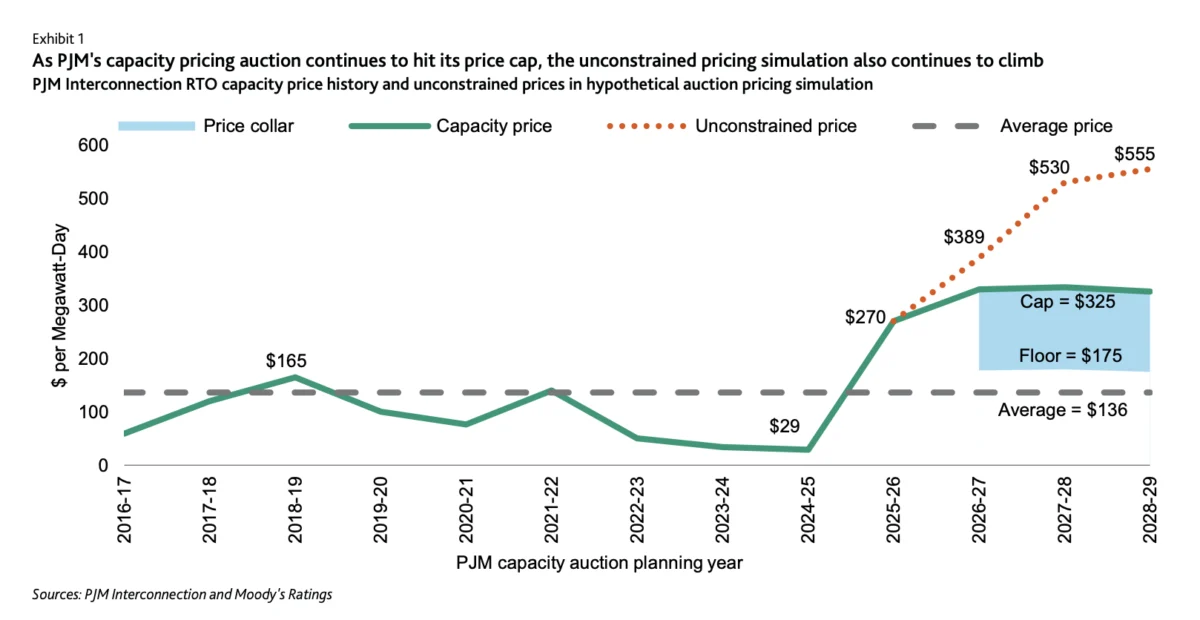
On July 14, PJM Interconnection – the largest grid operator in the U.S., serving roughly 67 million people from Illinois to Virginia and Washington, D.C. – announced the results of its capacity auction for the 2028-29 delivery year. For the third consecutive time, the auction cleared at $325 per megawatt-day, hitting the maximum allowed under its regulatory price cap. This critical benchmark means that even at the highest permissible price, the market failed to secure adequate future power supply, falling approximately 6.8 gigawatts (GW) short of what the grid needs to ensure reliable operation. To put this shortfall into perspective, 6.8 GW is roughly equivalent to the power output of several large nuclear power plants or a significant portion of a major metropolitan area’s peak demand.
This repeated ceiling-hitting phenomenon is the clearest and most alarming signal yet that America’s aggressive AI buildout comes with a substantial, often hidden, bill. Increasingly, it is ordinary ratepayers, rather than the technology giants driving this demand, who are shouldering the escalating costs. The relentless expansion of data centers, fueled by the insatiable energy appetite of AI computing, is reshaping the energy landscape at an unprecedented pace, challenging existing market mechanisms and regulatory frameworks.
The gravity of the situation was underscored by Moody’s Ratings in a July 22 sector report, which did not mince words about the underlying systemic flaw. Moody’s, an agency renowned for its dispassionate assessment of financial risk for bond investors, explicitly stated that the "current system lacks adequate mechanisms to ensure that the cost of building new supply is borne by the new entrants and instead socializes new build costs across all customers." This declaration from a major credit rating agency transforms what might seem like a technical energy market issue into a fundamental question of economic fairness and market efficiency.
In plainer, more direct terms, when a new hyperscale data center, perhaps spanning hundreds of acres and housing thousands of servers, activates hundreds of megawatts of new AI computing load, the substantial cost of building new power plants, transmission lines, and other essential infrastructure to serve that demand does not primarily land on a hyperscaler’s balance sheet. Instead, these costs are distributed across every household, small business, and industrial customer connected to the PJM grid, diluting the burden but ultimately shifting it to the broader public. This "socialization" of costs effectively subsidizes the rapid expansion of AI infrastructure, masking its true economic footprint and creating an uneven playing field.
What makes Moody’s finding particularly notable is its source. The agency’s role is to objectively price risk, not to engage in social commentary or editorializing about fairness. Yet, the report explicitly flagged that "other power markets in the U.S. require new large-load customers to secure power under direct supply contracts that recoup cost of new generation and associated infrastructure over time." This comparison is a pointed critique, implying that PJM’s current rules are, by comparison, outdated and out of step with best practices designed to ensure cost causality and market integrity. Such direct contracts, often long-term Power Purchase Agreements (PPAs), compel large consumers to directly finance or commit to new generation capacity, thereby internalizing the costs of their increased demand.
The Numbers Behind the Squeeze
The quantitative evidence behind this squeeze is stark and irrefutable. Total new generation capacity that cleared in this latest auction plummeted to just 525 megawatts (MW), a mere fraction – roughly half – of what cleared six months earlier, according to Syso Technologies’ detailed auction analysis. This dramatic decline in new supply commitments comes at a time when demand is surging. PJM recorded a peak electricity demand record high of 168.2 GW on July 2, nearly 3 GW above a record set almost two decades earlier. This juxtaposition of falling new supply and rising peak demand highlights a perilous widening gap in the region’s energy balance.
Data centers are unequivocally identified as the primary driver of this demand growth. PJM’s own market monitor, Monitoring Analytics, a fiercely independent body tasked with ensuring fair and competitive markets, found that of the $16.4 billion in total capacity charges resulting from this single auction, an astounding $6.3 billion is directly attributable to data center demand. Extending this analysis, the cumulative impact over the last four auctions combined reaches a staggering $29.4 billion in capacity charges tied to data center expansion, as reported by The Hill. These figures are not projections but concrete allocations within the capacity market, representing real costs that will be passed on to consumers.
The true underlying scarcity is further revealed by PJM’s own simulations. Without the current price cap in place, PJM’s models indicate that the region’s unconstrained capacity price would have soared to $554.72/MW-day – nearly 70% higher than the capped price. In the Chicago-area zone, served by Exelon’s ComEd utility, the hypothetical unconstrained price would have reached an even more astronomical $776.69/MW-day. These simulated prices underscore the profound stress on the system and the extent to which the current cap is insulating consumers from the immediate, but not the long-term, financial reality of the supply-demand imbalance. This scarcity stress extends well beyond any single state or utility zone, indicating a systemic issue across the entire PJM footprint.
These numbers are not confined to spreadsheets and regulatory reports; they are translating directly into tangible impacts on household budgets. Consumer Reports has documented individual cases, including an Ohio resident whose electricity bill spiked to $281 this past January. While many factors contribute to monthly utility bills, the underlying capacity charges and the broader upward pressure on energy prices due to data center demand are increasingly significant components.
Why Utilities Say One Thing and Bills Say Another
A significant tension exists between the assurances provided by utilities to investors and regulators – that ratepayers won’t be stuck with AI’s tab – and the reality of rising residential bills. Watchdog groups and academic analyses are consistently pointing to cases where precisely these costs are being shifted onto consumer bills through various mechanisms.
Harvard Law’s Electricity Law Initiative has meticulously identified two distinct cost channels through which the AI boom impacts ratepayers:
- Socialization of New Infrastructure Costs: Utilities often spread the costs of building new transmission lines, substations, and other grid upgrades – specifically required to connect and serve massive data center loads – across their entire rate base. These investments, while necessary to accommodate new demand, become a shared burden rather than a targeted expense for the direct beneficiary.
- Market-Based Capacity Price Increases: As data center-driven demand outstrips the pace of new generation supply, the market-clearing price for capacity rises. This is a direct function of supply and demand dynamics, where increased demand in a constrained market inevitably drives up prices for everyone purchasing capacity. Both of these mechanisms are clearly visible and demonstrably at play in PJM’s July auction results.
Adding to the ominous outlook, Reuters reported that households and businesses in PJM territory could face rate hikes of up to 60% over the next five years. This alarming projection, citing analysis by the global consulting and technology services firm ICF, highlights the accelerating impact as Big Tech’s data center buildout continues its relentless expansion. Such substantial increases would represent a significant economic burden for millions of families and businesses already grappling with inflation.
Mounting Backlash and Proposed Solutions
The mounting financial pressure has not gone unnoticed. The backlash has reached multiple state legislatures across the PJM footprint, where lawmakers are beginning to scrutinize what consumer advocates describe as outsized utility profits layered on top of rising bills. Discussions are underway regarding potential legislative actions, including mandates for more transparent cost allocation, direct contracting requirements for large energy users, or even new taxation structures for data centers to offset grid infrastructure costs.
In a clear acknowledgment that the normal market mechanisms are failing to produce enough new power fast enough, PJM is asking the Federal Energy Regulatory Commission (FERC) for permission to hold an emergency "backstop" capacity auction in September. This is an unusual and extraordinary step, signifying the operator’s deep concern about future reliability and the inadequacy of the current market to procure necessary resources. While a backstop auction might temporarily bridge the supply gap, it also indicates a deeper structural problem and could potentially introduce further market distortions or higher costs if not carefully managed.
Amidst this crisis, various analysts and policymakers have proposed requiring hyperscaler data center operators to sign long-term contracts for new generation. This idea, explored in Latitude Media’s coverage of a Mid-Atlantic governors’ proposal, aims to align the costs of new generation with the entities driving the demand. The argument is that by entering into long-term Power Purchase Agreements (PPAs) or similar direct contracts, data center operators would provide the financial certainty needed to spur investment in new power plants, thereby internalizing their energy footprint. However, critics warn that such measures, while logical, may not close the supply gap fast enough given the long lead times for new generation projects, and could risk distorting the broader market if not implemented carefully. Despite the growing consensus around the need for such mechanisms, adoption remains uneven, and PJM still conspicuously lacks the direct-contract requirement that other power markets already effectively utilize.
For now, the highly technical language of Moody’s Ratings reports and the swelling monthly bills of PJM’s tens of millions of residential customers are describing the exact same phenomenon, observed from opposite ends of the transaction. Someone is indeed paying for the AI revolution’s insatiable power hunger, and with increasing frequency and clarity, it is not the multinational corporations building the data centers, but the households and small businesses that simply want to keep their lights on. The urgency for systemic market reforms and equitable cost allocation has never been greater, as the future of grid reliability and energy affordability hangs in the balance.
For this story, Fortune journalists used generative AI as a research tool. An editor verified the accuracy of the information before publishing.
