
 By Lina Irawan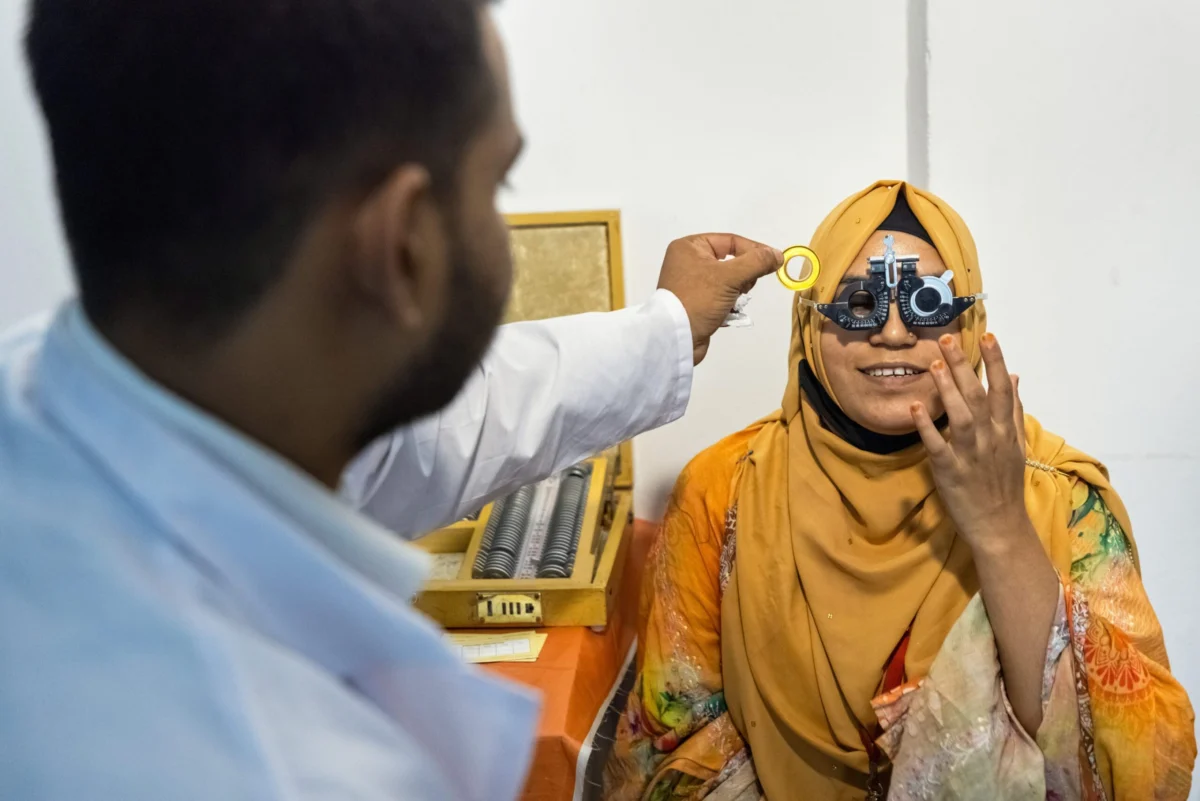
In the bustling, high-pressure environment of a Bangladeshi garment factory, where precision meets demanding quotas, the smallest impediment can have significant repercussions. For Ruma Aktar, a veteran sewing machine operator, the gradual blurring of close-up vision had become a daily struggle, turning once-simple tasks into a frustrating ordeal. Before acquiring her reading glasses, threading a needle was a painstaking process, often requiring multiple attempts, straining her eyes and her patience. The constant effort led to debilitating headaches and persistent eye strain, symptoms that are all too common among her peers but rarely spoken about. Her work, which requires meticulous attention to detail to produce thousands of garments daily, was becoming increasingly challenging. Mistakes, no matter how minor, could slow production, necessitate costly reworks, or even result in rejected items, directly impacting her productivity and, by extension, her income.
“Before I got the glasses, it took me a long time to thread the needle. Now I can thread it in just a short time. I make far fewer alterations than before,” Aktar recounted, the relief palpable in her voice. Her experience is a microcosm of a larger, often overlooked challenge within Bangladesh’s colossal garment industry, a sector that serves as the economic backbone of the nation. The simple act of donning a pair of affordable reading glasses has not only restored her efficiency but has also alleviated her physical discomfort, allowing her to work with renewed confidence and comfort.
Bangladesh stands as the world’s second-largest garment exporter, trailing only China, a testament to its formidable industrial capacity and a workforce numbering approximately 4 million. This vibrant sector contributes a substantial 11% to the nation’s gross domestic product, making it a critical engine for economic growth and poverty reduction. The vast majority of these workers are women, often migrating from rural areas in search of better livelihoods, making the conditions and efficiency of their work profoundly impactful on societal well-being. The industry thrives on speed, accuracy, and competitive pricing, placing immense pressure on operators to maintain high standards of quality and output. Within this context, unimpaired vision is not merely a convenience but an absolute necessity, a fundamental tool for the trade that, for too long, has been taken for granted or deemed an unaffordable luxury.
VisionSpring, a global nonprofit social enterprise dedicated to providing affordable eyewear to underserved populations, sheds light on the scale of the problem. Their estimates suggest that a staggering one in three Bangladeshi garment workers requires reading glasses but lacks access to them. This significant gap points to a widespread issue of uncorrected refractive error, predominantly presbyopia—an age-related condition that causes difficulty focusing on near objects. Presbyopia typically manifests in individuals in their late 30s and early 40s, precisely the demographic that constitutes a substantial portion of the experienced garment factory workforce. For these workers, whose livelihoods depend on intricate tasks like threading needles, sewing seams, and checking for defects, blurred near vision translates directly into reduced productivity, increased errors, and debilitating physical discomfort.
The absence of corrective eyewear among these workers is multi-faceted. Often, workers are unaware that their vision issues can be easily corrected, attributing their struggles to fatigue or old age. The cost of an eye exam and glasses, even if relatively low in developed countries, can be prohibitive for individuals earning meager wages. Moreover, cultural perceptions can play a role, with eyeglasses sometimes viewed as a sign of weakness or old age, or simply as a luxury item rather than an essential health intervention. The result is a silent epidemic of impaired vision that silently erodes worker welfare and factory efficiency.
Recognizing this pervasive yet solvable issue, some forward-thinking factory owners in Bangladesh are beginning to integrate vision correction programs into their operations. VisionSpring, in partnership with the Bangladesh Garment Manufacturers and Exporters Association (BGMEA), which represents factory owners, has initiated programs to supply affordable glasses, often costing less than ten dollars per pair, directly to workers. This collaborative approach aims to dismantle the traditional barriers to access, making vision care convenient and economically viable for both employees and employers.
Ella Gudwin, the chief executive of VisionSpring, emphasizes the immediate and tangible benefits observed from these interventions. “The benefits were immediate, as workers were better able to meet quality and production targets,” Gudwin stated. She elaborated that improved vision significantly reduces common errors such as skipped stitches, uneven hems, and misplaced buttons, thereby cutting down the need for time-consuming and costly rework. This reduction in errors not only boosts efficiency but also enhances product quality, a critical factor in maintaining competitiveness in the global market. Gudwin points out that vision correction has historically been overlooked because eyeglasses were often perceived as a luxury rather than a crucial workplace tool. The common misconception that glasses are expensive or unnecessary leads many factory workers experiencing age-related farsightedness to delay seeking treatment, inadvertently compromising their work quality and personal well-being. Bringing eye screenings directly into the factories, Gudwin argues, effectively removes these systemic and psychological barriers.
The Masco Group, a prominent Bangladeshi garment company, serves as an exemplary case study for this innovative approach. Fahima Akhter, a director at Masco Group, shared her company’s journey in addressing worker vision. Initially, managers were largely unaware of the extent of vision problems among their workforce, primarily because workers, fearing job insecurity or simply not knowing a solution existed, rarely voiced complaints about their eyesight. The implementation of a screening program, however, quickly unveiled the hidden reality. Masco Group has since screened approximately 5,000 workers, revealing that around 30% of them required and subsequently received corrective eyewear.
The success and positive impact of the program have prompted Masco Group to expand its initiative to its entire workforce of over 20,000 employees. Akhter articulated a profound shift in the company’s perspective: “We don’t consider it a cost. It is an investment.” This statement encapsulates a growing understanding within the industry that investing in worker well-being is not merely a philanthropic gesture but a strategic business decision with clear returns. Akhter explained the multifaceted benefits: “If the workers are working with better vision, their productivity and workplace safety will improve, and eventually this will translate into better productivity and profit for the company.” The enhanced focus and reduced strain lead to higher output, fewer defects, and a safer working environment, all of which contribute directly to the company’s bottom line. Moreover, improved worker morale and a sense of being valued can lead to higher retention rates, reducing the costs associated with training new employees.
The economic rationale behind this investment is strongly supported by empirical evidence. A randomized controlled research trial conducted in India, co-authored by Ella Gudwin and published in April in the prestigious British Journal of Ophthalmology, provides compelling data. The study demonstrated that sewing machine operators who received reading glasses increased their productivity by an impressive 6% while simultaneously making fewer errors. This translates into tangible financial gains. The research quantified the return on investment, finding that every $1 spent on vision screening and glasses generated an astounding $3.37 in productivity gains over a mere 12 weeks. Extrapolating these findings, the study estimated that expanding similar programs across the global textile and garment industry could generate the equivalent of an additional $27 billion in annual output. This staggering figure underscores the massive untapped potential residing within a seemingly simple intervention. It highlights how a relatively small investment in basic healthcare can unlock significant economic value, transforming both individual lives and global supply chains.
The implications of this research extend far beyond the garment sector. It provides a robust business case for other industries requiring fine motor skills and close-up vision, particularly in developing economies where access to affordable eye care remains limited. Gudwin’s insight that vision correction has long been overlooked, often seen as a luxury rather than an essential workplace tool, is critical. The common perception that glasses are expensive often deters workers, particularly those in their late 30s and early 40s who typically develop age-related farsightedness, from seeking treatment. By bringing eye screenings and affordable glasses directly into factories, these programs effectively bypass the traditional barriers of cost, access, and awareness, making vision correction an attainable reality for millions.
Fahima Akhter of Masco Group advocates for a broader, systemic change within Bangladesh’s garment sector, urging that vision screening become a standard workplace benefit. Her powerful declaration, “Having a clear vision is not a luxury, it is a necessity now,” encapsulates the paradigm shift required. This shift acknowledges that worker health and well-being are not peripheral concerns but are intrinsically linked to operational efficiency, product quality, and ultimately, a company’s long-term profitability and sustainability.
The story of Ruma Aktar and her reading glasses is more than just an anecdote; it represents a profound understanding of human capital and its intrinsic value. It illustrates how a straightforward, low-cost intervention can dramatically improve individual lives, enhance productivity, and drive economic growth. As the global garment industry continues to evolve, facing increasing demands for ethical practices and sustainable production, prioritizing worker health, including their vision, emerges not just as a moral imperative but as a strategic cornerstone for success. The initiative to provide affordable reading glasses is a testament to the power of simple solutions to address complex challenges, fostering a future where clear vision is recognized as a fundamental right and an indispensable asset in the workplace.
