
 By Lina Irawan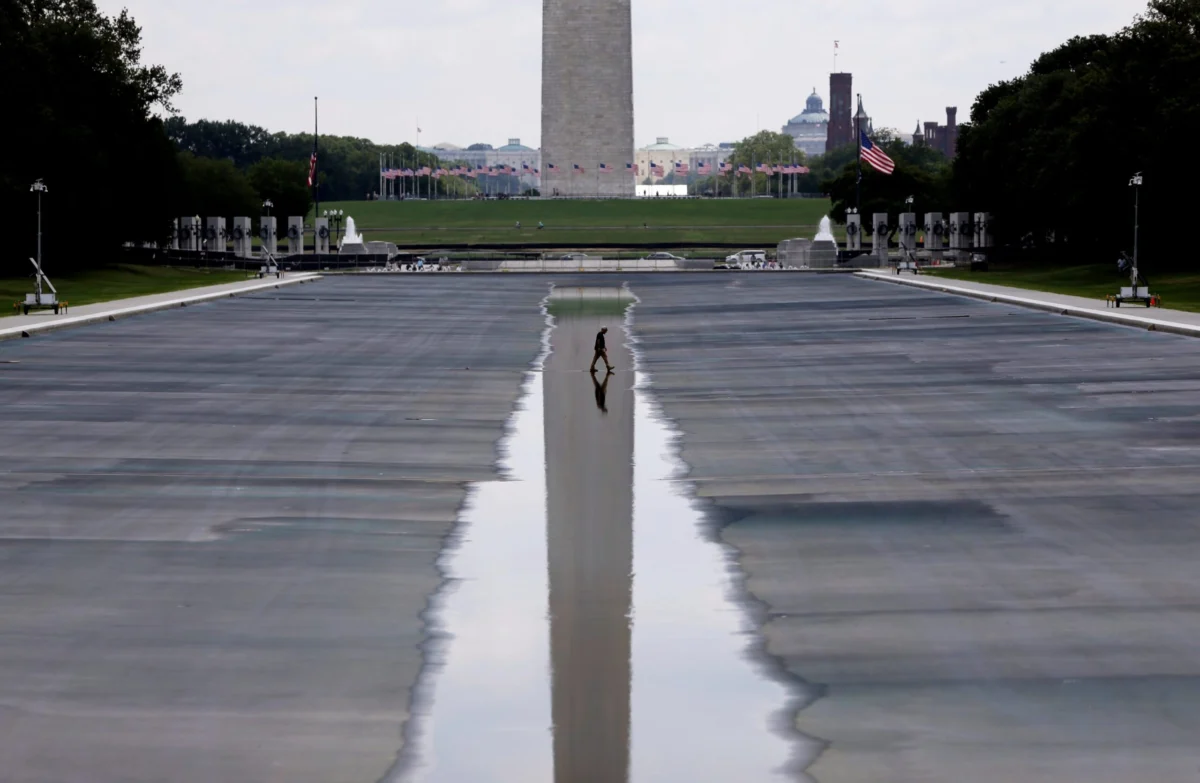
In a dramatic and politically charged court filing on Friday, Pirro’s office moved to drop all criminal charges against Hearn, who had been accused of deliberately damaging the Lincoln Memorial Reflecting Pool’s newly installed liner. The pool, a cherished national landmark, had undergone an expedited renovation ahead of the nation’s 250th birthday celebration, "America 250," slated for the weeks surrounding Independence Day in 2026. This sudden reversal by the Justice Department stands in stark contrast to earlier pronouncements, which had echoed President Trump’s emphatic claims of vandalism and hailed the prosecution as a firm response to desecration at a presidential pet project.
President Trump, however, wasted no time in publicly challenging Pirro’s decision. In a series of defiant social media posts over the weekend, he acknowledged that there "may have been some contractor difficulty" in the installation of the new pool liner. Yet, he vehemently insisted that "the major damage was caused by VANDALS!" His disagreement with his own U.S. Attorney was unambiguous: "I disagree 100% with Jeanine Pirro, the U.S. Attorney for the District of Columbia, on the Reflecting Pool," Trump declared, signaling a rare and public schism between the executive and a high-ranking appointee within the Justice Department. On Saturday, the President, without presenting any new substantiating evidence, reiterated his conviction that vandals were primarily responsible for the majority of the extensive damage to the historic pool.
The Justice Department’s dismissal represents an embarrassing setback for an administration that had initially championed the prosecution as a demonstration of law and order and a defense of national symbols. Government lawyers, in their comprehensive 20-page court filing, presented compelling new information that fundamentally altered the narrative. They stated that additional documents, meticulously provided by the Interior Department since Hearn’s indictment, revealed that the damage was not the result of malicious intent but rather a confluence of factors: a botched installation by a contractor and "the rush to complete the project prior to events associated with the America 250 celebration in the weeks surrounding Independence Day 2026."
Further bolstering their revised stance, the filing detailed a recent visual inspection that uncovered widespread damage throughout the pool, critically including areas in the middle where, prosecutors conceded, a vandal would be highly unlikely to attempt peeling the lining. This extensive and geographically dispersed damage pointed more persuasively to systemic failure rather than isolated acts of malice.
David Hearn, a former Olympic canoeist, had been specifically accused of pulling up a two-foot square piece of the pool’s lining. The accusation, which garnered national attention due to Hearn’s public profile and the political weight behind the claims, now appears to have been predicated on an incomplete understanding of the facts.
Pirro, a direct Trump appointee, articulated the Justice Department’s revised conclusion with striking candor in her filing: "Given all of this newly discovered information, it is difficult to attribute the widespread damage to the Reflecting Pool to vandalism, let alone to establish that fact beyond a reasonable doubt." She formally requested a judge to dismiss the case, acknowledging the profound shift in the government’s position.
Adding another layer of controversy, Pirro’s court filing pointedly blamed the Interior Department for providing "less than fulsome information at the outset of the case." The filing asserted, with unusual directness for an inter-agency critique, that "had DOI been forthcoming with the information clearly in its possession, the government would not have sought a grand jury indictment." This statement represents a jarring turn from Pirro’s initial stance, where just last month, she had publicly claimed the government’s case against Hearn was built on "tremendous evidence" when announcing the indictment. The implication of the U.S. Attorney’s office proceeding with charges based on incomplete or misleading information from another federal agency raises serious questions about inter-agency communication, investigative thoroughness, and political pressures influencing legal proceedings.
Hearn’s legal team swiftly capitalized on the dismissal, issuing a sharp statement on Saturday that criticized both President Trump and U.S. Attorney Pirro, while also indicating they were "weighing ‘legal remedies’" on behalf of their client. "Trump is mad at Pirro because she finally admitted what we made clear in our legal filings all along: Trump’s botched renovation was responsible for the damage – not Davey Hearn," the legal team declared, framing the situation as a vindication of their client and a condemnation of the administration’s project management. They also dismissed Pirro’s claim of being misled, stating, "However, her claim that she and her office were previously duped by Interior is nonsense. Starting immediately after the arraignment, our motions repeatedly proved that the administration was to blame for the Reflecting Pool failures, not Davey." This suggests a potential path for a civil lawsuit for malicious prosecution or wrongful arrest, which could further escalate the political and legal fallout.
Interior Department officials did not respond to requests for comment regarding Pirro’s allegations of withholding information or the substance of the court filing.
President Trump, undeterred by the legal dismissal, continued to press his vandalism narrative on Saturday. He posted a nearly four-minute video, purportedly from a security camera, depicting three individuals with their hands in the pool, one for an extended period. The President claimed the video definitively shows "material is being cut with a knife or a box cutter, for all to see!" However, a critical review of the video, which appears to be shot from a considerable distance, does not clearly substantiate the claim of vandalism. The footage lacks the clarity to definitively ascertain the actions of the individuals or if any damage was inflicted. Moreover, the presence of workers nearby who do not appear to notice or intervene suggests the activities might not have been perceived as illicit at the time. This highlights the ongoing battle over evidence and interpretation, with the President relying on circumstantial video footage to maintain his narrative against a formal legal dismissal based on a deeper investigation.
The saga of the Reflecting Pool began in May when President Trump announced ambitious plans to "beautify" the landmark, particularly in anticipation of the "America 250" celebration. Virginia-based Atlantic Industrial Coatings was awarded a substantial $14.7 million no-bid contract to repaint and waterproof the pool’s concrete floor. The absence of a competitive bidding process for such a significant federal contract had already raised eyebrows among procurement watchdogs and congressional oversight committees, hinting at potential favoritism or a lack of due diligence.
Trump’s personal involvement extended to directing the specific aesthetic choices, including the controversial decision to paint the pool’s bottom with what he termed "American flag blue." This highly visible and politically symbolic choice added another layer of scrutiny to the project’s execution. However, problems manifested alarmingly quickly. Within days of the project’s completion and the refilling of the pool, large chunks of the new liner began to peel off, visibly compromising the integrity and appearance of the renovated landmark.
In the immediate aftermath of this visible deterioration, President Trump was quick to attribute the damage to vandals. This assertion was seemingly corroborated, at least initially, by a report from the National Park Service to the U.S. Park Police on June 9, which claimed an incident involving a "sharp knife or razor" cutting the pool’s new liner. This report formed the early basis for the vandalism narrative and subsequently, the indictment of David Hearn. However, as the U.S. Attorney’s office now acknowledges, the initial information provided was "less than fulsome," suggesting a rushed conclusion or an incomplete investigation.
The Reflecting Pool project is not an isolated incident but rather one of several high-profile and often controversial infrastructure and beautification initiatives championed by President Trump across the nation’s capital. Most prominently, he spearheaded the demolition of the White House’s East Wing to construct a lavish $400 million ballroom, a project that drew criticism for its scale, cost, and historical impact. Furthermore, the administration has announced plans to build a towering arch between the revered Lincoln Memorial and Arlington National Cemetery, another project that has ignited debate over historical preservation, urban planning, and the appropriate use of national monumental spaces. These projects collectively underscore a broader administrative philosophy emphasizing grand gestures, rapid execution, and a personal aesthetic vision, often with significant financial implications and public contention.
The public disagreement between President Trump and U.S. Attorney Pirro lays bare the complexities and political pressures inherent in such high-profile federal projects. Legal experts suggest that Pirro’s decision to dismiss the charges, particularly with her direct critique of the Interior Department, demonstrates a commitment to prosecutorial integrity, even if it creates political friction with the President who appointed her. The acknowledgment of "botched installation" and "rush to complete" points to systemic issues in project management and oversight rather than individual malice. From a construction and engineering standpoint, experts often caution against expedited timelines for complex projects involving specialized coatings and environmental factors, as these can easily lead to material failures, especially when coupled with unconventional specifications like a unique "American flag blue" color.
As the dust settles on the criminal charges against David Hearn, the controversy surrounding the Reflecting Pool is far from over. Hearn’s legal team is exploring civil remedies, which could lead to further legal battles and public revelations. The broader political narrative will continue to pit claims of administrative incompetence and rushed projects against presidential assertions of vandalism and external sabotage. The fate of the Reflecting Pool’s full repair, the accountability for its initial damage, and the enduring legacy of President Trump’s architectural and beautification initiatives across Washington D.C. remain subjects of intense public scrutiny and debate. The dismissal of charges, while a victory for Hearn, has only deepened the fissures within the administration and amplified questions about transparency, accountability, and the true cost of national symbolism.
