
 By admin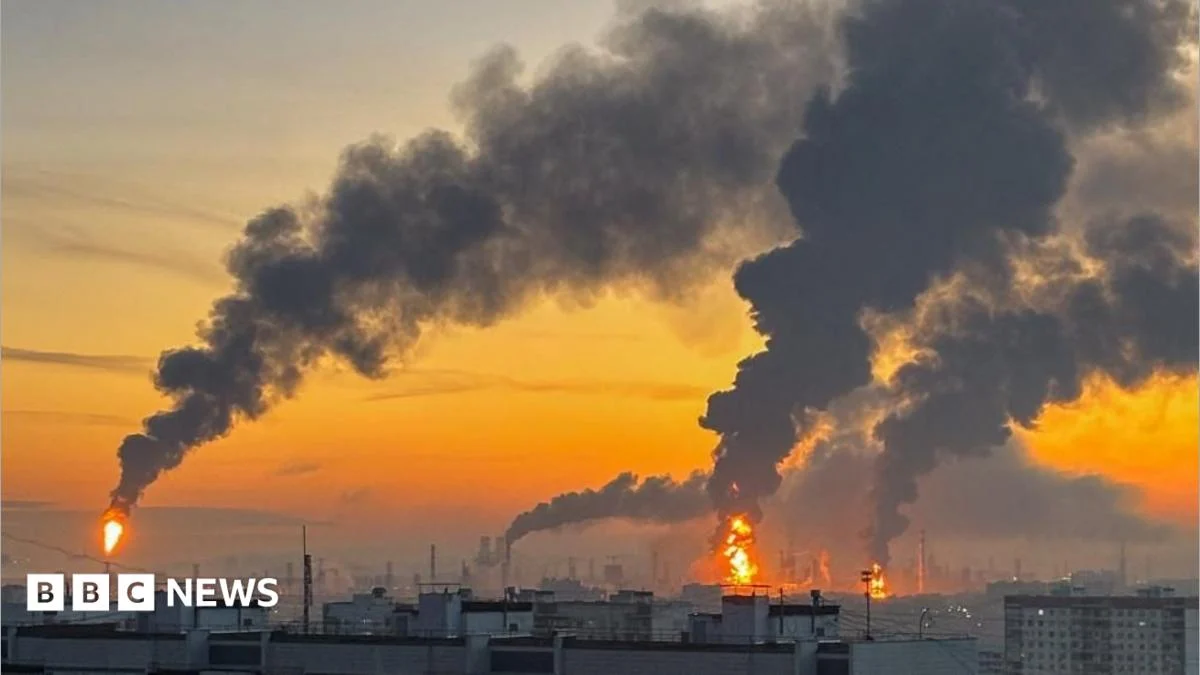
In a dramatic escalation of the ongoing conflict, Ukraine launched its most extensive drone assault to date on the Moscow region, striking the nation’s primary oil refinery and a residential building. Moscow Mayor Sergei Sobyanin declared that 450 drones were intercepted en route to the capital, characterizing it as "the most massive" attack since the full-scale invasion began in February 2022. The coordinated strikes resulted in tragic loss of life, with the region’s governor reporting at least two fatalities and 20 individuals injured.
Ukrainian President Volodymyr Zelensky confirmed Kyiv’s involvement, stating that drones and missiles had successfully targeted a "key" Russian oil facility and a logistics site within the region. He emphasized the strategic significance of these strikes, asserting that they represented "billions of dollars that sustain the war machine." This assertion underscores Ukraine’s evolving strategy to cripple Russia’s economic capacity to wage war by disrupting its energy sector and supply chains.
The drone attacks on Sunday came amidst a broader pattern of intensified strikes by both Russia and Ukraine. In recent weeks, both nations have increasingly focused their military efforts on energy-generating and transport facilities, as well as critical logistics hubs. This tit-for-tat strategy aims to inflict maximum damage on the adversary’s infrastructure and war-fighting capabilities.
The human toll of the Ukrainian drone offensive was starkly evident in Sofyino, where a 44-year-old woman was killed when a drone impacted a three-story residential building. Governor Andrei Vorobyev of the Moscow region reported that an additional five people, including two children, sustained injuries in this incident. Further tragedy struck the Orekhovo-Zuevo district, where an elderly man lost his life after his private house was hit by a drone.
Social media platforms were inundated with unverified videos purportedly depicting explosions in the night sky above Moscow and a burning warehouse. While the BBC has not independently verified these images, they paint a grim picture of the scale and intensity of the assault. Mayor Sobyanin confirmed that a drone had struck a building adjacent to one of the capital’s main boulevards, as well as the oil refinery. Ukrainian military officials claimed that three critical processing units at the refinery were damaged, a significant blow to Russia’s energy production capabilities.
The targeted oil refinery plays a pivotal role in supplying the Moscow region, accounting for over a third of its total fuel output, according to Ukraine’s Ministry of Defence. Furthermore, a substantial portion of its petrol, diesel, and aviation fuel is destined for the Russian military’s operational needs. Ukraine’s Defence Minister articulated the strategic rationale behind targeting such facilities, stating that these strikes "directly undermine the enemy’s ability to continue its war of aggression and supply its military formations." This highlights Ukraine’s intent to degrade Russia’s logistical support and operational readiness.
Mayor Sobyanin also suggested that the large-scale drone attack was an "attempt to disrupt" Russia’s ongoing parliamentary election, which was in its third day on Sunday. The election, tightly controlled by the Kremlin, has been widely criticized by international observers and opposition figures as lacking freedom, fairness, and transparency. The timing of the drone attack, coinciding with the election, could be interpreted as an effort to sow chaos and further delegitimise the electoral process.
Adding to the grim casualty count, Russian state media reported that an election official was among two individuals killed by a drone attack on a bus in a Moscow-controlled area of Kherson, Ukraine, on Sunday. This report, citing the head of Russia’s election commission, underscores the interconnectedness of the conflict and its impact on both sides.
The drone activity also significantly disrupted air travel in and around Moscow. Sheremetyevo Airport, the capital’s busiest, issued warnings of "temporary restrictions" on flights overnight. Similarly, Vnukovo Airport halted all arrivals and departures. While flight restrictions were lifted by Sunday morning at both airports, passengers were cautioned that flight delays might still occur. This disruption to air traffic further illustrates the reach and impact of the Ukrainian drone offensive.
The attacks on Sunday were part of a brutal weekend of violence that saw significant civilian casualties in Ukraine. In Fastiv, Kyiv region, a mother and her two young children were killed in a Russian attack on Saturday, according to regional head Tymur Tkachenko. Tkachenko later reported that a child who had been injured in a separate attack in Vyshhorod, north of Kyiv, succumbed to their injuries in hospital. In the northeastern Sumy region, four people were killed when a Russian drone struck the car they were traveling in, as confirmed by top local official Oleh Hryhorov. President Zelensky also reported that a Russian drone strike on a monastery in the Kherson region on Saturday resulted in the death of one member of the clergy and injuries to four others.
The recent surge in attacks on energy infrastructure by both Russia and Ukraine has occurred despite a claimed agreement between the two sides not to target such facilities, according to a social media post by former US President Donald Trump. Trump’s administration has taken a firm stance against Russia’s actions, signing a sanctions bill on Friday that imposes tariffs on major purchasers of Russian oil and gas, including China and India. This legislation empowers the US President to levy 100% tariffs on these significant buyers of Russian energy, aiming to further isolate Russia economically and diminish its revenue streams.
The ongoing conflict, initiated by Russian President Vladimir Putin’s full-scale invasion of Ukraine in February 2022, continues to be marked by intense military engagements and devastating consequences for civilian populations on both sides. The recent drone attacks represent a significant escalation in Ukraine’s offensive capabilities and its strategic intent to disrupt Russia’s war economy. The targeting of key energy infrastructure, in particular, signals a deliberate effort to cripple Russia’s ability to sustain its military operations and project power. The international community continues to monitor the situation closely, with sanctions and diplomatic efforts playing a crucial role in the broader geopolitical landscape surrounding the conflict. The increasing sophistication and scale of drone warfare employed by Ukraine suggest a growing capacity to project power deep into Russian territory, potentially reshaping the dynamics of the conflict in the months to come. The psychological impact of such attacks on the Russian populace, particularly in and around the capital, also represents a significant dimension of this aerial offensive, aiming to erode public support for the war and increase pressure on the Kremlin. The long-term implications of these attacks, both militarily and politically, remain to be seen, but they undoubtedly mark a pivotal moment in the protracted war.
