
 By admin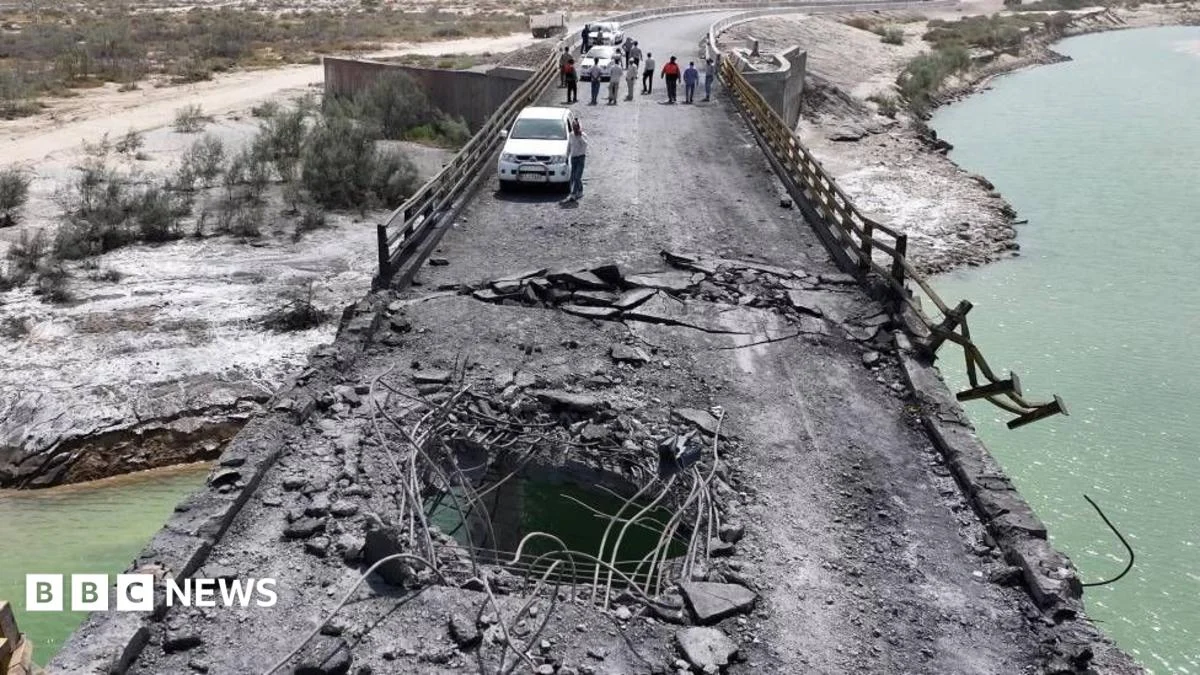
The United States military has launched its seventh consecutive night of strikes against Iran, a significant escalation following President Donald Trump’s declaration that the temporary ceasefire agreement between the two nations was "over." The intensified military action underscores a dramatic unraveling of diplomatic efforts and a rapid descent into renewed hostilities, with both sides exchanging accusations and retaliatory measures. US Central Command (Centcom) confirmed that its forces targeted a range of Iranian military assets, including surveillance sites, crucial military logistics infrastructure, underground weapons storage facilities, and maritime capabilities. In response, Iran stated it retaliated by targeting US allies in the region, with Kuwait reporting significant damage to a power plant, a water distillation plant, and an oil facility.
The renewed conflict has already exacted a human toll. On Saturday, Centcom announced that two US service members had been killed during Friday’s attacks, with one additional service member reported missing. These casualties mark a stark reminder of the dangerous reality on the ground as the preliminary deal, signed in mid-June with the aim of enabling talks for a permanent peace, has faltered within a mere month of its inception. The agreement, which saw both sides pledge to halt fighting, appeared to make little progress in negotiations, ultimately leading President Trump to declare the deal void on July 8th.
The fallout from the collapsing ceasefire has been immediate and severe. On Saturday, Iran’s Supreme Leader, Mojtaba Khamenei, issued a strong written statement condemning the United States. He declared that America’s "repeated breaches" of the agreement had "laid bare a fundamental truth: the signature of the US president is utterly worthless and devoid of credibility." Khamenei, who has maintained a low public profile since the war began with the assassination of his father, characterized the ongoing conflict as a "dark episode of criminality and broken promises," which he asserted was irrefutable evidence of American "dishonesty" and its "malicious nature."
The ripple effects of Iran’s alleged retaliatory strikes have been felt across the region. Kuwait’s state news agency reported that an oil facility had sustained substantial damage and that injuries had occurred as a result of "repeated Iranian attacks." Similarly, Jordan’s military announced the interception of 10 Iranian missiles fired into its airspace overnight, though no damage was reported. Bahrain also stated that its air defense systems had successfully "thwarted" Iranian attacks. These actions have drawn strong condemnation from regional bodies. Jasem Mohamed Albudaiwi, the Secretary General of the Gulf Cooperation Council (GCC), an organization representing six Gulf states including Saudi Arabia, Kuwait, Qatar, Bahrain, the United Arab Emirates, and Oman, described the attacks on Kuwait, Jordan, and Bahrain as "a grave violation of international law." He further accused Tehran of deliberately targeting civilian infrastructure, an act he deemed constituting "war crimes." Albudaiwi emphasized that this "dangerous escalation" necessitates international accountability.
Adding to the diplomatic tension, Iran’s Deputy Foreign Minister, Kazem Gharibabadi, told state media that Tehran had been "engaged in negotiations" but had suspended its obligations under the deal in response to what he termed "aggressive actions" by the United States. The initial ceasefire, though largely observed, had been punctuated by Iranian attacks on oil tankers. These incidents were reportedly aimed at compelling compliance with Iran’s demands that ships seek authorization to cross the Strait of Hormuz, a critical waterway through which approximately one-fifth of the world’s oil and liquefied natural gas ordinarily transits. These actions were subsequently met with US strikes.
Centcom detailed the latest wave of US strikes, stating they concluded after several hours at 21:30 ET on Friday, which corresponded to 02:30 BST on Saturday. The command confirmed the use of a comprehensive array of military assets, including fighter aircraft, aerial drones, and warships, in addition to other capabilities. Iranian state media reported that explosions were audible in the central city of Yazd, as well as on Qeshm island and at the port of Bandar Abbas, both located near the Strait of Hormuz. BBC Persian has independently verified video evidence depicting damage and debris on and around the Shahid Mirzaei tunnels, a significant route north of Bandar Abbas. Local authorities further reported that an attack on electricity facilities and desalination pumps at a plant near Jask had resulted in approximately 10,000 people in 20 villages being deprived of drinking water. In a related development, over 100 telecommunications masts were rendered inoperable, disrupting landline, mobile, and internet services across northern Hormozgan province.
The US military has also moved to debunk claims made by Iran. Centcom specifically denied a report from Iran’s Fars news agency alleging that two oil tankers had "exploded and caught fire while passing through a mined route south of the Strait of Hormuz." Centcom’s statement was unequivocal: "Like most IRGC claims, this is false."
These latest US strikes followed claims made by Iran’s armed forces on Friday, asserting they had attacked multiple US military facilities across the Gulf region, including in Kuwait, Bahrain, and Jordan. Notably, Iran also claimed, for the first time, to have targeted facilities in Syria, a claim that the US has denied. Further details emerged regarding casualties sustained by US forces. Sources speaking to the BBC’s US partner, CBS News, indicated that several American service members had been injured during Iranian attacks on two Jordanian bases over the preceding week. Centcom later confirmed via a post on X (formerly Twitter) that four service members had been medically evacuated to Jordanian hospitals following Friday’s strikes, but had since been discharged. The identities of the two service members killed in the attacks were withheld pending notification of their next of kin, as per standard military protocol.
The United States has also refuted earlier Iranian assertions that US forces had targeted civilian infrastructure within Iran, including bridges, a train station, and an airport. However, BBC Verify and BBC Persian have independently verified footage showing damage to the Gariveh Bridge. Nighttime videos captured a fireball erupting on top of the structure, while daylight images revealed a section of the road collapsed, with rubble surrounding the damaged bridge. Provincial authorities in Hormozgan province, the affected region, stated that seven people had lost their lives in the attacks. A White House spokesperson, in a statement to the BBC, affirmed that the US had "carried out strikes exclusively on military targets, including military logistics infrastructure."
In a further demonstration of its targeting strategy, the US military announced it had destroyed a control tower at the port of Chabahar. Defense Secretary Pete Hegseth shared an image of the tower’s collapse as it was struck. Centcom clarified that this control tower was an integral part of the Islamic Revolutionary Guard Corps’ (IRGC) maritime surveillance network.
The renewed hostilities have significant implications for regional stability and global energy markets. The Strait of Hormuz, a chokepoint for a substantial portion of the world’s oil supply, remains a focal point of tension. The collapse of the ceasefire agreement signals a return to a more confrontational posture, potentially leading to further economic disruption and heightened geopolitical risks. The international community watches with concern as diplomatic channels appear increasingly strained, and the specter of a wider regional conflict looms larger. The rhetoric from both sides, particularly the strong denunciations from Iran’s Supreme Leader, suggests a deep-seated distrust and a hardening of positions, making a swift return to de-escalation unlikely. The coming days and weeks will be critical in determining the trajectory of this escalating crisis.
