
 By Rifan Muazin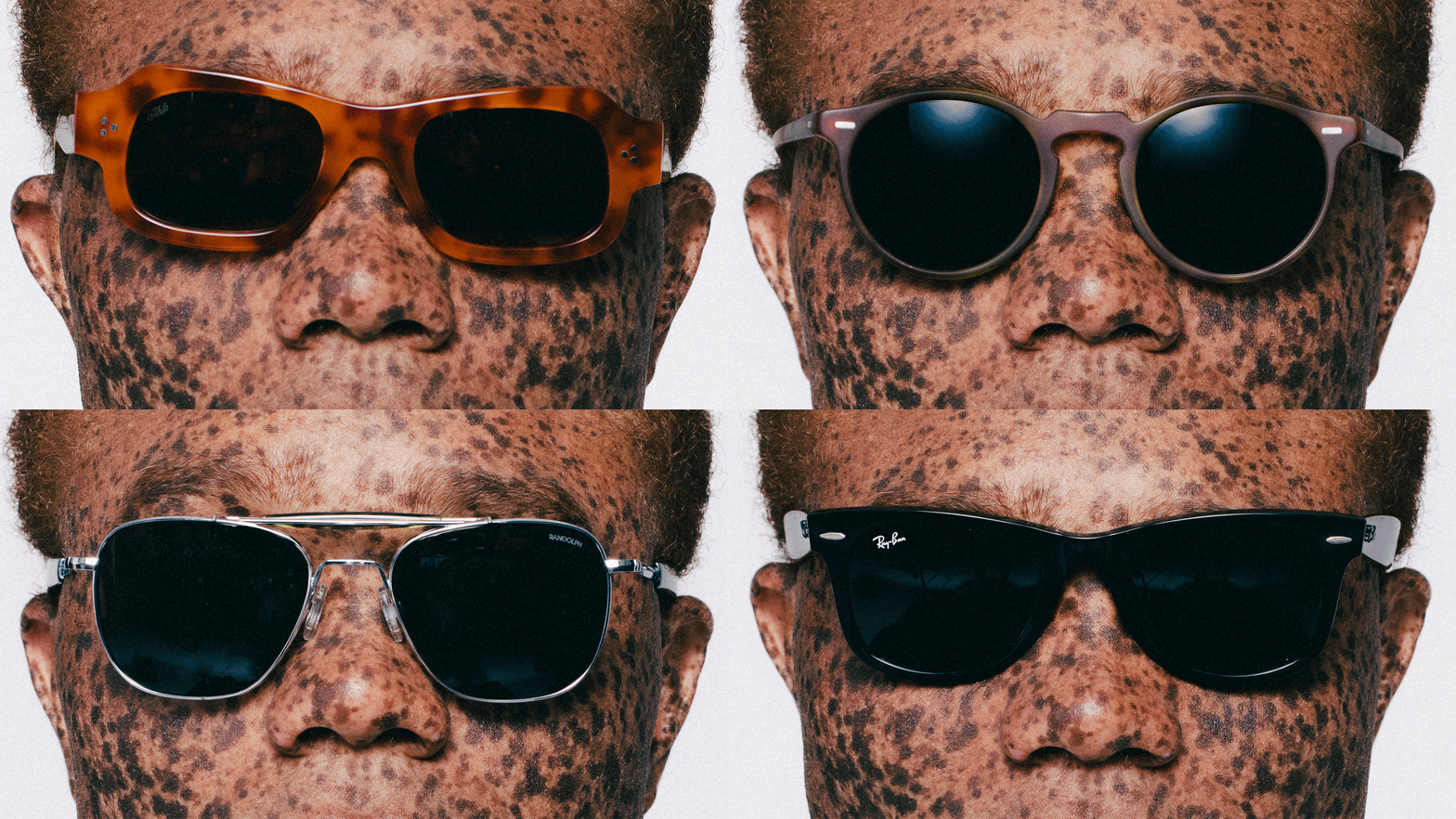
The global eyewear market, valued at over $160 billion, has seen a significant shift toward premiumization in recent years. Men are increasingly viewing sunglasses as long-term investments rather than disposable seasonal items. This shift is driven by a deeper understanding of craftsmanship—moving away from generic injection-molded plastics toward hand-polished cellulose acetate and high-grade metals. As the "quiet luxury" movement continues to permeate menswear, the focus has landed squarely on the quality of the hinge, the clarity of the lens, and the historical weight of the silhouette.
If you are uncertain where to begin your journey into high-end eyewear, the Ray-Ban Original Wayfarer remains the undisputed benchmark. First introduced in 1952, the Wayfarer represented a radical departure from the thin metal frames of the past, utilizing a chunky, trapezoidal plastic shape that redefined cool for the mid-century. While they are forever linked to Tom Cruise’s sliding entrance in Risky Business, their appeal is universal. Much like a pair of Levi’s 501 jeans, the Wayfarer is a democratic masterpiece; it looks as at home on a Hollywood mogul as it does on a weekend warrior. The current "Original Classic" model maintains the distinct tilt—known as the "pantoscopic tilt"—which angles the lenses toward the cheeks, a feature designed for both style and optimal sun coverage. At a price point hovering around $172, they offer the best entry-level investment for a timeless look.
For those who prefer a more structured, metallic aesthetic, Randolph Engineering provides a masterclass in American manufacturing. Since 1982, Randolph has been the prime contractor for aviator sunglasses for the U.S. military. Each pair of their Aviator Sunglasses is built to "Mil-Spec" standards in Randolph, Massachusetts, undergoing a rigorous 200-step assembly process. The frames are often plated in 23k gold or bright chrome and feature the brand’s signature "bayonet" temples, which were originally designed to fit comfortably under pilot headsets and helmets without causing pressure points. Unlike cheaper teardrop aviators that can feel flimsy, Randolphs possess a reassuring heft and durability. Their lenses are engineered for extreme environments, offering distortion-free "SkyTec" technology that provides the same visual acuity required by fighter pilots.
In the realm of European sophistication, Persol stands alone. The brand’s 649 Original model is perhaps the most famous example of Italian eyewear design. Originally conceived in 1957 for Turin tram drivers who needed protection from the dust and sun, the 649 gained international stardom when it was adopted by "The King of Cool," Steve McQueen. These frames are easily identified by the "Silver Arrow" hinge and the Meflecto system—a series of small cylinders inserted into the acetate temples that allow them to flex and mold to the shape of the wearer’s head. This technological innovation, patented in the 1930s, remains one of the most comfortable fitting systems in the industry. The 649’s teardrop shape, rendered in rich Havana tortoiseshell, offers a "menswear guy" alternative to the more common metal aviator, blending mid-century racing heritage with Neapolitan elegance.
The fashion pendulum has recently swung back toward high-performance optics, bringing Oakley back to the forefront of the style conversation. The Oakley Radar EV Path represents the pinnacle of the "sport-chic" trend, where gear designed for MLB outfielders and Tour de France cyclists is repurposed for the street. This shift is fueled by the Y2K resurgence and the "gorpcore" movement, which prioritizes functional, technical outdoors gear. The Radar EV Path features a shield lens that provides an unobstructed field of view and utilizes Oakley’s proprietary Prizm lens technology, which fine-tunes individual colors to enhance detail and contrast. While they are undeniably aggressive in their styling, they offer a level of lightweight comfort and grip—thanks to "Unobtainium" earsocks—that traditional fashion glasses cannot match.
For the man who values "quiet luxury" and artisanal pedigree, the Moscot Lemtosh is the gold standard. A family-run institution on New York City’s Lower East Side for over a century, Moscot has perfected the art of the understated frame. The Lemtosh is a rounded, "nerd-chic" silhouette that has been worn by everyone from Buddy Holly to Johnny Depp. It avoids loud logos in favor of distinctive diamond-shaped rivets and a keyhole bridge. Because they are available in multiple sizes and a vast array of colors, the Lemtosh can be customized to the exact proportions of a man’s face, a level of tailoring rarely seen in mass-market eyewear. They are the perfect "upgrade" for someone who finds the Wayfarer too ubiquitous but wants to maintain a classic, intellectual profile.
Similarly, Oliver Peoples has carved out a niche as the eyewear of choice for the Hollywood elite and the creatively inclined. Their Gregory Peck Sunglasses, created in collaboration with the actor’s estate, are modeled after the frames Peck wore as Atticus Finch in the 1962 film To Kill a Mockingbird. These frames exude a mid-century academic charm, featuring a slightly more rounded lens and a refined keyhole bridge. Oliver Peoples is known for its "no-logo" philosophy, relying instead on the quality of its Japanese-made acetate and the elegance of its proportions. These are the sunglasses for the man who prefers a sportcoat to a bomber jacket and a book to a blockbuster.
At the highest end of the spectrum lies Matsuda, a Japanese brand that treats eyewear as wearable sculpture. The Matsuda M5006 is a testament to the artisanal heritage of Sabae, Japan, the world’s capital for titanium eyewear. Each pair can take up to 250 steps to complete, featuring intricate filigree engravings that are applied by hand. The M5006 is a rimless, hexagonal design that utilizes ultra-lightweight titanium, offering a futuristic yet retro-steampunk vibe. In an era of mass production, Matsuda represents a commitment to the "small-batch" philosophy, where every screw and hinge is a custom-engineered component. For the collector, these are not just sunglasses; they are heirlooms.
Understanding the technical anatomy of these products is essential for making an informed purchase. When evaluating a pair of high-end sunglasses, the material of the frame is the first indicator of quality. Cellulose acetate is the preferred choice for premium frames because it is a plant-based plastic that retains its deep luster and can be adjusted by an optician using heat. This is a far cry from "injected" plastics, which are brittle and cannot be reshaped. Furthermore, the hinge is the most common point of failure. A quality pair will feature a "riveted" hinge, where the metal is pinned through the acetate rather than just glued. The number of "barrels" in the hinge—the interlocking loops that hold the screw—also matters; five-barrel or seven-barrel hinges offer significantly more stability and a smoother opening action than standard three-barrel versions.
Lens technology is the final piece of the puzzle. While glass lenses offer the best scratch resistance and optical clarity, they are heavier and can cause the glasses to slide down the nose. Consequently, many top-tier brands have moved toward CR-39 or nylon lenses, which are impact-resistant and lightweight while maintaining excellent clarity. Polarization is another key feature to consider; by using a special chemical film to filter out horizontal light waves, polarized lenses eliminate glare from surfaces like water or pavement. This significantly reduces eye strain and is a non-negotiable feature for anyone spending significant time driving or near the ocean.
Ultimately, the best sunglasses for men are those that align with both the shape of the face and the lifestyle of the wearer. While face-shape rules (such as "square faces need round frames") are helpful guidelines, they are no longer strict laws in the modern fashion era. Size and proportion are more critical. A frame that is too wide will make the head look small, while a frame that is too narrow will create an unflattering "pinched" effect. By investing in brands like Ray-Ban, Randolph, Persol, and Matsuda, a man ensures that his eyewear is not just a shield against the sun, but a perennial pillar of his personal style. These are the tools that allow a man to navigate the world with confidence, protected by the best optics the industry has to offer and framed by the most iconic silhouettes in history.
