
 By admin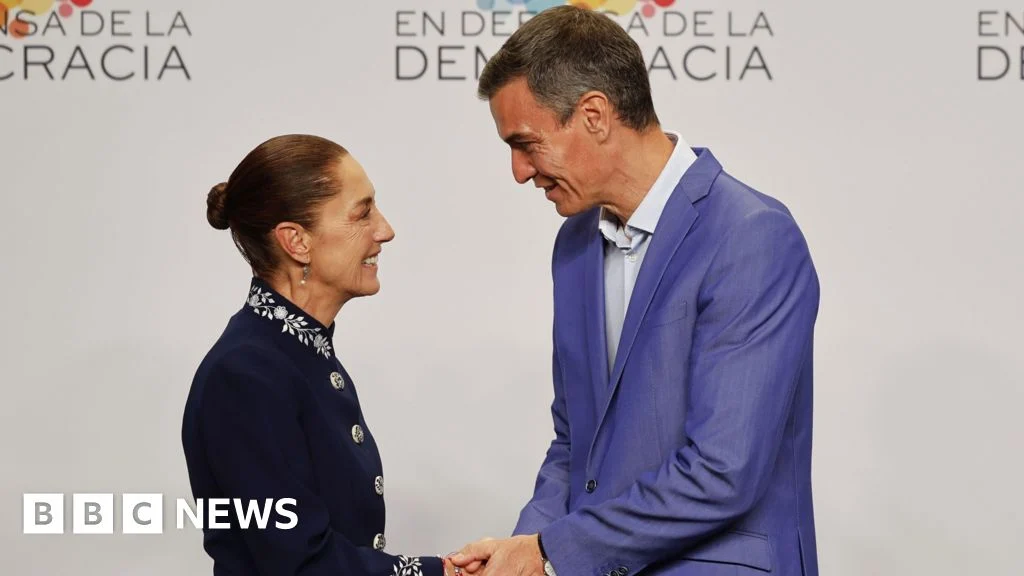
Mexican President Claudia Sheinbaum has emphatically stated that there is "no diplomatic crisis" with Spain, a declaration that signifies a significant potential thaw in the historically complex and often fraught relationship between the two nations. Her remarks, made upon arrival at a summit of left-leaning leaders in Barcelona, underscore a new era of dialogue and cooperation, moving away from the deep-seated historical grievances that have long cast a shadow over bilateral ties. "There is no diplomatic crisis. There never has been," Sheinbaum asserted, immediately addressing years of strained relations stemming from Spain’s colonial conquest of Mexico. "What is very important is that we recognise the strength of our country’s indigenous peoples," she added, linking the reconciliation process to a broader acknowledgment of historical injustices and the enduring legacy of Mexico’s indigenous communities.
The long-standing dispute over Spain’s colonisation of Mexico, which involved the dismantling of the Aztec empire and resulted in immense loss of life through conflict and disease in the 16th century, had escalated in recent years. This historical trauma became a prominent political issue, leading to persistent calls from Mexico for a formal apology from Spain. The tension reached a peak in 2019 when Sheinbaum’s predecessor, Andrés Manuel López Obrador, directly demanded an apology for the human rights violations committed during the conquest. When this plea went unanswered, Mexico took the unprecedented step of not extending an invitation to Spain’s King Felipe VI for Sheinbaum’s inauguration in 2024, a move that Spain reciprocated by refusing to send any official representative. This diplomatic snub marked a low point in a relationship that has spanned centuries.
However, recent months have seen a discernible shift towards reconciliation. A pivotal moment occurred in March when King Felipe VI, in a historic address while visiting an exhibition on indigenous Mexican women in Madrid, acknowledged that "there had been a lot of abuse" during the conquest. He further stated, "There are things that, when we study them, with our present-day criteria, our values, obviously cannot make us feel proud." This marked the first time a Spanish monarch had publicly admitted to atrocities committed during the colonial era, a significant concession that resonated deeply in Mexico. This subtle yet powerful acknowledgment appears to have paved the way for further dialogue.
Following King Felipe’s remarks, it was revealed that Sheinbaum had extended an invitation to him to attend the upcoming FIFA World Cup, which Mexico is co-hosting with the United States and Canada. According to the Spanish royal palace, Sheinbaum suggested that this global sporting event would provide "a timely opportunity to evoke the depth and unique character of the ties between Mexico and Spain." This gesture of goodwill, coupled with the King’s admission, signals a mutual desire to move beyond historical resentments and forge a more constructive future.
Adding to this momentum, Spain’s Foreign Minister, José Manuel Albares, received praise from Sheinbaum in October of the previous year when he articulated that there had been "pain and injustice" in the shared history of the two nations. These carefully chosen words, acknowledging past wrongs without dwelling on blame, represent a nuanced approach to historical reconciliation, one that resonates with Sheinbaum’s emphasis on recognizing the strength and resilience of indigenous peoples.
Sheinbaum’s presence at the "In Defence of Democracy" summit in Barcelona, where she met with Spanish Prime Minister Pedro Sánchez, was seen as a particularly positive development. While Sánchez himself remained tight-lipped on the specifics of bilateral relations, Spain’s Economy Minister was quoted by Reuters as describing Sheinbaum’s attendance as "a very important and positive sign of a rapprochement between the two countries." This visit marks the first by a Mexican president to Spain in eight years, underscoring the significance of this diplomatic engagement.
The "In Defence of Democracy" summit itself served as a backdrop for discussions on pressing global issues, highlighting the shared concerns of left-leaning leaders. The initiative, now in its fourth iteration, aims to counter the rise of illiberalism and extremism worldwide. Sánchez, as co-chair of the summit, delivered a stark warning about the current geopolitical landscape. "Democracy cannot be taken for granted," he declared, pointing to "attacks on the multilateral system, one attempt after another to challenge the rules of international law, and a dangerous normalisation of the use of force." His words reflected a broader anxiety among progressive leaders about the erosion of democratic norms and the resurgence of authoritarian tendencies globally.
Echoing these concerns, Brazilian President Luiz Inácio Lula da Silva, also a co-chair of the summit, launched a scathing critique of the United Nations Security Council, labeling its five permanent members—the United States, China, Russia, France, and the United Kingdom—as "lords of war" due to their veto power. He argued that the council was failing to function effectively in addressing contemporary global challenges. "No president of any country in the world, however powerful, has the right to keep imposing rules on other countries," Lula stated, advocating for a more equitable and representative international governance structure.
A tangible outcome of the leaders’ discussions was a joint statement agreeing to increase aid deliveries to Cuba, which they collectively described as experiencing a "humanitarian crisis." This commitment reflects a shared concern for the well-being of the Cuban people and a desire to offer concrete support amidst their current challenges.
In stark contrast to the progressive agenda discussed in Barcelona, the summit’s timing coincided with a rally held in Milan by the right-wing "Patriots for Europe" party. This grouping, led by Jordan Bardella of France’s far-right Rassemblement National (RN), along with Italy’s Deputy Prime Minister Matteo Salvini and the Dutch far-right leader Geert Wilders, convened to protest against immigration and what they perceive as excessive bureaucracy from the European Union. Bardella articulated that immigration and the "ever-increasing regulations imposed by the European Commission and the European Union on European industry and on the economies of the eurozone" would be central to their discussions. Salvini, addressing the crowd, positioned his party as the "only true adversary for the Brussels bureaucrats who serve a few businessmen and warmongers," framing their movement as a bulwark against the established European order.
The contrasting ideologies and objectives of these two gatherings—one seeking to strengthen democratic institutions and address global inequalities, the other rallying against perceived threats to national sovereignty and economic interests—underscore the polarized political landscape of contemporary Europe and beyond. Sheinbaum’s proactive approach to mending ties with Spain, however, suggests a pragmatic and forward-looking foreign policy, one that prioritizes constructive engagement over dwelling on historical grievances. Her declaration of "no diplomatic crisis" is not merely a statement of fact but a signal of intent, aimed at building bridges and fostering a more collaborative future for Mexico and Spain, a future that acknowledges the painful past while embracing the potential for mutual understanding and shared progress. The engagement with Sánchez and the broader context of the "In Defence of Democracy" summit suggest that Mexico, under Sheinbaum’s leadership, is seeking to reassert its influence on the global stage, not through confrontation, but through dialogue and the pursuit of common ground.
