
 By admin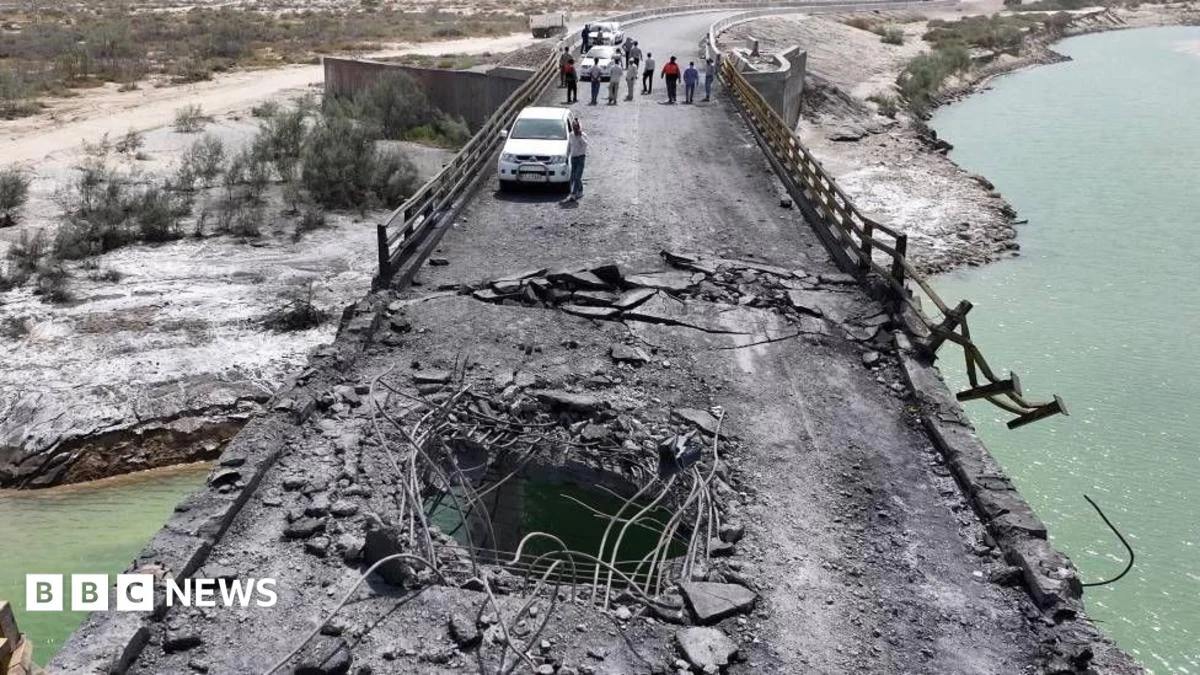
In a significant escalation of hostilities, the United States military confirmed it had carried out the seventh consecutive night of strikes against targets within Iran, commencing after President Donald Trump declared the temporary ceasefire agreement, brokered in June to facilitate peace talks, as effectively "over." This latest round of military action, which concluded at 21:30 ET (02:30 BST) after several hours, saw US Central Command (Centcom) forces meticulously targeting what they described as "surveillance sites, military logistics infrastructure, underground weapons storage, and maritime capabilities." The announcement from Centcom detailed a comprehensive military operation utilizing a potent array of assets, including fighter aircraft, aerial drones, and warships, underscoring the scale and strategic intent behind the sustained strikes.
The immediate fallout of the US offensive was a swift and forceful response from Iran, which declared it had retaliated by targeting US allies across the region. Kuwait, a key regional partner of the United States, reported that its critical infrastructure had been hit, specifically a power plant and an oil facility. The Kuwaiti Ministry of Electricity and Water issued a statement confirming that "another electricity and water distillation plant was targeted by a hostile attack that led to a fire erupting in one of the plant’s components," resulting in the deactivation of some power generation units. The severity of the impact on Kuwait’s energy sector was further highlighted later on Saturday when the nation’s state news agency reported that an oil facility had sustained significant damage, and several individuals had been injured in what were described as "repeated Iranian attacks." This direct targeting of a third-party nation demonstrates a deliberate Iranian strategy to project its response beyond immediate US military installations and into the broader regional security architecture.
The ripple effects of the escalating conflict extended to Jordan and Bahrain as well. The Jordanian military announced it had successfully intercepted 10 Iranian missiles that were fired into its airspace overnight. While no damage was reported from these interceptions, the event underscores the expanding reach of Iranian retaliatory actions and the heightened risk to regional stability. Similarly, Bahrain reported that its air defenses had "thwarted" Iranian attacks, indicating a coordinated effort by Iran to strike across multiple fronts. These incidents collectively paint a grim picture of a rapidly deteriorating security environment in the Middle East, with the potential for wider regional conflagration.
Evidence of the impact of the US strikes within Iran has also begun to emerge. Explosions were reportedly heard in the central city of Yazd, as well as on Qeshm island and at the port of Bandar Abbas, strategic locations situated adjacent to the critical Strait of Hormuz. BBC Persian has independently verified the authenticity of two video recordings that depict damage and debris scattered on and around the twin Shahid Mirzaei tunnels, a vital transportation artery north of Bandar Abbas. Local authorities further reported that an attack on electricity facilities and desalination pumps at a plant near Jask had had a devastating impact on the local population, leaving approximately 10,000 people across 20 villages without access to drinking water. This highlights the humanitarian consequences of the conflict, with civilian populations bearing the brunt of the escalating military actions. Moreover, the disruption to essential services has been widespread, with more than 100 telecommunications masts knocked out of service, crippling landline, mobile, and internet connectivity in northern Hormozgan province. This widespread communication blackout not only isolates communities but also hinders the flow of accurate information and emergency response efforts.
The context for these renewed hostilities lies in the collapse of a fragile ceasefire agreement. The US and Iran had initially agreed to a cessation of hostilities in June, a move intended to create a conducive environment for talks aimed at resolving the protracted war. While the ceasefire was largely observed, it was periodically tested by Iranian actions, including attacks on oil tankers, which Tehran claimed were aimed at enforcing its demands for ships to seek authorization before transiting the Strait of Hormuz. These Iranian incursions into maritime security were met with US strikes against Iranian sites, creating a cyclical pattern of escalation. However, the diplomatic efforts to achieve a lasting resolution appeared to falter, with no significant progress reported. This impasse ultimately led President Trump to declare the ceasefire officially over last week, paving the way for the current intensified military operations.
Since the breakdown of the ceasefire, the US has not only resumed its strikes on Iranian targets but has also reimposed a naval blockade of Iranian ports. This blockade further tightens the economic and strategic noose around Iran, aiming to restrict its maritime activities and exert maximum pressure. In response, Iran has declared the Strait of Hormuz closed to shipping, a move that has brought traffic in the vital waterway to a virtual standstill. The significance of the Strait of Hormuz cannot be overstated; it is a critical chokepoint through which an estimated one-fifth of the world’s oil and liquefied natural gas transits. The head of the International Energy Agency, Fatih Birol, has publicly expressed grave concerns about the potential impact of this blockade on global energy supplies, warning of potential price spikes and disruptions to the international energy market.
Amidst the escalating rhetoric and military actions, the US military has also actively refuted Iranian claims regarding specific incidents. Centcom specifically denied a report published by Iran’s Fars news agency alleging that two oil tankers had "exploded and caught fire while passing through a mined route south of the Strait of Hormuz." Centcom’s statement was unequivocal: "Like most IRGC claims, this is false." This highlights the ongoing information war accompanying the kinetic conflict, with both sides seeking to shape the narrative and control public perception.
The Iranian military’s claims on Friday extended to alleging attacks on multiple US military facilities across the Gulf region, including installations in Kuwait, Bahrain, and Jordan, and notably, for the first time, in Syria. The US has denied these claims regarding Syria. However, sources speaking to the BBC’s US partner, CBS News, have indicated that several American service members sustained injuries during Iranian attacks on two Jordanian bases over the preceding week, suggesting a more tangible impact on US forces than initially acknowledged by official US statements on the broader conflict.
Conversely, the US has vehemently denied Tehran’s earlier assertions that American forces had targeted civilian infrastructure within Iran, including bridges, a train station, and an airport. However, BBC Verify and BBC Persian have corroborated footage depicting damage to the Gariveh Bridge. Nighttime videos showed a ball of flame erupting on top of the bridge, while daylight images revealed a section of the road crumbled and surrounded by rubble. Provincial authorities in the affected region, Hormozgan province, reported that seven individuals had lost their lives in these alleged attacks, adding a somber human toll to the conflict. In response to these accusations, a White House spokesperson reiterated to the BBC that the US had "carried out strikes exclusively on military targets, including military logistics infrastructure." This underscores the US’s stated commitment to avoiding civilian casualties, though the evidence presented by BBC Verify and BBC Persian suggests potential discrepancies.
Further details emerged regarding specific US strikes, with the US military announcing the destruction of a control tower in the port of Chabahar. Defense Secretary Pete Hegseth even shared an image of the tower collapsing as it was struck, with Centcom asserting that the tower was an integral part of an IRGC (Islamic Revolutionary Guard Corps) maritime surveillance network. This specific targeting of surveillance infrastructure indicates a strategic objective to degrade Iran’s ability to monitor and control maritime traffic, particularly in the sensitive Strait of Hormuz. The sustained US military operations, coupled with Iran’s retaliatory actions and its closure of the Strait, have created a volatile and unpredictable environment. The potential for miscalculation and further escalation remains exceptionally high, with significant implications for regional security and global energy markets. The international community watches with growing concern as the conflict between the US and Iran intensifies, threatening to destabilize an already fragile geopolitical landscape.
