
 By admin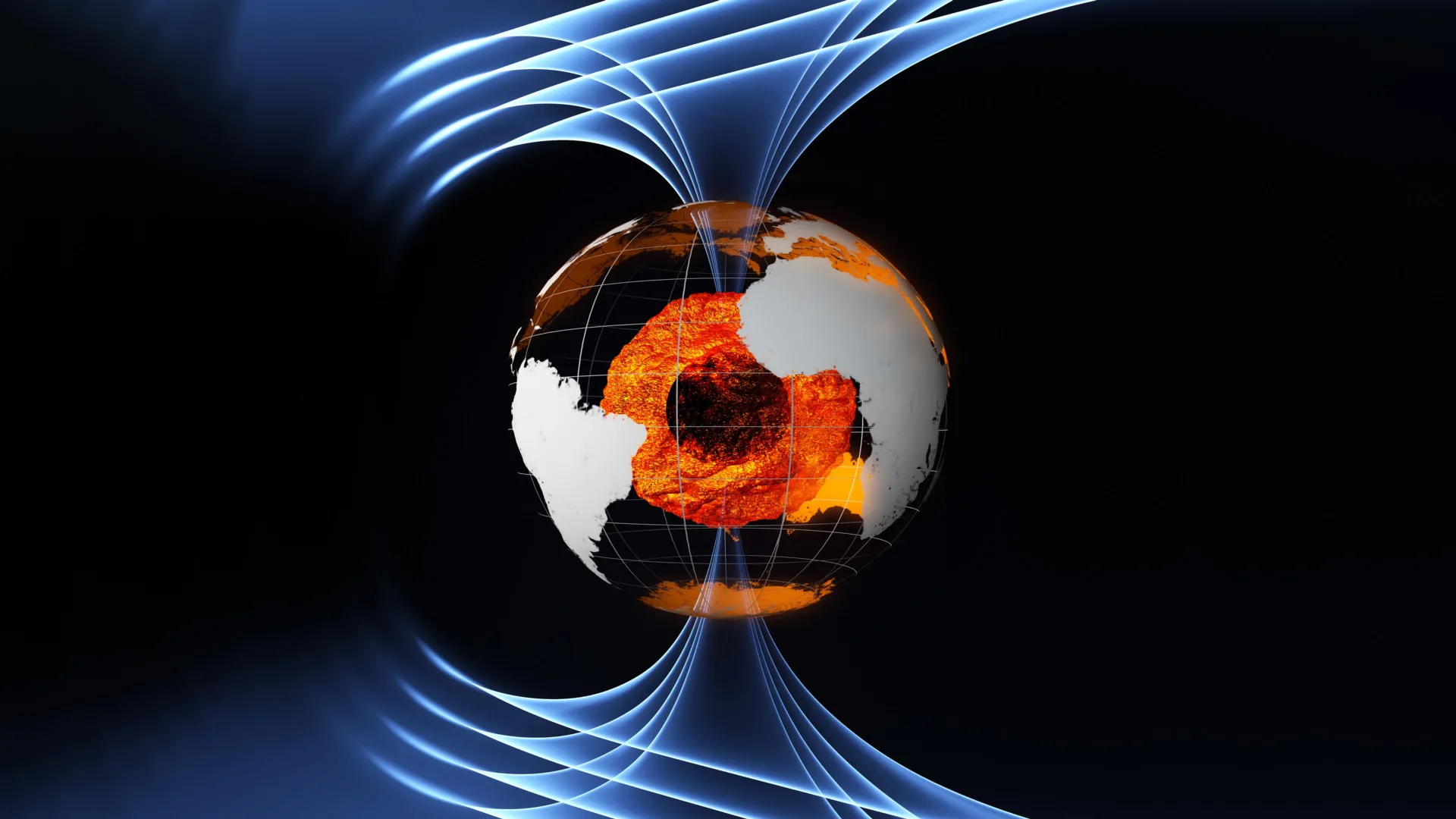
The Unseen Engine: Earth’s Geodynamo and its Enigma
At approximately 2,200 kilometers below Earth’s surface lies the molten outer core, a vast ocean of superheated, electrically conducting liquid iron. This colossal subterranean ocean is not static; its ceaseless, convective movements are the powerhouse behind Earth’s geomagnetic field. This incredible phenomenon, known as the geodynamo, acts as a protective shield, deflecting harmful charged particles from the Sun and enabling life to thrive on our planet. For decades, scientific consensus, built upon meticulous observations of small, subtle variations in this geomagnetic field, pointed to a largely consistent pattern: the bulk of the outer core’s flow exhibited a predominantly westward drift. This slow, majestic procession was considered a relatively stable characteristic of the geodynamo, evolving gradually over timescales of centuries to millennia. Geoscientists have long relied on this understanding to model the Earth’s interior and predict the behavior of its magnetic field. The westward drift was not merely an interesting observation; it was a cornerstone of our models for core dynamics, reflecting the interplay of thermal convection, the Coriolis force (arising from Earth’s rotation), and electromagnetic forces within the conductive fluid.
A Dramatic Shift: The Pacific Reversal
However, this long-standing pattern was dramatically disrupted in 2010. Beneath the vast expanse of the Pacific Ocean, a substantial region of this molten material abruptly ceased its gentle westward progression. Instead, it initiated a vigorous eastward flow. This sudden and powerful reversal was not merely a subtle alteration but a profound deviation from the expected behavior, catching the scientific community by surprise. The underlying cause of this unprecedented directional change remains an enigma, prompting a concerted effort among researchers to decipher the complex forces at play within Earth’s inaccessible core. The scale of this reversal, involving a significant portion of the outer core’s fluid dynamics in a relatively short period, challenged the prevailing view of a more sluggish, stable core circulation. It suggested that localized, intense phenomena could exert a far greater influence on the global geodynamo than previously conceived, injecting an unexpected element of rapid variability into our understanding of deep Earth processes.
Peering Deep with Satellites: Unveiling Core Dynamics from Orbit
To unravel the intricacies of this extraordinary event, scientists turned to advanced space-based observatories. Satellite missions, particularly ESA’s Swarm and CryoSat, along with data from Germany’s CHAMP mission and Denmark’s Ørsted mission, have provided an invaluable vantage point for studying Earth’s magnetic field with unparalleled precision. These specialized satellites are equipped with highly sensitive magnetometers capable of detecting minute changes in the magnetic field emanating from various sources, including the deep interior. The data collection for this particular study spanned a considerable period, from 1997 through 2025, offering a continuous and detailed timeline of magnetic field evolution both before and after the 2010 reversal.
ESA’s Swarm constellation, launched in 2013, has been particularly crucial. Comprising three identical satellites orbiting in carefully coordinated formations, Swarm’s primary mission is to precisely map and monitor Earth’s magnetic field. Its unique orbital configuration allows researchers to effectively separate magnetic signals originating from the core from those generated by other sources, such as the crust, oceans, ionosphere, and magnetosphere. This capability is paramount because the magnetic field measured at the surface or in low Earth orbit is a composite of these various contributions. By meticulously filtering out the "noise" from shallower sources, Swarm provides an exceptionally clear "view" of the geodynamo’s activity. CryoSat, while primarily designed for ice sheet monitoring, also carries a magnetometer that contributes to the broader understanding of Earth’s magnetic field, showcasing the synergistic power of diverse satellite missions. The combination of these datasets allowed researchers to reconstruct changing flow patterns near the core-mantle boundary with unprecedented accuracy, enabling them to identify the abrupt changes directly linked to the Pacific reversal and other significant geomagnetic events, such as the 2017 geomagnetic jerk.
Unveiling the Dynamics: The Study’s Groundbreaking Findings
The comprehensive analysis, published in the Journal of Studies of Earth’s Deep Interior, synthesized ground-based observations with the wealth of satellite measurements. The findings confirmed that a broad area of iron-rich fluid situated beneath the equatorial Pacific indeed transitioned from a weak westward flow to a strong eastward flow in 2010. This was a direct observation of a major shift in the core’s dynamics, not merely an inference. The speed and intensity of this reversal were particularly striking.
Historically, scientists had largely perceived the large-scale circulation within the outer core as a relatively stable system, evolving over very long geological timescales. The sudden and pronounced change observed beneath the Pacific dramatically challenged this long-held assumption. It strongly suggests that the geodynamo system is capable of far more rapid and localized variations than previously believed, underscoring its inherent complexity and dynamism. These groundbreaking findings offer crucial new clues about the turbulent motions that are fundamentally responsible for producing Earth’s magnetic field. Furthermore, they open tantalizing avenues for investigating potential connections between the vigorous activity within the outer core and changes occurring even deeper inside the planet, hinting at a more interconnected and dynamic deep Earth system than previously imagined.
Challenging Paradigms and New Questions
Frederik Dahl Madsen, the lead author of the study from the University of Edinburgh’s School of Geosciences, articulated the profound implications of these findings. "The large-scale flow reversal beneath the Pacific raises new questions about the behavior of Earth’s deep interior that challenge our existing models," Madsen stated. "Scientists now face the critical task of understanding whether this reversal represents a short-lived fluctuation, part of a repeating oscillation within the geodynamo, or if it signifies a new stable equilibrium for core circulation. The answer will have significant ramifications for our understanding of Earth’s magnetic field evolution and its long-term stability." The distinction between these possibilities is not academic; a short-lived fluctuation might imply a transient perturbation, an oscillation would suggest a predictable, albeit complex, cycle, while a new stable equilibrium would indicate a fundamental shift in the core’s long-term behavior. Madsen emphasized that "continued monitoring will be absolutely essential to determine how the flow evolves over the coming years and to discern which of these scenarios is unfolding."
Interconnected Depths: Links to the Inner Core
The research extended its analytical reach even further, exploring potential interdependencies within the Earth’s deepest layers. Madsen pointed out that "the research model indicates that the strong eastward flow beneath the Pacific has notably weakened since 2020," suggesting a dynamic, rather than static, post-reversal behavior. He further added a compelling hypothesis: "The rise of the strong eastward flow in the Pacific is contemporary with a change in behavior in the inner core, as inferred from geodesy and seismology. We hypothesize that these changes in the deep interior are intimately associated with the changes in flow beneath the Pacific."
This proposed link is particularly exciting. Geodesy, the science of measuring Earth’s shape, gravity field, and rotation, and seismology, the study of earthquakes and seismic waves, provide independent means to probe the solid inner core. Changes detected through these methods, such as variations in the inner core’s rotation rate or seismic wave propagation anomalies, could suggest a coupling between the inner and outer core. This implies that events in one region might trigger or be influenced by events in another, suggesting a more integrated and interactive deep Earth system than previously theorized. The core-mantle boundary (CMB), the interface between the liquid outer core and the solid lower mantle, is considered a critical region for deep Earth dynamics, where heat transfer and chemical interactions could also play a role in modulating core flow and influencing the entire planetary system.
The Power of Persistent Observation: Detecting Earth’s Molten Core From Space
The continuous, global coverage provided by satellite missions like Swarm is a game-changer compared to traditional ground-based magnetic observatories, which offer only localized measurements. As ESA’s Swarm Mission Manager, Anja Stromme, highlighted, "Although Swarm was launched after the dramatic reversal event of 2010, it has provided high-precision data that tell us about Earth’s inner core in the period that followed, offering a crucial post-event perspective." She underscored the mission’s enduring value: "Importantly, Swarm provides continuous global coverage over many years, allowing scientists to track how core dynamics evolve over time rather than relying only on sparse ground-based magnetic observatories. Long-duration satellite magnetic measurements allow researchers to follow changes in the geodynamo in near-real-time and significantly improve models of Earth’s magnetic field evolution. Future observations from missions such as Swarm will play a crucial role in continuing this vital research." This sustained monitoring is not just about detecting discrete events; it’s about building a comprehensive, time-resolved understanding of the geodynamo’s ongoing evolution.
Towards a Cyclical Understanding?
Beyond the dramatic reversal itself, the satellite measurements have revealed even finer details of the core’s turbulent behavior. They have identified "wave-like accelerations" and "rapidly shifting flow structures" that would have been exceedingly difficult, if not impossible, to detect in noisier or less comprehensive datasets. These intricate patterns suggest a highly dynamic environment, where localized perturbations propagate and interact.
Crucially, the findings indicate that the strong eastward flow, after reaching its peak intensity several years ago, may now be weakening. This observed deceleration raises the intriguing possibility that the 2010 reversal was not a permanent shift but rather a temporary phenomenon, or perhaps even a component of a longer, inherent natural cycle within the outer core. If confirmed, such a cycle would add another layer of complexity to the geodynamo, suggesting that the core operates with internal rhythms and feedback loops that are still largely uncharacterized. Understanding these cycles would be vital for developing more accurate predictive models of Earth’s magnetic field.
Why It Matters: Protecting Our World
While these profound events unfold thousands of kilometers beneath our feet and pose no immediate, direct threat to human populations or the planet’s climate, their study is absolutely central to comprehending the fundamental processes that govern Earth’s existence. The movement of liquid iron in the outer core is, after all, the generator of the very magnetic field that envelops our planet, shielding it from the constant onslaught of charged particles released by the Sun – the solar wind. Without this indispensable protective field, Earth’s atmosphere would be gradually stripped away, and our increasingly interconnected technological systems, from satellites to power grids, would face much greater exposure to the destructive forces of harmful solar radiation.
Earth’s magnetic field is not static; it is a perpetually changing entity. As the intricate flows within the core evolve, the magnetic field itself gradually shifts, both in strength and orientation. These continuous changes have tangible impacts on a variety of critical applications. They can influence global navigation systems, affect the reliability and lifespan of spacecraft operations, and are essential inputs for models used to predict and study "space weather" – the conditions in space that can affect Earth and its technological systems. Therefore, learning how and why the outer core changes its behavior is not merely an academic pursuit; it is of paramount importance for both fundamental scientific research and a broad spectrum of practical applications that underpin modern society.
According to Elisabetta Iorfida, ESA’s Swarm Mission Scientist, the Pacific reversal represents a pivotal moment in geophysics. She noted, "This study profoundly challenges the long-standing idea that a stable, predominantly westward circulation dominates the outer core. It vividly demonstrates that regional changes can emerge with astonishing rapidity, within the span of just a single decade." Iorfida concluded with a forward-looking perspective: "This research raises intriguing questions about how Earth’s deepest layers are dynamically connected. As the magnetic field continues its relentless evolution, satellite missions are providing an increasingly detailed and unprecedented view of the dynamic processes unfolding deep inside our planet, continually revealing that Earth’s core may be far more variable, complex, and interconnected than once believed." This ongoing journey of discovery into Earth’s fiery heart promises to continue yielding astonishing insights into the very nature of our living planet.
