
 By admin
The landscape of digital travel planning is undergoing a seismic shift as generative artificial intelligence moves beyond simple text generation and into the realm of "agentic" utility. For years, travelers have experimented with Large Language Models (LLMs) like OpenAI’s ChatGPT and Anthropic’s Claude to brainstorm itineraries or draft complaint letters. However, these tools have historically been hampered by a significant limitation: they lacked access to a user’s specific, real-time travel data, loyalty balances, and historical preferences. This gap often resulted in "hallucinations"—the generation of plausible but factually incorrect information—or generic advice that failed to account for a traveler’s elite status or point stockpiles.
Addressing this fragmentation, Gondola AI—a sophisticated data platform known within the industry for powering monthly hotel point valuations for major travel outlets—has officially launched its Model Context Protocol (MCP) integration. This development marks a pivotal moment in the evolution of AI travel assistants, allowing users to connect their personal travel ecosystems directly to the "brains" of the world’s most powerful AI models. By bridging the gap between raw computing power and personal data, Gondola AI is attempting to transform the AI chatbot from a mere search engine replacement into a highly specialized travel concierge.

To understand the significance of this launch, one must first understand the underlying technology. The Model Context Protocol (MCP) is an open standard designed to enable AI applications to seamlessly connect to external tools and data repositories. Think of the AI model as a brilliant scholar who has read every book in the world but has no access to your personal mail or bank statements. MCP acts as the secure pipeline that hands that scholar your specific files, allowing them to provide advice that is not just generally smart, but specifically relevant to your life. In the context of Gondola AI, this means ChatGPT or Claude can now "see" your home airport, your preferred airline carriers, your Hyatt Globalist status, and the 150,000 Delta SkyMiles sitting in your account.
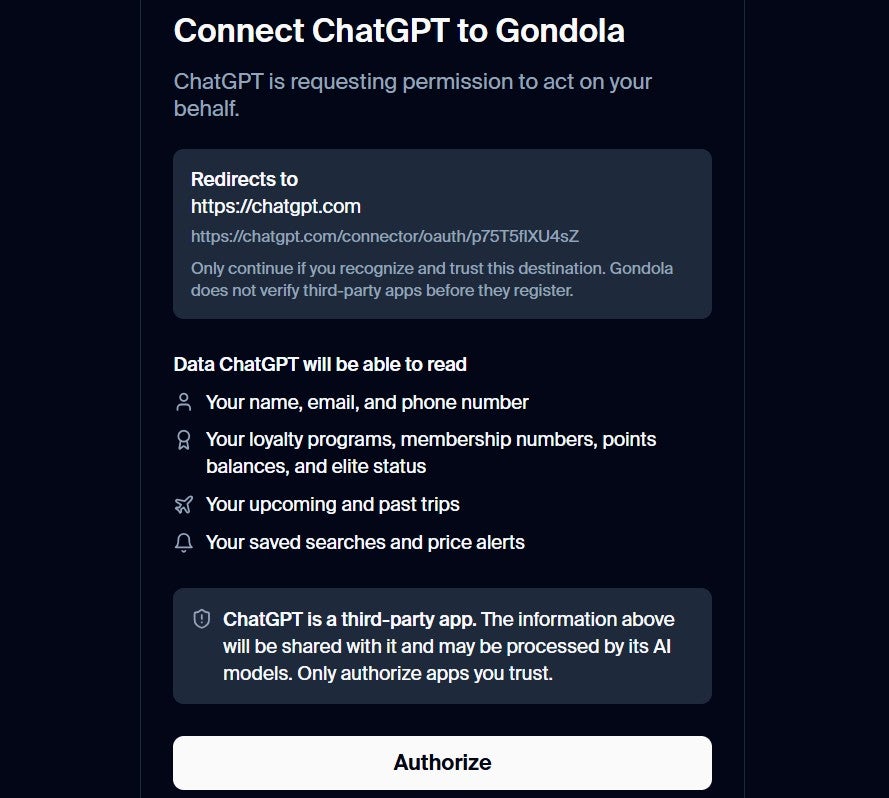
The setup process for the Gondola MCP integration is designed with a focus on user experience, utilizing OAuth—an industry-standard protocol for authorization—to ensure that users maintain control over their data. Once a traveler authorizes Gondola to scan and parse travel-related communications in their email accounts, the MCP acts as a bridge. For ChatGPT users, the installation involves a simple plugin activation through the ChatGPT store. Once authorized, the AI gains a new "vision" into the user’s Gondola profile, which tracks everything from upcoming flight confirmations to historical hotel stays.
In practical application, the utility of this integration becomes immediately apparent. During a week-long trial of the system, the capabilities of the Gondola-enhanced ChatGPT were put to the test. Traditional AI prompts like "find me a hotel in London" usually yield a list of popular tourist spots. However, with the Gondola MCP enabled, the prompt can be much more nuanced: "Based on my current hotel point balances and my preference for boutique properties, where should I stay in London for three nights in October?"

The results of such queries reveal the depth of the integration. Because Gondola tracks point valuations—calculating, for instance, that a World of Hyatt point is typically worth significantly more than a Hilton Honors point—the AI can perform a real-time cost-benefit analysis. It can suggest a Hyatt property where the redemption value exceeds the cash price, while simultaneously checking the user’s calendar for conflicting trips. This level of personalization was previously the exclusive domain of high-end human travel consultants or the most dedicated "points and miles" enthusiasts who spent hours cross-referencing spreadsheets.
However, the transition to AI-driven travel planning is not without its growing pains. Early testing of the Gondola MCP highlighted both the staggering potential and the current technical limitations of the medium. In some instances, the AI referenced flight details from 2022 as if they were upcoming, indicating that the data parsing algorithms occasionally struggle to distinguish between historical records and future itineraries. In other cases, the AI failed to fully leverage the benefits of a user’s elite status, such as complimentary breakfast or suite upgrades, when comparing two different hotel options.
These "misses" underscore a critical reality of the current AI era: these tools are collaborative. The Gondola MCP is designed to learn over time. As users interact with the agent, explicitly stating preferences—such as a disdain for layovers longer than three hours or a preference for Marriott over IHG—the system refines the user’s "travel profile." After several days of consistent use, the recommendations provided by the AI became noticeably more aligned with the user’s actual travel style. The AI began to prioritize properties with high-speed Wi-Fi and fitness centers, reflecting preferences mentioned in previous conversations.
The broader implications for the travel industry are profound. We are moving away from the era of "search" and toward the era of "action." Major players like Expedia and Booking.com have already integrated basic AI search features into their platforms, and Hilton recently debuted an AI planning tool aimed at helping guests discover properties. Yet, Gondola’s approach is unique because it is platform-agnostic. Rather than being tied to a single hotel brand or booking engine, Gondola acts as a central intelligence hub that works across the entire travel spectrum. This independence allows the AI to provide more objective advice, such as suggesting a traveler use their points at a Marriott property even if they are currently browsing a Hilton-branded tool.
From a data security perspective, the integration raises valid questions that every modern traveler must weigh. To function at peak efficiency, Gondola requires access to sensitive information, including email headers and loyalty account details. While Gondola emphasizes that access is granted via secure OAuth tokens and can be revoked at any moment through a "Connected Agents" dashboard, the "privacy vs. utility" trade-off remains a central theme. For many, the convenience of having an AI that knows their Delta SkyMiles balance and can automatically draft a rebooking request during a flight cancellation is worth the data sharing. For others, the idea of an AI having a comprehensive map of their past and future movements may feel like a step too far.
Industry experts suggest that the Gondola MCP launch is just the first wave of a larger movement. As more travel providers adopt the Model Context Protocol, we may soon see a world where your AI agent doesn’t just suggest a hotel, but actually completes the booking, applies your suite night awards, and coordinates the Uber pickup from the airport—all while ensuring the entire trip stays within your preferred budget and loyalty ecosystem.
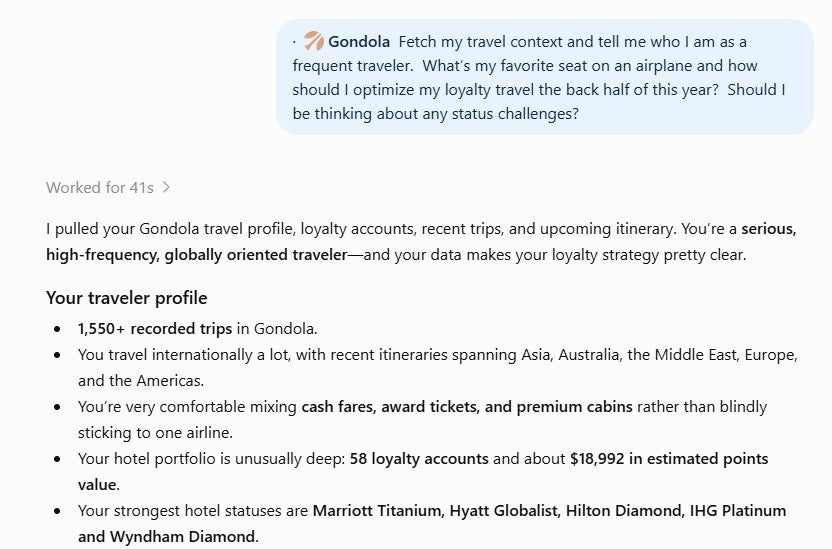
For the "power traveler"—the individual who manages multiple credit cards, elite statuses, and complex itineraries—the Gondola MCP integration represents a significant reduction in cognitive load. Instead of logging into five different airline apps to check balances, the user can simply ask their AI, "Which of my loyalty programs gives me the best value for a business class seat to Tokyo next June?" The AI, powered by Gondola’s real-time valuations and the user’s specific data, provides a definitive answer in seconds.
In conclusion, while the technology is still in its nascent stages and prone to occasional errors, the Gondola AI MCP integration for ChatGPT and Claude is a formidable tool for the modern traveler. It represents a shift toward a more intelligent, personalized, and data-driven way of navigating the world. As the system continues to ingest more data and the underlying AI models become more adept at handling complex logic, the "AI travel agent" may finally move from a science-fiction concept to an essential travel companion. For those already immersed in the world of generative AI, the Gondola integration is a must-try, offering a glimpse into a future where travel planning is as simple as having a conversation with a well-informed friend who happens to have a perfect memory of every trip you’ve ever taken.
