
 By admin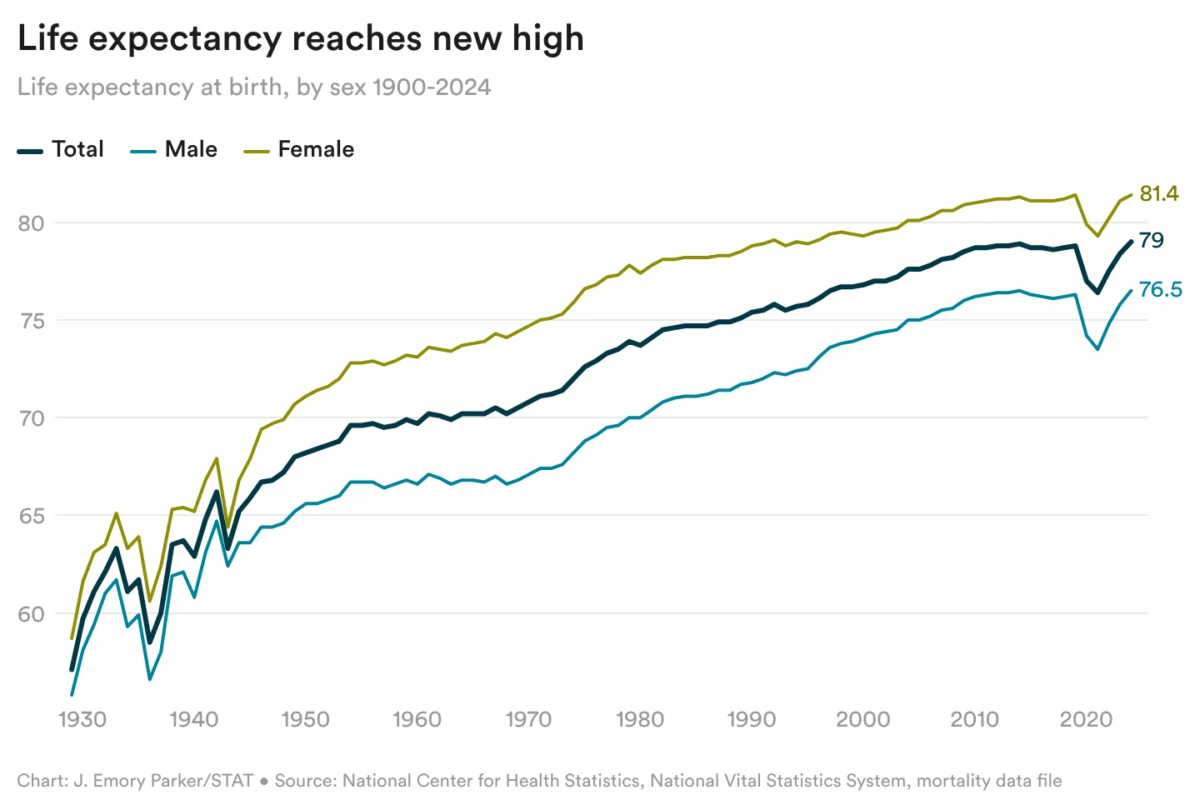
In a significant milestone for public health, American life expectancy at birth has officially surpassed pre-pandemic levels, reaching a new high of 79 years in 2024. According to the latest data released by the CDC’s National Center for Health Statistics (NCHS), this figure represents a notable recovery from the sharp declines witnessed during the height of the COVID-19 pandemic. Specifically, the 2024 estimate shows an increase of 0.6 years from 2023 and a 0.2-year improvement over 2019, the final full year before the global health crisis began to erode decades of progress in longevity. The rebound is attributed to a multifaceted decline in mortality across several key categories. While the primary driver was the substantial decrease in deaths directly linked to COVID-19, the NCHS report highlights that improvements in other areas were equally critical. Unintentional injuries—a category that includes drug overdoses—saw the most significant decrease, alongside downward trends in deaths caused by heart disease, cancer, and homicide. This data suggests that while the healthcare system remains under strain, the immediate existential threat posed by the pandemic has receded, allowing broader public health initiatives and medical advancements to once again move the needle on national longevity.
However, this statistical triumph arrives at a moment of profound political and administrative turbulence within the federal agencies that oversee medical research and public health. A controversy is currently unfolding at the White House Office of Management and Budget (OMB) regarding a proposed regulation that would subject federal science funding to unprecedented levels of political intervention. The proposal has drawn sharp criticism from the scientific community, but recent reports suggest that the public’s ability to weigh in on the matter is being quietly curtailed. Anil Oza of STAT reports that at least 42 public comments submitted regarding this regulation have been removed from the official record without explanation. Among these deleted comments was a poignant plea from Magdeleine Bradford-Butcher, whose daughter lives with cystic fibrosis. Bradford-Butcher’s comment was specifically addressed to Russell Vought, the director of the OMB, whose own daughter also suffers from the same condition. Both children have benefited from Trikafta, a breakthrough medication whose development was heavily supported by research funded by the National Institutes of Health (NIH).
The removal of these comments—ten of which specifically mentioned the Vought family’s personal connection to federally funded research—has sparked a legal and ethical firestorm. Legal experts suggest that the selective deletion of public comments could violate the Administrative Procedure Act, which requires federal agencies to consider and respond to public input during the rulemaking process. The incident highlights a growing tension between the executive branch’s desire for tighter control over federal spending and the traditional independence of scientific agencies like the NIH. Critics argue that if political appointees gain the power to veto specific research grants based on ideological preferences rather than peer-reviewed merit, the pipeline for future medical miracles like Trikafta could be permanently obstructed. For families like the Bradford-Butchers, the stakes are not merely academic; they are existential. The deletion of her comment, she argues, represents a silencing of the very people whose lives depend on the stability of the federal research apparatus.
As the debate over the future of science funding intensifies, hospitals are turning to increasingly sophisticated technologies to manage internal crises, specifically the persistent issue of drug diversion. Drug diversion—the theft or unauthorized use of controlled substances by healthcare professionals—is a pervasive problem that compromises patient safety and contributes to the broader opioid epidemic. Chris Fortier, former chief pharmacy officer at Massachusetts General Hospital, notes that diversion is an omnipresent reality in the clinical setting, yet it remains notoriously difficult to detect through traditional manual audits. In response, a growing number of health systems are adopting artificial intelligence and machine learning platforms designed to flag suspicious behavior in real-time.
A recent study conducted by Invistics, a firm specializing in diversion detection software, claims that AI-driven systems can identify drug theft at significantly higher rates and with greater speed than human supervisors. These systems work by aggregating data from automated dispensing cabinets, electronic health records, and employee time clocks to identify anomalies, such as a nurse who consistently pulls higher doses of fentanyl than their peers or who frequently accesses the medication room on their days off. However, the implementation of these "digital sentries" is not without controversy. Outside experts caution that while AI can provide valuable leads, it is not a panacea. There are concerns regarding "algorithmic bias" and the potential for false positives that could unfairly tarnish a clinician’s reputation or career. Furthermore, experts emphasize that AI is only as effective as the human oversight following the flag. Without a robust, transparent investigative process, the technology risks becoming a tool for workplace surveillance rather than a legitimate safeguard for patient health.

The technological evolution of hospital management is occurring against a backdrop of sweeping changes to the national healthcare safety net. The impacts of recent and pending Medicaid cuts are beginning to reshape the landscape of American medicine, particularly in rural regions where the margin for error is razor-thin. In states like Maine, which possesses the highest proportion of rural residents in the country and an aging population heavily reliant on Medicare and Medicaid, the outlook is increasingly grim. STAT’s "Unraveled" series, led by reporter Daniel Payne, has documented a growing sense of alarm among healthcare executives and providers in these areas. In Maine, often referred to as "Vacationland," the reality for permanent residents is one of declining access to essential services.
Health systems in these rural corridors are already reporting a contraction of services in anticipation of further funding reductions. Tom Judge, the founding executive director of LifeFlight of Maine, observes that the capabilities of small, community-based hospitals are in a state of steady decline even as the demand for care continues to climb. This mismatch between supply and demand is creating "healthcare deserts," where residents must travel hours for specialized care or even basic emergency services. The "Unraveled" series explores how these cuts—unprecedented in their scale—threaten to dismantle the infrastructure that supports the nation’s most vulnerable populations. From Louisiana to the Northeast, the story is the same: as federal support wanes, the burden of care shifts to local systems that are ill-equipped to handle the financial strain, leading to hospital closures and a measurable decrease in the quality of rural life.
While policy debates and technological shifts dominate the headlines, researchers are also looking toward unique geographical environments to solve emerging public health threats. On Martha’s Vineyard, a first-of-its-kind study is being launched by researchers from Mass General Brigham to investigate the mysterious rise of alpha-gal syndrome. Known commonly as the "red meat allergy," alpha-gal is a tickborne condition that triggers a severe, often life-threatening allergic reaction to the sugar molecule galactose-alpha-1,3-galactose found in most mammals. The syndrome has seen an explosive rise across the United States over the last decade, but Martha’s Vineyard has become a particular hotspot for the condition. The study aims to recruit 300 island residents and follow them for two years to determine why certain individuals develop the allergy after a tick bite while others do not.
This research follows in the footsteps of other groundbreaking ecological and medical experiments on Massachusetts islands. On the neighboring island of Nantucket, the "Mice Against Ticks" project continues to push the boundaries of genetic engineering. Led by Kevin Esvelt of MIT, the project proposes to release tens of thousands of genetically modified mice into the wild to break the cycle of Lyme disease transmission. By using CRISPR technology to make mice immune to the Lyme bacterium, researchers hope to significantly reduce the number of infected ticks that bite humans. The project is notable not only for its scientific ambition but for its commitment to "community-guided science," where residents have a direct say in the progression of the research. Currently, the team is testing the modified mice on a remote, uninhabited island to ensure ecological safety before considering a wider release on Nantucket or Martha’s Vineyard.
Finally, the medical community is being asked to reconsider how it approaches preventative care for the oldest and most vulnerable members of society. In a compelling First Opinion essay for STAT, cancer epidemiologist Kim Johnson reflects on the death of her 78-year-old aunt, who succumbed to stage 4 breast cancer just weeks after a surprise diagnosis. Johnson’s aunt had been a resident of a long-term care facility, a setting where national cancer screening guidelines are often vague or non-existent. Johnson argues that the current medical literature focuses too heavily on the potential "harms" of screening the elderly—such as the physical toll of biopsies or the psychological stress of over-diagnosis—while neglecting the subset of residents who could still derive meaningful benefit from early detection.
Her aunt’s experience serves as a catalyst for a broader discussion on ageism in clinical guidelines. Johnson contends that the assumption that life in a long-term care facility precludes the need for aggressive screening is a flawed one that can lead to unnecessary suffering. She calls for a more nuanced, individualized approach to geriatric oncology that balances quality of life with the right to diagnostic clarity. As life expectancy continues its upward trajectory, the medical establishment must grapple with these complex ethical questions, ensuring that the years added to the American lifespan are accompanied by the dignity and care that every patient deserves, regardless of their age or residence. Together, these stories paint a picture of a healthcare system at a crossroads—one that is celebrating historic gains in longevity while simultaneously battling internal political strife, technological growing pains, and the daunting challenge of maintaining equity in a rapidly changing world.
