
 By Rifan Muazin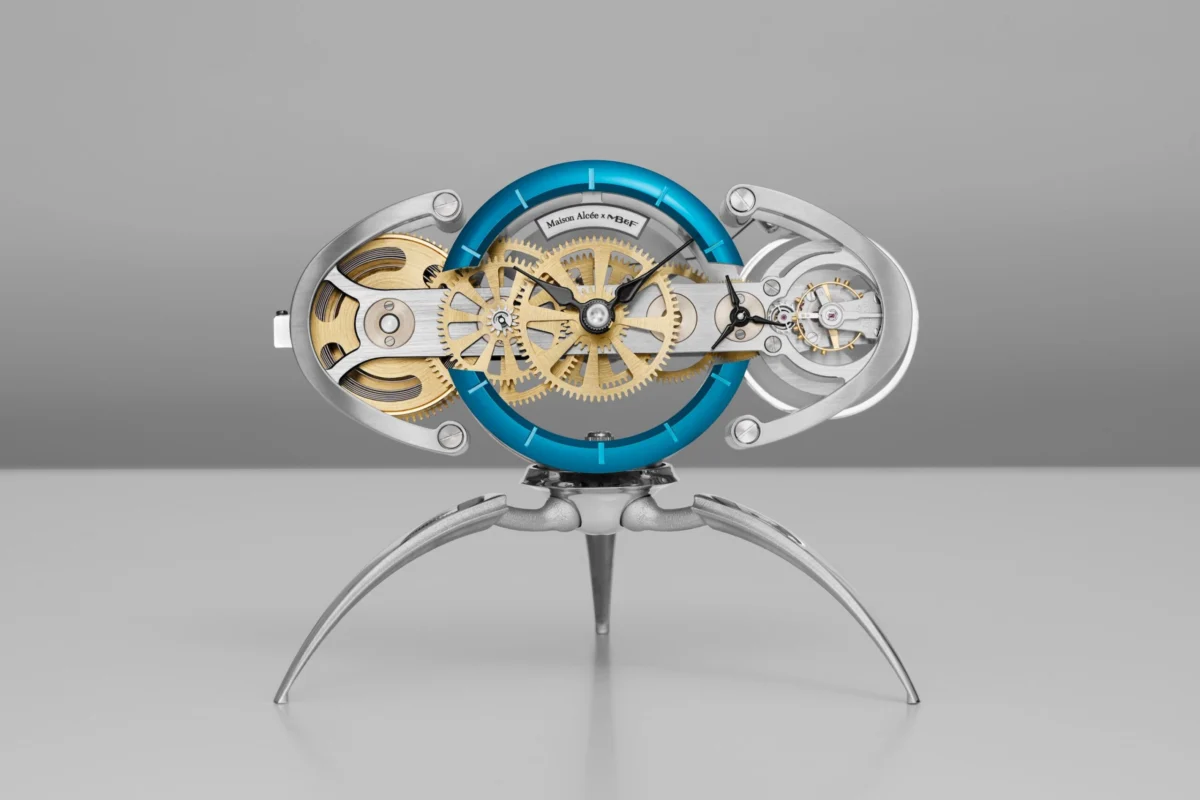
The high-end horological landscape of August 2024 is defined by a fascinating tension between the ultra-modern and the deeply traditional, a duality perfectly encapsulated by the latest curation from the "Watch Guy Watches" series. This month, the industry’s most provocative "mad scientists," MB&F, have pivoted from the wrist to the desk, challenging the very definition of luxury consumption by asking their clients to build their own five-figure timepieces. Simultaneously, Tiffany & Co. continues its aggressive push into serious watchmaking under LVMH stewardship, while Atelier Wen and Urwerk prove that the future of the industry lies in the hands of independent creators who refuse to follow the established rules of Swiss hegemony.
At the forefront of this month’s releases is the Nostromo, a desk clock born from a collaboration between MB&F and the nascent French clockmaker Maison Alcée. To the uninitiated, the Nostromo appears to be another entry in MB&F’s long history of "horological machines"—a spindly, three-legged structure that evokes the eerie aesthetic of the USCSS Nostromo from Ridley Scott’s 1979 masterpiece, Alien. However, the $16,000 price tag comes with a catch that would be unthinkable for most luxury brands: the clock arrives in 222 separate pieces. This is not a manufacturing oversight, but the core philosophy of Maison Alcée, a brand founded in 2022 by Alcée and Benoît Montfort with the goal of demystifying the mechanics of time.

The "build-it-yourself" model represents a significant shift in the luxury market, moving away from passive ownership toward experiential engagement. For the collector, the 250-page instruction manual is not a chore, but a guided tour through the architecture of a mechanical movement. MB&F, through its M.A.D.Gallery initiative, has long sought to treat horology as kinetic art, and the Nostromo is the ultimate expression of this. The assembly process is estimated to take a "civilian" roughly ten hours. Despite its approachable DIY nature, the clock is a technical powerhouse, featuring a staggering 14-day power reserve and an integrated hour chime. Once the 222 components—including the escapement and the sub-seconds display—are meticulously joined, the entire body is designed to rotate on its three-legged base, providing a tactile and visual reward for the builder’s labor. This limited edition of 50 pieces sold out almost instantly, echoing the success of previous Maison Alcée kits and proving that there is a massive appetite for "slow horology" in an increasingly digital world.
While MB&F looks toward the stars, Tiffany & Co. is looking toward its own storied archives, albeit through a distinctly modern lens. Since its acquisition by LVMH, the legendary New York jeweler has been revitalizing its watch division, seeking to reclaim the prestige it held during the mid-20th century. The latest fruit of this effort is the Tiffany Timer Titanium Platinum, a 100-piece limited edition that serves as a sophisticated follow-up to the chronographs released earlier this year. This timepiece is a masterclass in material contrast, pairing a lightweight, sandblasted titanium case with a precious platinum bezel.
The technical heart of the Tiffany Timer is perhaps its most impressive feature: the Zenith El Primero Calibre 400. By utilizing this legendary high-frequency movement—which beats at 5 Hz (36,000 vibrations per hour)—Tiffany is signaling its commitment to horological excellence. The choice of the El Primero is a strategic one, leveraging the internal synergies of the LVMH group while providing collectors with a movement that has been a benchmark for chronographs since 1969. The design of the watch is a subtle nod to the "Bird on a Rock" motif, a signature of Tiffany’s legendary designer Jean Schlumberger. The motif is intricately rendered on the automatic winding rotor, visible through a sapphire caseback. The dial, a deep, velvety blue, is accented with the iconic Tiffany Blue, creating a color palette that is unmistakably Tiffany without being garish. This release demonstrates that Tiffany & Co. is no longer content with producing "fashion watches"; they are now a formidable player in the high-end sports chronograph market.

The conversation around global horology would be incomplete without mentioning the rise of Chinese high-end watchmaking, a movement led by Atelier Wen. Founded by French entrepreneurs Robin Tallendier and Wilfried Buiron, Atelier Wen is dedicated to elevating Chinese craftsmanship to the level of Swiss Haute Horlogerie. Their latest collaboration with the influential designer and collector William Massena of Massena LAB, the Inflection Shuò, is a testament to this mission. The watch is housed in a case made of tantalum, a rare, dense, and notoriously difficult-to-machine metal that possesses a unique bluish-grey luster.
The centerpiece of the Inflection Shuò is its handcrafted 18k gold dial, which utilizes the "tremblage" technique—a method of hand-engraving that creates a textured, shimmering surface. The dial features a "California" layout, a design characterized by a mix of Roman and Arabic numerals, originally patented by Rolex in the 1940s to improve legibility for divers. However, Atelier Wen and Massena LAB have localized this concept, replacing the Roman numerals with hand-calligraphed Chinese characters for the bottom half of the dial. This blend of Western design history and Eastern artistry is powered by a customized Girard-Perregaux Calibre GP03300, a high-end Swiss movement that provides a bridge between the two cultures. With only 10 pieces in white gold and 40 in rose gold, the Inflection Shuò is a rare artifact that challenges the traditional Eurocentric narrative of luxury watchmaking.
Finally, we turn to Urwerk, a brand that has spent the last two decades redefining how we perceive the passage of time. Founded by watchmaker Felix Baumgartner and designer Martin Frei, Urwerk is famous for its satellite complication, where wandering hour carousels replace traditional hands. Their latest "Special Project," the UR-1001 Amadeus, is a gargantuan titanium pocket watch that feels less like a timekeeper and more like a relic from a futuristic civilization. The "Amadeus" name refers to the intricate, baroque-style hand engraving that covers the titanium case, a striking contrast to the sci-fi mechanics housed within.

The UR-1001 Amadeus is not just a watch; it is a philosophical instrument designed to track "Deep Time." While most watches focus on seconds, minutes, and hours, the UR-1001 features a "Long-Term Indicator" that tracks the passage of years. One gauge measures five-year increments up to a century, at which point a separate 1,000-year linear indicator advances. This feature forces the wearer to consider their own mortality and the relative insignificance of a human lifespan against the backdrop of a millennium. It is a piece of "mechanical memento mori," reminding us that while we may own the watch, time eventually outlasts us all. Urwerk’s decision to produce only a single piece of the Amadeus ensures its status as a legendary "unicorn" in the collecting world, a one-of-one masterpiece that combines ancient decorative arts with avant-garde mechanical engineering.
The common thread across these four disparate releases is a rejection of the status quo. Whether it is through the democratization of watch assembly with MB&F, the material innovation of Tiffany, the cultural synthesis of Atelier Wen, or the philosophical depth of Urwerk, these brands are pushing the boundaries of what a timepiece can be. In an era where a smartphone provides perfect atomic time, the relevance of a mechanical watch lies in its ability to tell a story, evoke an emotion, or demonstrate a level of human skill that borders on the impossible.
As the industry moves toward the final quarter of the year, these releases set a high bar for innovation. They suggest that collectors are looking for more than just brand names; they are looking for authenticity, complexity, and a connection to the craft. The MB&F Nostromo proves that the joy of horology can be found in the act of creation; the Tiffany Timer shows that heritage can be successfully modernized; the Atelier Wen Inflection Shuò proves that excellence knows no borders; and the Urwerk UR-1001 Amadeus reminds us that time is the ultimate luxury. For the "true watch nerds," August has been a month of profound inspiration, proving once again that the heart of horology beats stronger than ever.
