
 By admin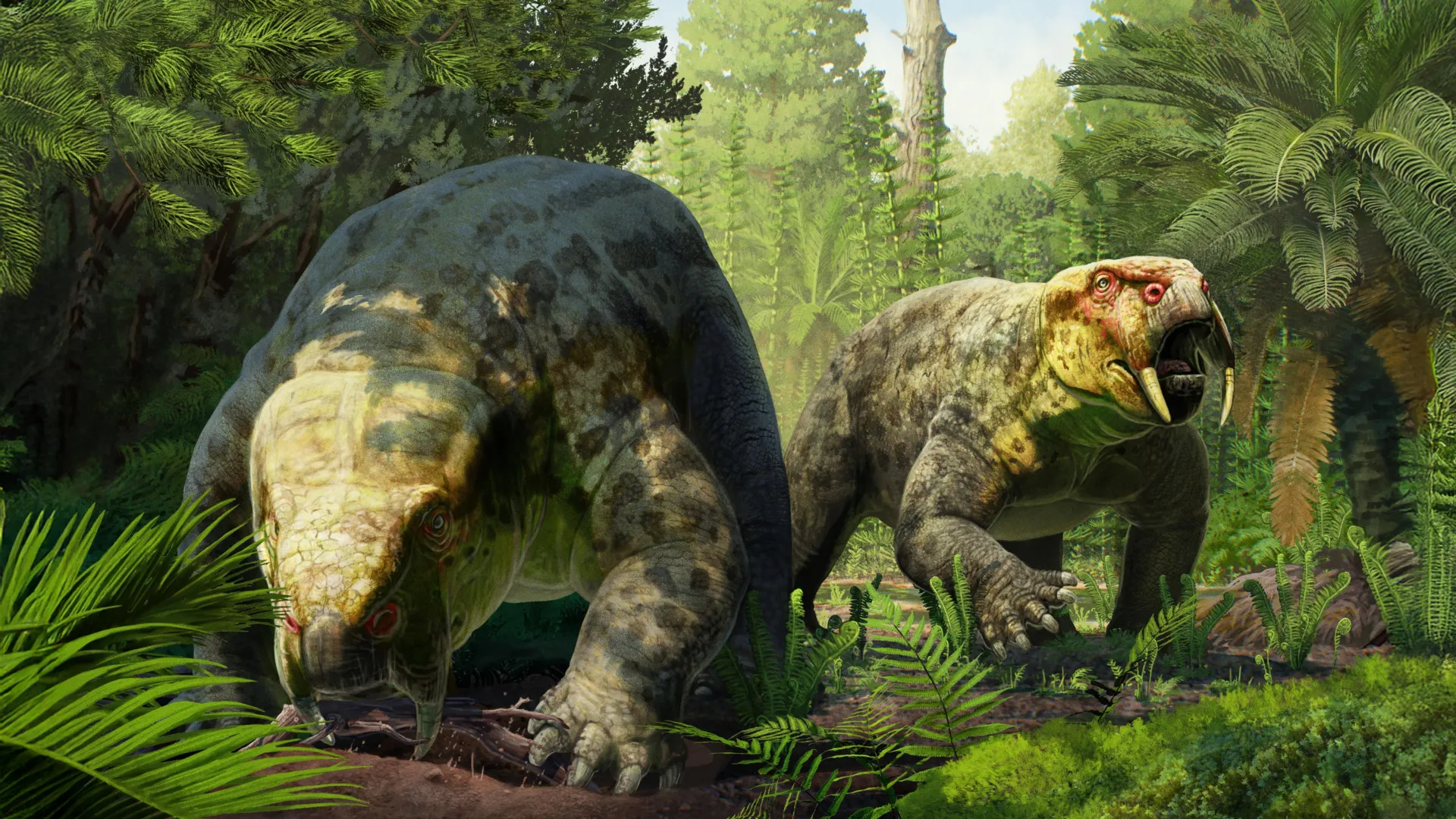
The Triassic Canvas: A World in Flux
To appreciate the profound implications of this discovery, it’s essential to understand the geological and biological context of the Triassic period. Spanning roughly 252 to 201 million years ago, the Triassic was a pivotal epoch in Earth’s history, sandwiched between the Permian-Triassic extinction event—the most severe mass extinction ever—and the Jurassic period, characterized by the rise of gigantic dinosaurs. During the Early and Middle Triassic, life slowly recovered and diversified, laying the groundwork for many modern animal groups. The supercontinent Pangea dominated the Earth, creating vast interior landmasses with arid climates and distinct seasonal variations. This unique global geography facilitated widespread faunal interchange, a crucial factor in understanding the Dinodontosaurus discovery.
Before dinosaurs rose to ecological dominance in the Late Triassic, terrestrial ecosystems were primarily ruled by a diverse group of mammal-like reptiles called synapsids. Among these, dicynodonts were particularly successful. These herbivorous synapsids, characterized by their tusk-like canines and beaked mouths, were widespread and occupied various ecological niches as the primary large plant-eaters of their time. They ranged in size from small burrowers to large, rhino-like creatures, thriving across Pangea for millions of years. The discovery of a new dicynodont species, therefore, offers a crucial window into the pre-dinosaur world and the complex interconnections of ancient continents.
Unearthing a Sixty-Year Secret: The Tanzanian Expedition
The story of Dinodontosaurus isiyavamanda began not in a modern laboratory, but in the dusty archives of a museum, tracing its roots back more than six decades. In 1963, a British expedition embarked on a paleontological survey of what is now Tanzania, a region known for its rich geological formations that preserve a snapshot of ancient life. The team meticulously collected a vast array of synapsid fossils, carefully excavating them from their ancient resting places and transporting them back to London. These priceless specimens were eventually deposited into the collections of the Natural History Museum, London, a repository for millions of years of Earth’s biological heritage.
However, the sheer volume of fossil material collected during such expeditions often means that comprehensive study takes decades, if not longer. Many of the Tanzanian fossils were indeed examined and contributed to our understanding of ancient ecosystems. Yet, a substantial portion remained only partially studied, or even completely undescribed, lying in wait within museum drawers and cabinets. These unexamined specimens represented tantalizing unanswered questions, silent witnesses to ecosystems that flourished approximately 240 million years ago, their full scientific potential yet to be realized.
Among this vast collection lay an undescribed, associated skeleton belonging to a dicynodont. Decades later, this specimen was joined by a more recently discovered fragmentary skull from the same region. It was the meticulous re-examination of these long-held and newly acquired pieces of the puzzle that finally began to unravel the mystery.
Anatomical Revelation: Dinodontosaurus isiyavamanda
A dedicated research team, employing modern analytical techniques and drawing upon extensive comparative anatomical knowledge, embarked on a detailed study of these Tanzanian dicynodont remains. Their comprehensive analysis involved careful comparison with known dicynodont genera from around the world. The results were startling and deeply significant: both the historical skeleton and the more recent skull belonged to the genus Dinodontosaurus. This identification came as a considerable surprise to the paleontological community, as prior to this discovery, Dinodontosaurus had only been definitively confirmed in South America, primarily from fossil-rich deposits in Argentina and Brazil.
This initial identification was merely the first step. A closer, more granular anatomical comparison of the Tanzanian fossils with their South American counterparts revealed distinct morphological differences. These subtle yet consistent variations in skeletal structure, particularly within the skull and jaw, indicated that the Tanzanian specimens represented a species previously unknown to science. The researchers bestowed upon this new species the name Dinodontosaurus isiyavamanda. The species epithet, "isiyavamanda," is a thoughtful and respectful acknowledgment of the Wamanda people, the indigenous community who inhabit the region of Tanzania where these invaluable fossils were first discovered, embedding the local heritage directly into the scientific nomenclature.
Gondwanan Connections: Rewriting Paleogeography
The identification of Dinodontosaurus isiyavamanda holds broader implications far beyond merely adding another name to the prehistoric bestiary. Its presence in Tanzania creates a crucial biostratigraphic link that has the potential to fundamentally alter our understanding of ancient continental connections and the relative ages of geological formations across the supercontinent Gondwana.
During the Triassic period, Africa and South America were not separate continents but integral parts of Gondwana, the southern supercontinent. The presence of the same genus, Dinodontosaurus, in both eastern Africa (Tanzania) and South America is a powerful piece of evidence for their shared landmass history. Paleontologists frequently use such widespread, distinctive fossil genera as "index fossils" to correlate the ages of rock layers in different geographic locations. If the same species or genus is found in two widely separated regions, it strongly suggests that the rock formations in which they are found were deposited at approximately the same time.
Previously, scientists had largely correlated the fossil-bearing rocks of Tanzania with similar deposits found in South Africa. This comparison was based on the presence of several shared fossil genera between the two regions, leading to the assumption that both sets of rocks were of a similar Middle Triassic age. These South African rocks had been extensively studied and dated, establishing a chronological framework that influenced the dating of other Gondwanan deposits, including those in Tanzania.
However, the new Dinodontosaurus discovery dramatically shifts this established comparison. With the robust confirmation of the Dinodontosaurus genus in both Tanzania and South America, researchers now have a more direct and precise way to correlate the fossil-bearing rock sequences in these two regions. The implication is clear: the deposits in Tanzania and South America that contain Dinodontosaurus are likely equivalent in age. This is where the story takes a critical turn for dinosaur evolution.
The Chronological Conundrum: Dating the Dawn of Dinosaurs
The impact of this discovery reverberates through the very foundations of early dinosaur chronology. Recent advancements in radiometric dating, particularly applied to volcanic ash layers interbedded within the fossil-rich sedimentary sequences of South America, have provided remarkably precise dates for these deposits. These South American rocks are particularly significant because they have yielded some of the earliest universally accepted dinosaur fossils, providing critical benchmarks for the origin and initial diversification of the dinosaur lineage.
What these precise radiometric dates from South America have revealed is that the early dinosaur-bearing sequences there are as much as 10 million years younger than what was previously considered their comparable counterparts in South Africa. This 10-million-year discrepancy is enormous in geological terms and has profound implications. If the Tanzanian deposits are now more reliably correlated with the younger South American sequences (due to the shared Dinodontosaurus genus) rather than the older South African ones, then the Tanzanian fossils must also be younger than previously thought.
Consequently, this strengthens the case that any fossils from Tanzania previously considered candidates for the oldest potential dinosaurs should no longer hold that distinction. The revised timeline suggests that these Tanzanian "proto-dinosaurs" are likely not older than the earliest dinosaurs found in South America. This mandates a significant reconsideration of both the timing and the geography of the earliest stages of dinosaur evolution, pushing back the presumed presence of the very first dinosaurs in eastern Africa and placing greater emphasis on South America as a primary cradle for their initial diversification.
Implications for Dinosaur Evolution: A Shifting Timeline
The revision of the dinosaur origin timeline by as much as 10 million years is not a minor adjustment; it reshapes our understanding of a critical period in Earth’s history. It forces paleontologists to refine their models of how and when dinosaurs rose to prominence, potentially impacting theories about their competitive advantage over synapsids and their dispersal patterns across Pangea.
For decades, certain Tanzanian fossils had been viewed as crucial pieces of evidence for the earliest dinosaur ancestors, suggesting an African origin or at least a very early widespread distribution. With this new dating, the focus might shift more definitively towards regions like Argentina and Brazil, where the oldest undisputed dinosaur fossils (such as Eoraptor and Herrerasaurus) are found in rocks now more accurately dated to the Late Triassic. The question now becomes: If dinosaurs weren’t as ancient in Tanzania, what does this tell us about the environmental pressures and evolutionary opportunities that allowed them to emerge and thrive elsewhere? It also underscores the dynamic and often iterative nature of scientific discovery, where new data can dramatically alter long-held hypotheses.
Voices from the Field and Lab: Expert Insights
Hady George, a PhD student in the School of Earth Sciences at the University of Bristol and the lead author of the study, eloquently summarized the discovery’s significance. "Our discovery marks the first confirmed record of the genus Dinodontosaurus outside South America," George stated. "The finding links the Tanzanian and South American fossil-bearing rocks, showing they are of equivalent age. This helps confirm that the oldest dinosaur candidates from Tanzania are probably no older than those from South America, refining the timeline of dinosaur origins." George also highlighted the ongoing nature of scientific inquiry, adding that "forthcoming research projects will examine the remaining fossil material and explore the biomechanics and ecology of Triassic dicynodonts."
The journey of this particular discovery also highlights the often circuitous and lengthy path of scientific endeavor. Paleontologist Nigel Larkin, a Visiting Research Fellow in the School of Biological Sciences at the University of Reading and a co-author of the study, shared a remarkable personal connection to the specimen. He revealed that he had studied the very same dicynodont skeleton decades ago, during his MSc thesis at University College London in 1994, and even then, suspected it represented a species new to science.
Larkin reflected on the passage of time and the evolution of scientific practice: "I’m glad I waited, as the international team we put together, headed by Hady George, has done an amazing job of fleshing-out this story in much more detail and depth than I could have achieved on my own." He further emphasized the transformative impact of modern technology: "Techniques have improved vastly over the last 30 years too – we can do so much more with micro-CT scanning, etc. to examine such specimens than we ever could have imagined in the 1990s, and international collaboration is so much easier." His concluding remark perfectly encapsulated the perspective of a paleontologist: "And what’s 30 years? It’s the blink of an eye compared to the age of this prehistoric specimen." Micro-CT scanning, for instance, allows researchers to non-invasively create detailed 3D models of internal bone structures, revealing features that would be impossible to observe otherwise, thereby unlocking secrets hidden for millions of years.
The Enduring Power of Museum Collections
The work powerfully underscores the profound scientific value of revisiting and thoroughly examining fossils that have been carefully preserved and stored in museum collections for decades. These institutions serve as invaluable archives of Earth’s biological history, often holding specimens whose full scientific potential can only be unlocked with new analytical techniques, comparative discoveries, or simply dedicated time and fresh perspectives.
Dr. Mike Day, Curator of Non-Mammalian Tetrapods at the Natural History Museum, London, eloquently articulated this sentiment. "This fossil specimen from Tanzania has been in our care for over 60 years, and it’s wonderful that its identity has now been brought to light," he explained. "By revealing that Dinodontosaurus lived in South America and eastern Africa, it offers a glimpse of our planet 240 million years ago." Dr. Day’s words serve as a potent reminder that scientific breakthroughs are not solely the domain of new field discoveries. "It goes to show how revisiting museum collections can change our understanding of the past just as much as finding new fossils in the field, showing the importance of looking after these invaluable records of life on Earth." The meticulous curation and accessibility of these collections are paramount, as they continue to yield critical insights into ancient ecosystems, evolutionary pathways, and paleogeographical connections.
Future Horizons: Unlocking Remaining Mysteries
Despite the significant strides made by this study, the scientific journey for Dinodontosaurus isiyavamanda is far from over. A substantial portion of the Tanzanian Dinodontosaurus remains has yet to be fully studied, particularly the postcranial skeleton—the bones of the body other than the skull. These elements are crucial for understanding the animal’s locomotion, posture, muscular attachments, and overall body plan. Future research will meticulously examine these unstudied remains, comparing them in detail with Dinodontosaurus fossils from South America to identify any further regional variations or shared characteristics.
Beyond anatomical description, the research team has ambitious plans to delve into the biomechanics of Dinodontosaurus and its related dicynodonts. By analyzing the structure of their bones and joints, scientists aim to reconstruct how these animals moved, fed, and interacted with their environment. This work could provide crucial insights into a long-standing paleontological puzzle: how several species of large plant-eating animals, often occupying similar ecological niches, were able to coexist in Triassic ecosystems millions of years before dinosaurs rose to dominance. Understanding the niche partitioning and resource utilization strategies of these ancient herbivores could illuminate the ecological dynamics of a critical evolutionary period.
The discovery of Dinodontosaurus isiyavamanda is a testament to the enduring power of paleontological research, where a decades-old specimen, re-examined with modern tools and fresh eyes, can dramatically reshape our understanding of Earth’s ancient past. It reinforces the interconnectedness of continents, the fluidity of geological timelines, and the continuous quest to piece together the grand narrative of life on our planet, one fossil at a time.
