
 By admin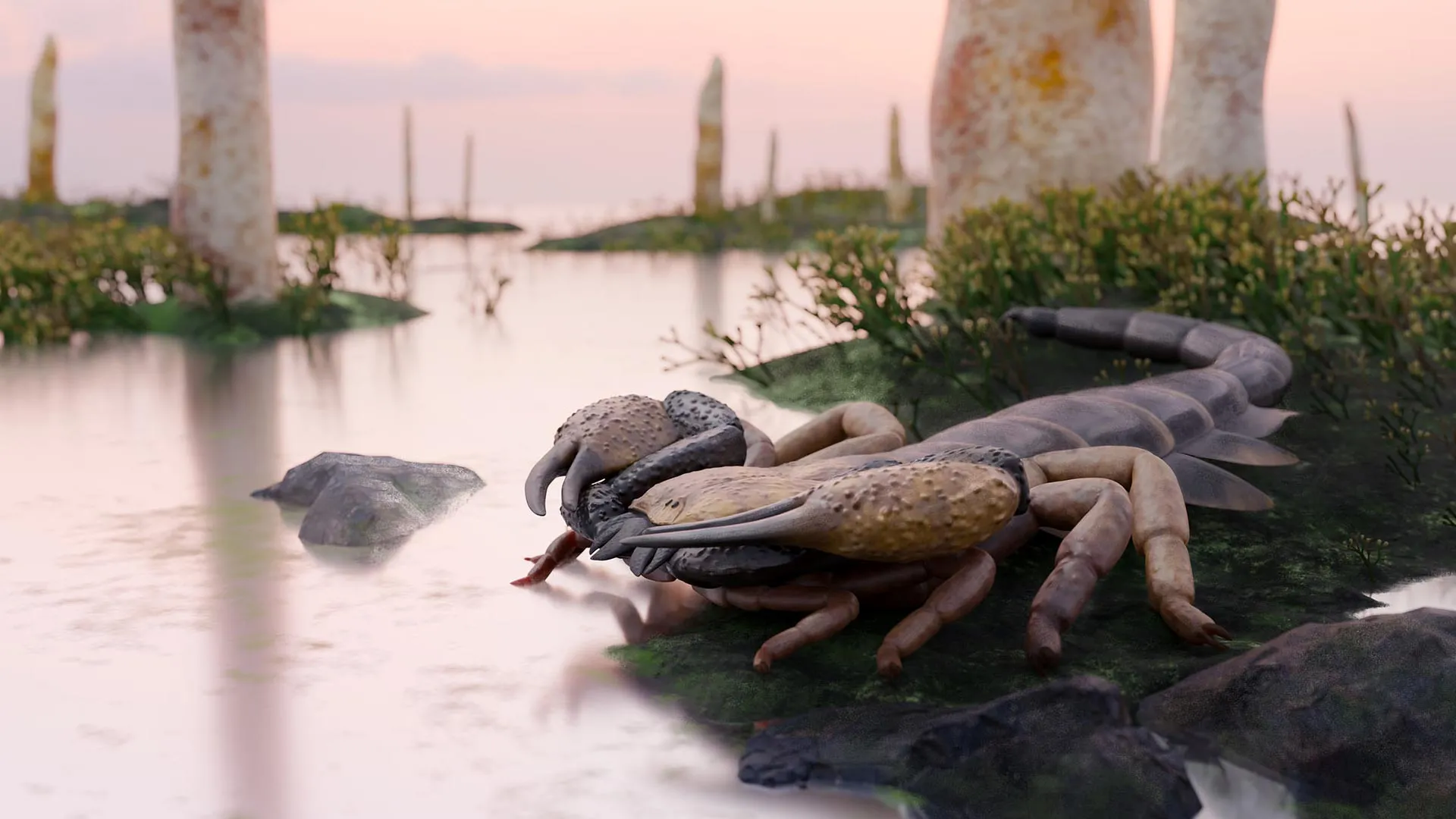
The creature, formally named Praearcturus gigas, was an imposing figure in the ancient landscapes it inhabited approximately 415 million years ago during the Early Devonian period. With an estimated length of roughly one meter – roughly the size of a small domestic dog – and formidable pincers extending over 16 centimeters, Praearcturus gigas would have been an apex predator in the sprawling floodplain environments of its time. The specific epithet "gigas" (Latin for "giant") is certainly fitting for a creature that dwarfed nearly all other terrestrial life forms of its era.
The journey to definitively identify Praearcturus as a scorpion and a distinct species was a testament to the power of persistent scientific inquiry and technological advancement. A comprehensive study published in the prestigious journal Palaeontology employed cutting-edge analytical methods and detailed comparisons with more recently described fossil species. This meticulous approach allowed the researchers to discern crucial anatomical features previously obscured or misinterpreted, finally resolving a paleontological mystery that had spanned over a century.
A Giant From Before the Age of Trees: Rewriting the Timeline of Gigantism
Dr. Richard J. Howard, Curator of Fossil Arthropods at the Natural History Museum, London, and the lead author of the pivotal study, underscored the profound significance of this discovery. "When we think of giant arthropods, people often picture the lush, oxygen-rich Carboniferous rainforests, teeming with colossal millipedes like Arthropleura or immense dragonfly-like insects such as Meganeura, which soared through the skies later in Earth’s history," Dr. Howard explained. "However, Praearcturus lived at least 50 million years earlier than these well-known giants, well before the evolution of complex forests and vast swathes of trees, at a time when life on land was only just tentatively beginning its colonization of the terrestrial realm."
This temporal placement is critical. The Carboniferous period (roughly 359 to 299 million years ago) is famously associated with the rise of widespread forests and, consequently, high atmospheric oxygen levels, which have long been hypothesized as a key driver for arthropod gigantism. Arthropods, with their external skeletons and tracheal respiratory systems, are thought to be limited in size by the efficiency of oxygen diffusion. Higher oxygen concentrations in the atmosphere would have allowed for larger body sizes by making respiration more efficient. The discovery of Praearcturus challenges this established narrative by pushing the timeline of extraordinary arthropod size far back into the Early Devonian, an era not characterized by such conditions.
"Confirming that this animal is unequivocally a scorpion fundamentally changes our understanding of how and when these creatures evolved to such extraordinary sizes," Dr. Howard added. The implications are far-reaching, suggesting that the ecological and environmental factors enabling gigantism might be more diverse and complex than previously assumed. This discovery pushes the story of giant arthropods much further back in time than the period usually associated with enormous insects and other invertebrates, demanding a re-evaluation of evolutionary pressures during Earth’s early terrestrial history.
The Hundred-Year Puzzle of Praearcturus
Dr. Russell Garwood, a distinguished Paleontologist at The University of Manchester and a key member of the research team, shed light on the long-standing enigma surrounding Praearcturus. "This creature has puzzled us paleontologists for more than a century," Dr. Garwood stated. "The initial fossils were so fragmentary and lacked definitive features that its true identity remained elusive, leading to various misinterpretations over the decades."
The breakthrough came from a painstaking process of bringing together material from several diverse collections – not just the original specimens but also more recently discovered fossils. This allowed for a more complete anatomical picture. "By leveraging cutting-edge imaging techniques, particularly micro-CT scanning and advanced microscopy, we’ve been able to build a clearer, three-dimensional picture of the animal’s internal and external structures than was previously possible, which is really exciting," Dr. Garwood elaborated. These technologies revealed intricate details of the animal’s segmented body, limb attachments, and particularly its chelicerae (mouthparts) and pedipalps (pincers), which bear unmistakable scorpion characteristics.
What truly fascinates researchers is the sheer size of Praearcturus in the context of its environment. "What makes Praearcturus so interesting is that it became enormous at a time when life on land was otherwise comparatively very small," Dr. Garwood noted. "This suggests it inhabited a world that could somehow support a giant predator, even when complex food webs were still nascent." To delve deeper into this ancient world, the team meticulously compared the size of Praearcturus with other known animals alive during the Early Devonian. This comparative analysis led them to an intriguing conclusion: "To reach such extraordinary sizes, and considering the prevailing conditions, we concluded that perhaps it primarily lived in water, where life was already accustomed to achieving greater sizes due to hydrostatic support and different ecological pressures."
Why Did This Scorpion Grow So Large? A New Hypothesis
The timing of Praearcturus gigas‘ existence during the Early Devonian is crucial to understanding its unique gigantism. This period, often dubbed the "Age of Fishes," saw terrestrial ecosystems still very much in their infancy. While small, primitive plants and fungi had begun to spread across the barren landscapes, forming microbial mats and low-lying vegetation, the vast, complex forests and intricate ecosystems that would characterize later periods had not yet developed. This means Praearcturus lived long before the dramatic increase in atmospheric oxygen levels that occurred during the Carboniferous, which has traditionally been linked to the enormous size of some later arthropods.
Instead, the researchers propose a compelling alternative hypothesis: ecological opportunity. In the nascent terrestrial and freshwater environments of the Early Devonian, there were relatively few other large predators vying for resources. This scarcity of competition could have created a unique ecological vacuum, allowing Praearcturus to dominate its environment in a way that became significantly harder once terrestrial ecosystems grew more crowded and complex with the evolution of more diverse fauna and flora.
In this scenario, a lack of significant predatory threats or competition for resources might have reduced selective pressures against large size. Larger individuals might have had an advantage in subduing what prey was available (perhaps early fish, smaller arthropods, or even early tetrapods if they were present in its habitat), or simply in deterring what few competitors existed. This "first-mover advantage" in a relatively unexploited niche could have facilitated the evolution of such remarkable dimensions without the need for exceptionally high oxygen levels.
A Scorpion That May Have Lived in Water: Bridging Worlds
Adding another layer of intrigue to the Praearcturus narrative are tantalizing clues suggesting that this ancient scorpion may have spent a significant part of its life in aquatic environments, blurring the lines between land and water dwellers. Some of the re-examined specimens preserve distinct, flap-like structures on the abdomen. These features bear a striking resemblance to gill-like appendages or respiratory structures seen in modern crustaceans, such as lobsters and crabs, which are highly adapted for aquatic respiration. This raises the fascinating possibility that Praearcturus, unlike most modern scorpions, could move between water and land, potentially inhabiting estuarine or freshwater floodplain settings.
An extensive analysis of the broader arachnid fossil record, spearheaded by Dr. Garwood and the research team, further bolstered this aquatic hypothesis. They observed that scorpions are unusually common in sedimentary rocks from this specific period compared with other arachnids. This pattern is significant because freshwater environments, with their higher sedimentation rates and often anoxic conditions, tend to be excellent preservers of fossilized remains, increasing the chances of an organism being captured in the geological record.
This discovery places Praearcturus at an especially important and dynamic stage in Earth’s history: the pivotal moment when animal life was actively beginning to explore and colonize habitats beyond the ancient oceans. It was an era of profound evolutionary experimentation, with various lineages making tentative forays onto land, developing new adaptations for respiration, locomotion, and reproduction in novel environments.
Dr. Greg Edgecombe, a Merit Researcher at the Natural History Museum, London, and a co-author of the study, emphasized this transitional aspect. "The boundary between land and sea was much less defined at this time than it is today," Dr. Edgecombe explained. "Coastal plains, river deltas, and floodplains would have presented a mosaic of semi-aquatic and intermittently dry habitats. Praearcturus gives us a fascinating glimpse into how early animals adapted to these fluid and changing environments." He further speculated on its evolutionary trajectory: "It may even represent a lineage that returned to the water after earlier scorpion ancestors had already begun living on land, showcasing the complex and often non-linear path of evolution." Such a "return to water" would be a remarkable example of secondary aquatic adaptation, mirroring similar evolutionary events seen in other groups, such as whales among mammals.
A 150-Year Fossil Mystery Unraveled
The journey to correctly identify Praearcturus gigas has been a long and winding one, spanning nearly a century and a half. Scientists first described the fossil in 1871, but the incomplete nature of the initial specimens led to a significant misinterpretation. At the time, lacking crucial anatomical features like a distinct tail (telson) or fully articulated appendages, it was interpreted as a giant crustacean, perhaps even resembling a colossal woodlouse or a primitive isopod. This initial classification was understandable given the limited paleontological knowledge and analytical tools available in the 19th century. The fragmentary nature of the fossils, coupled with the absence of key diagnostic anatomical markers, made confident identification exceedingly difficult for more than a hundred years.
The new interpretation became possible only after researchers could compare these historic specimens, many of which had been housed in various museum collections for decades, with better-preserved fossils discovered more recently in other locations. These newer remains proved to be invaluable, as they revealed unambiguous anatomical traits found specifically in scorpions – such as the characteristic segmentation of the body, the structure of the chelicerae, and the form of the pedipalps – providing scientists with the conclusive evidence needed to reassess and correctly reclassify Praearcturus.
This finding powerfully demonstrates the enduring scientific value of older museum specimens. Often considered mere historical artifacts, these collections are "sleeping giants" of information, capable of producing major discoveries long after they were first collected. "Specimens collected over a century ago can still hold entirely new insights, especially when re-examined through the lens of modern scientific understanding and technology," Dr. Howard affirmed. "By revisiting them with advanced techniques, such as high-resolution imaging and comparative morphology, we can uncover discoveries that fundamentally reshape our understanding of life on Earth and its evolutionary history."
Rethinking Prehistoric Arthropod Gigantism
The identification of such an enormous scorpion thriving so early in the history of terrestrial life profoundly challenges traditional scientific ideas about why prehistoric arthropods sometimes evolved to gigantic sizes. For decades, the dominant hypothesis centered on high atmospheric oxygen levels as the primary enabling factor. Praearcturus gigas, however, lived in an era not characterized by such oxygen-rich conditions, forcing a re-evaluation of this long-held theory.
The results of this study strongly suggest that high oxygen levels and other specific environmental conditions, while potentially influential in later periods, may not have been the sole or even primary factors involved in early arthropod gigantism. Instead, the concept of ecological opportunity – particularly the relative absence of competing large predators and the availability of unexploited niches – may have played an equally, if not more, significant role in allowing animals such as Praearcturus to reach their remarkable and unprecedented dimensions.
This paradigm shift encourages paleontologists to consider a more complex interplay of environmental, ecological, and physiological factors when investigating ancient gigantism. Future research will undoubtedly delve deeper into the precise environmental conditions of the Early Devonian, seeking more detailed proxies for atmospheric composition, temperature, and specific food webs that could have supported such a formidable creature. The discovery of Praearcturus gigas stands as a powerful reminder that Earth’s ancient history is far from fully understood, with new discoveries constantly emerging from old collections and pushing the boundaries of our knowledge.
