
 By admin
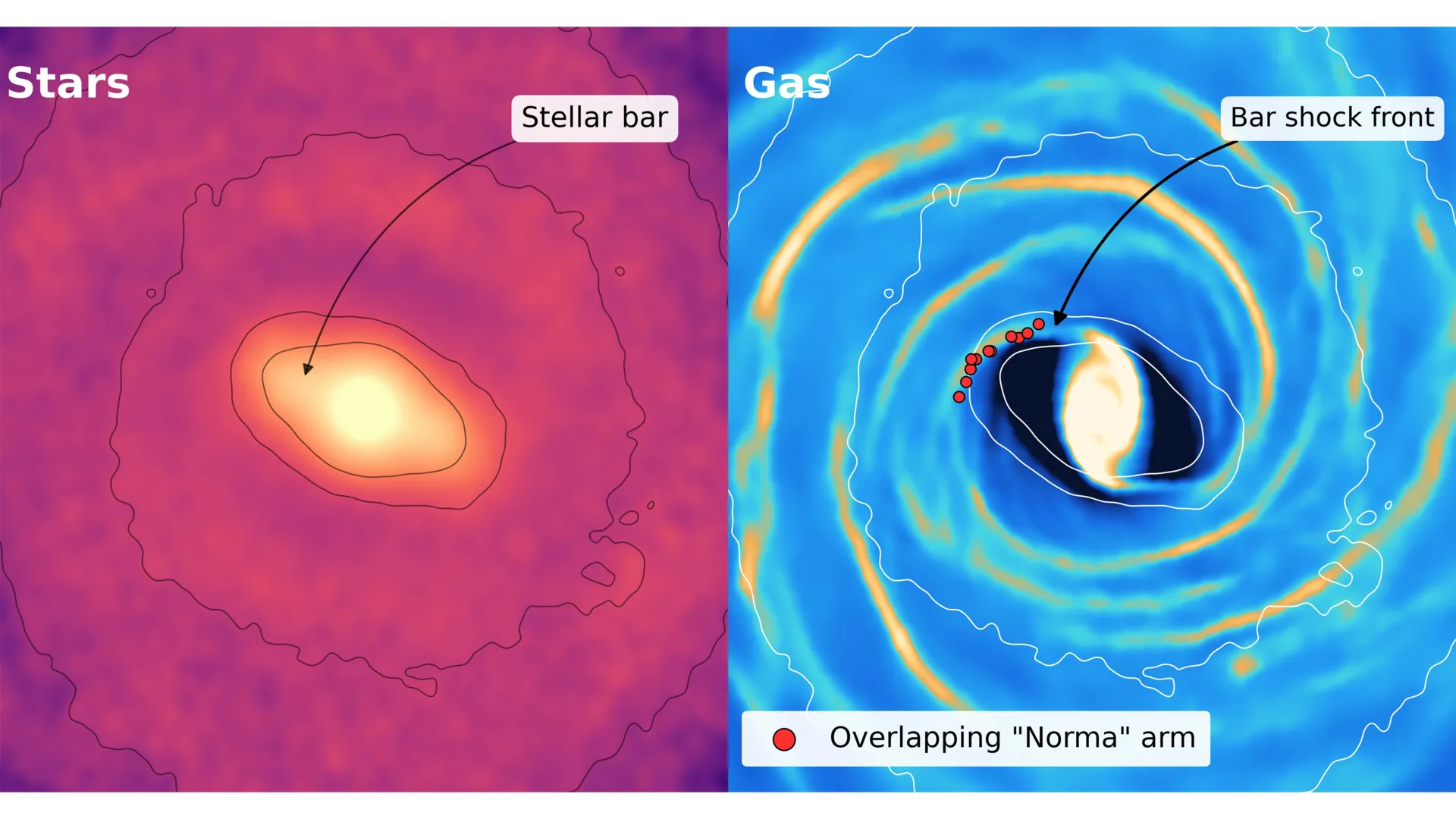
This groundbreaking discovery, led by Dr. Hillary Davis during her PhD studies at the University of Sydney’s School of Physics and Sydney Institute for Astronomy, uncovers a previously overlooked ‘star factory’ operating at the very heart of our galaxy. Dr. Davis and her team found compelling evidence that a colossal, rapidly rotating structure of stars, known as the Galactic bar, is generating powerful shock waves that ripple through surrounding clouds of gas. Crucially, these waves compress the gas with such intensity that they create the ideal conditions for new stars to ignite, even in a region where such violent forces typically inhibit star formation. This revelation challenges long-held assumptions about stellar nurseries and the dynamics of galactic centers.
Published in the prestigious journal Nature Astronomy, the study not only reshapes our understanding of star birth within the Milky Way but also casts significant doubt on the true nature of the Norma spiral arm. Named for the constellation Norma as observed from Earth, this arm has long been considered a fundamental component of our galaxy’s majestic spiral structure. However, the new research suggests that at least a portion of what we perceive as the Norma arm might actually be a manifestation of the intense star-forming activity along the leading edge of the Galactic bar.
Dr. Davis, who recently completed her doctoral research, emphasized the fundamental physics at play: "At its heart, star formation is a process we understand from everyday physics. Forces set matter in motion. In this case, gas is compressed, and that compression can create the conditions for new stars to be born on a massive scale." She further highlighted the extraordinary nature of their findings: "In most similar galaxies, star formation very commonly occurs along spiral arms. What’s extraordinary is seeing this happen in a different region of our Galaxy, where shocks are usually so strong that star formation is often suppressed." This distinction places the Milky Way in a unique category among barred spiral galaxies.
A Hidden Star Factory at the Heart of the Milky Way
To fully appreciate the significance of this discovery, it’s essential to understand the architectural blueprint of our galaxy. The Milky Way belongs to a class of galaxies known as barred spiral galaxies, which constitute roughly two-thirds of all observed spiral galaxies. Unlike their unbarred counterparts, which feature a central bulge surrounded by spiral arms, barred spirals possess an elongated, bar-shaped structure composed of billions of stars stretching across their central region. In our galaxy, this dominant feature is known as the Galactic bar. Its presence was long debated but firmly established through infrared observations in the late 20th century, revealing its enormous scale and profound influence on galactic dynamics.
The Galactic bar is not merely a static collection of stars; it’s a dynamic entity rotating like a colossal cosmic propeller. As it spins, its immense gravitational pull profoundly influences the distribution and movement of nearby gas. This interaction drives gas into powerful, supersonic shock fronts – analogous to sonic booms created by aircraft, but on a galactic scale. These fronts act like cosmic snowplows, compressing the gas in much the same way a shock wave compresses air. In typical astrophysical environments, such intense compression often leads to gas heating and turbulence, which usually inhibits gravitational collapse and thus prevents the formation of new stars. The conditions are simply too chaotic and energetic for gas clouds to cool sufficiently and coalesce.
Studying this structure from our vantage point within Earth is particularly arduous. We are embedded within the Milky Way’s disk, rather than viewing it from an external perspective, which makes direct observation of the galactic center akin to trying to map a forest while standing inside it. Furthermore, vast amounts of interstellar dust and gas obscure our line of sight towards the galactic core, absorbing and scattering visible light and making it nearly impossible to resolve structures in these regions.
"The Galactic bar cannot be easily observed because of a combination of our position in the Galaxy and dust obscuring our view," Dr. Davis explained. "As a result, the bar’s properties have been highly debated for decades." Astronomers have grappled with questions regarding its precise length, orientation, rotation speed, and its overall impact on galactic evolution.
Observations of other barred galaxies have largely corroborated the expectation that these shock fronts generally inhibit the formation of new stars, even in regions teeming with abundant gas. The prevailing wisdom has been that the intense, high-pressure conditions make it exceedingly difficult for the tenuous gas to cool, fragment, and collapse under its own gravity to form protostars.
However, the new findings from Dr. Davis’s team indicate that the Milky Way may be an exception to this rule. While not the sole known instance, our galaxy appears to belong to a relatively small and intriguing group of barred spirals where substantial star formation takes place directly along the shock fronts of the central bar. This suggests a more complex interplay of forces within the Milky Way’s core, perhaps hinting at specific conditions – such as gas density, magnetic field configurations, or the strength and shape of the bar itself – that allow star formation to proceed against the odds.
"We believe that the Milky Way’s bar has star formation occurring along its shock front, which is uncommon for most bars in nearby galaxies," Dr. Davis affirmed. This distinct behavior raises fascinating questions about the evolutionary history and internal dynamics that make our galaxy unique.
A Milky Way Spiral Arm May Not Be What It Seems
To investigate this unusual star-forming activity and decipher the Galactic bar’s secrets, the research team employed a sophisticated methodology. They meticulously compared detailed, large-scale computer simulations – models designed to show how galaxies evolve over billions of years under the influence of gravity, gas dynamics, and star formation – with an extensive dataset of astronomical observations specifically targeting regions where massive stars are known to be forming.
A crucial component of their observational evidence came from the study of masers. Masers, an acronym for Microwave Amplification by Stimulated Emission of Radiation, are naturally occurring astrophysical phenomena that emit highly concentrated microwave radiation. Operating on the same fundamental principle as lasers but at much longer microwave wavelengths, these cosmic beacons are intimately associated with the earliest stages of massive star formation. Specific molecules, such as water (H2O), methanol (CH3OH), and silicon monoxide (SiO), in dense, warm gas around newly forming stars emit these maser signals. Their intense, directional emission makes them incredibly powerful tracers for pinpointing the exact locations of nascent massive stars, even through thick curtains of interstellar dust. Furthermore, their precise positions and velocities can be measured with remarkable accuracy, making them invaluable tools for galactic cartography.
By meticulously examining the precise positions and kinematics of these masers, the researchers uncovered a striking and unexpected match: the observed locations of these star-forming regions aligned remarkably well with the predicted locations of shock fronts generated by the Galactic bar in their computer simulations.
"We found that masers previously associated with the Norma arm closely align with the shock front predicted by our simulations," Dr. Davis revealed. This critical alignment led to a profound reinterpretation: "This suggests that at least part of the so-called Norma arm may not be a spiral arm at all, but a region of star formation along the leading edge of the Galactic bar."
This revelation has far-reaching implications, potentially requiring a significant revision of the Milky Way’s structural map. Spiral arms, like the Perseus, Sagittarius, Scutum-Centaurus, and Norma arms, are traditionally understood as long, winding structures where gas and dust accumulate, leading to enhanced star formation. If a significant portion of what we’ve identified as the Norma arm is, in fact, a feature of the central bar, it fundamentally alters our understanding of how gas flows and stars form in that particular quadrant of our galaxy.
"This raises questions about the Galaxy’s spiral structure, and the bar region of the Milky Way, which needs further investigation," Dr. Davis added. The possibility is significant because it suggests that some of the star formation previously attributed to the Norma spiral arm could instead be occurring along the central bar. If confirmed through further observational and theoretical work, this interpretation would necessitate a significant re-evaluation of how astronomers understand the arrangement of stars, gas, and dust in that pivotal part of the Milky Way. It implies a more dynamic and interconnected relationship between the bar and the larger galactic disk than previously assumed.
New Evidence Could Redraw the Milky Way’s Map
Beyond simply revealing an unusual location for star birth, the research also sheds invaluable new light on the fundamental physical properties of the Galactic bar itself. For decades, astronomers have engaged in spirited debates regarding the bar’s precise length, its angular orientation relative to our sun, and its rotational speed. These properties are not merely academic curiosities; they are crucial parameters that dictate the bar’s influence on the overall dynamics and evolution of the entire galaxy, affecting everything from gas inflow to the distribution of dark matter. As mentioned, the challenges posed by the Milky Way’s obscuring dust and our internal viewing position have made direct and definitive measurements incredibly difficult, leading to a wide range of estimates in the scientific literature.
"Our findings place further constraints on the size, angle and rotation speed of this central bar," Dr. Davis stated. The team’s rigorous analysis indicates that the bar extends approximately 4.3 kiloparsecs – an astonishing distance equivalent to about 14,000 light-years – outward from the galactic center along its long axis. This measurement lends strong support to a particular model of the Milky Way: one containing a relatively long bar that rotates slowly. A slow-rotating, long bar would have different dynamical effects on the surrounding gas and stars compared to a shorter, faster-spinning bar, influencing the morphology of the spiral arms and the overall stability of the galactic disk.
These results powerfully illustrate how increasingly sophisticated and computationally intensive simulations can serve as indispensable tools for scientists seeking to investigate regions of our galaxy that are difficult or impossible to observe directly. By comparing these highly detailed, physics-based models, which track the evolution of billions of particles over billions of years, against the limited yet precise astronomical evidence available, researchers can dramatically narrow down the range of possible structures and physical processes shaping the Milky Way. This iterative process of refining models based on observational data is a cornerstone of modern astrophysics.
"By comparing a new generation of large-scale computerized galaxy simulations, evolving over billions of years, against a more limited set of observations, we now have a stronger understanding of the bar and star formation processes in the Milky Way," Dr. Davis concluded. This synergy between theoretical modeling and observational astronomy is paramount for unraveling the complex mysteries of our cosmic home.
The authors reported no competing interests, underscoring the objectivity of their scientific endeavor. This vital research was made possible through generous funding from a consortium of international bodies, including the Australian Research Council, the Knut and Alice Wallenberg Foundation, the Swedish Research Council, the Swedish National Space Agency, the LMK Foundation, and eSSENCE (Sweden). The computational heavy lifting required for the large-scale simulations and data processing was provided by state-of-the-art computing resources and data storage facilities at National Computing Infrastructure Australia, an NCRIS capability supported by the Australian Government, and LUNARC, the Centre for Scientific and Technical Computing at Lund University, Sweden. These advanced computational platforms are critical for pushing the boundaries of astrophysical research, enabling scientists to model the universe with unprecedented detail and precision.
