
 By admin
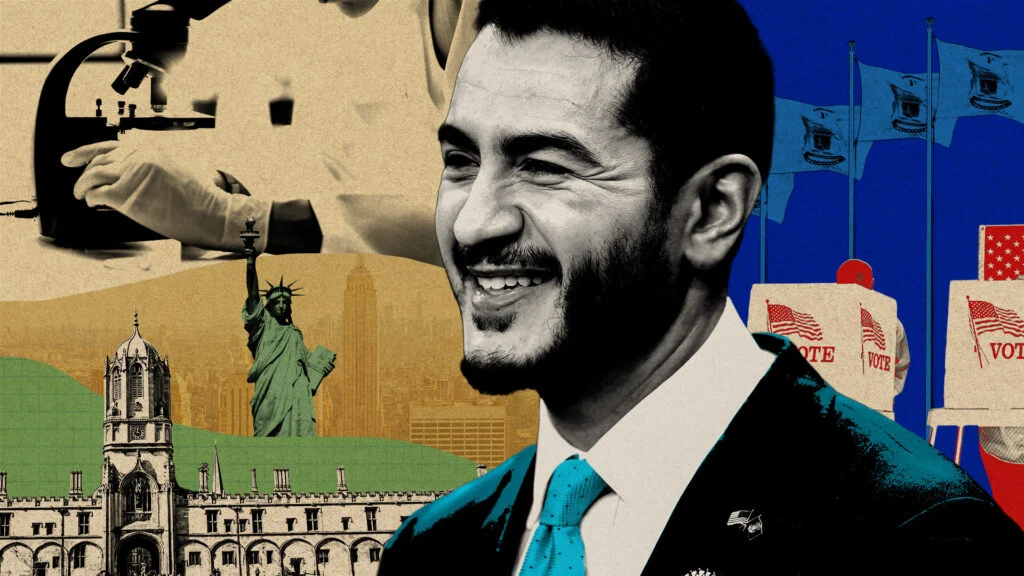
In the high-octane world of American politics, candidates are often reduced to soundbites, social media clips, and partisan caricatures. Abdul El-Sayed, the Democratic candidate for the U.S. Senate in Michigan, is no exception to this rule of modern campaigning. To his detractors and political rivals, he is a "little weasel"—a label famously bestowed upon him by Vice President JD Vance—or a radical whose heritage and policy stances are used as fodder for xenophobic rhetoric. Former President Donald Trump has gone further, claiming El-Sayed would "open the floodgates" to terrorism, painting a dystopian picture of a "nightmare of violence" under his watch. Yet, beneath the bruising and often contentious veneer of a campaign with only six days remaining, there lies a candidate whose profile is unlike almost any other in the history of the United States Senate.
Abdul El-Sayed does not typically make headlines for the academic rigor of his background, yet it is that very background that defines his approach to governance. He is a man who literally wrote the textbook on applying systems science to public health—a discipline that examines how complex, interlocking social, economic, and environmental factors produce health outcomes across a population. He is a Rhodes Scholar with a doctoral degree from Oxford and a medical degree from Columbia University. He is a former health commissioner who rebuilt Detroit’s decimated public health infrastructure from the ground up. If elected, he would not only be the first Muslim to serve in the U.S. Senate but also the first epidemiologist to grace the upper house, and the first Democrat with a medical degree to serve there since 1969.
A Scientific Bulwark in a Changing Political Landscape
The timing of El-Sayed’s candidacy is particularly poignant. As the federal government braces for a potential overhaul of its health agencies under the influence of figures like Robert F. Kennedy Jr., many in the scientific community view El-Sayed as a necessary counterweight. Kennedy, who has been tapped by the Trump administration to lead a "Make America Healthy Again" initiative, has signaled plans to radically reform the Food and Drug Administration (FDA), the Centers for Disease Control and Prevention (CDC), and the National Institutes of Health (NIH). To critics, Kennedy’s agenda represents a retreat from evidence-based medicine; to El-Sayed, it is an existential threat to the nation’s foundational public health infrastructure.
The tension between these two visions of health was on full display this week. At a campaign event in Michigan for El-Sayed’s opponent, former Republican Representative and FBI agent Mike Rogers, Kennedy made disparaging remarks about the scientific contributions of the Arab world, stating that "500 million Arabs in the world… don’t produce science" and fail to win Nobel or Fields prizes. El-Sayed, himself an Arab-American scientist with two doctoral degrees, was quick to fire back. In an interview with STAT, he called the comments "ironic," noting that a man who "traffics in eugenicist terms" was lecturing voters about a scientist who actually believes in the efficacy of vaccines and the rigor of the scientific method.

El-Sayed’s critique of the current administration’s health leadership is scathing. He has described Kennedy as "truly the most incompetent HHS secretary we’ve ever had" in waiting, and he has made it clear that his goal in the Senate would be to hold the administration accountable. He envisions a seat on the Senate Committee on Health, Education, Labor, and Pensions (HELP), where he could oversee the budgets of the Department of Health and Human Services (HHS). "I can’t wait to sit across from RFK Jr. and actually grill him," El-Sayed said, signaling a desire to bring his epidemiological training to the oversight process.
The Education of an Epidemiologist
El-Sayed’s journey to the political stage began in Rochester Hills, Michigan, where he was born in 1984 to Egyptian immigrant parents. His father, an engineer, and his mother, a nurse practitioner, instilled in him a belief in the American Dream, but also a consciousness of the global inequities that define the human experience. He often shares a story from his childhood visits to his grandmother in Egypt. She would point out his cousins—one smarter, one more athletic, one more hardworking—and tell him that despite their talents, he had the "best thing of all": the ability to go back to America.
This realization of "privilege" became the catalyst for his career. In his memoir, Healing Politics, he describes this as a "matched-pair epidemiological study." The primary difference between his life and the lives of his cousins was not merit, but access to clean water, political stability, and a high-income healthcare system. This sense of "profound responsibility" followed him to the University of Michigan, where he was named valedictorian of the class of 2007.
His interest in the intersection of social factors and health was further ignited after reading a study on how the rise in Islamophobia following the 9/11 attacks led to an increase in preterm births among Arab-American women in California. Having experienced the sting of racial slurs and bullying on the football field himself, El-Sayed saw his personal life and his scientific interests collide. He pursued this further at Oxford as a Rhodes Scholar, using artificial intelligence and agent-based modeling to simulate how social disparities drive obesity rates in England.
From the Clinic to the City
Despite his academic success, El-Sayed found himself at a crossroads during his medical training at Columbia. He recalls a formative and devastating experience with a patient he calls "Martha," an unhoused woman who had been systematically failed by the medical and social safety nets. Watching the system cycle her in and out of the emergency room without addressing the root causes of her alcoholism, diabetes, and housing instability led El-Sayed to a radical conclusion: clinical medicine was not the path to solving the problems he cared about. He withdrew his residency application, choosing instead to focus on the "upstream" causes of illness as a professor of epidemiology.

His transition to public service came in 2015, when he was appointed as the health commissioner for the City of Detroit. At the time, Detroit’s health department had been privatized and hollowed out following the city’s bankruptcy. El-Sayed was tasked with rebuilding it from scratch. His tenure was marked by ambitious initiatives, such as a program providing free eyeglasses to thousands of schoolchildren and a major push for lead testing in the wake of the Flint water crisis.
However, El-Sayed’s time in Detroit also highlighted the limitations of local government. He grew frustrated with how federal policy and funding cuts could dismantle local progress. This frustration peaked with the 2016 election of Donald Trump, prompting El-Sayed to resign and launch a bid for governor of Michigan in 2018. Though he lost the primary to Gretchen Whitmer, he emerged as a national figure for the progressive movement, eventually leading to his current Senate run.
The Policy Pillar: Medicare for All
At the heart of El-Sayed’s platform is "Medicare for All," a policy he has championed alongside Senator Bernie Sanders. While critics like Mike Rogers argue that a single-payer system would lead to the rationing of care and astronomical costs, El-Sayed approaches the issue with a researcher’s eye. He argues that the current American healthcare system is already rationing care—not by need, but by the ability to pay.
Recent data from the Kaiser Family Foundation (KFF) suggests that the public may be more receptive to El-Sayed’s message than his opponents admit. Support for a national health plan has reached its highest level since 2016, with two-thirds of Americans expressing favorability. However, the poll also notes that support is volatile, dropping significantly when voters are told the plan could eliminate private insurance or require tax hikes.
El-Sayed’s supporters argue that his expertise allows him to move beyond slogans. Hayden Rooke-Ley, a professor at Brown University, notes that El-Sayed has "carefully analyzed the healthcare system" to determine the most efficient way to finance it. El-Sayed points to the massive administrative waste in the current system—estimated by some studies to be as high as $500 billion annually—as a resource that could be redirected toward universal coverage.

A Vision for 2029 and Beyond
As the campaign enters its final days, El-Sayed is looking beyond the immediate political skirmishes. He sees the potential "remaking" of federal agencies under the Trump administration as an opportunity to eventually "build what we need." His vision for the future of public health includes a more responsive CDC, an FDA that can accelerate drug approvals without compromising safety, and an NIH that prioritizes research responsive to the everyday needs of Americans.
He remains a polarizing figure. His opponent, Mike Rogers, continues to attack him for not being a "real doctor" because he did not complete a residency—an attack El-Sayed dismisses as a misunderstanding of the role of a public health leader. Rogers also continues to lean into the rhetoric of "American carnage," framing El-Sayed’s progressive policies as a threat to Michigan’s economic stability.
For El-Sayed, however, the race is about more than just a seat in the Senate; it is about the soul of American public health. Whether he is hosting his podcast, America Dissected, or rallying with labor unions in Grand Rapids, his message remains consistent: the health of a population is a reflection of its politics. As Katelyn Jetelina, founder of Your Local Epidemiologist, puts it, El-Sayed’s appeal lies in his ability to envision a system that doesn’t just react to crises but proactively builds a healthier society.
If the "energy" his supporters describe translates into a victory on Tuesday, the U.S. Senate will gain its first systems scientist—a man who believes that the most effective medicine is often found not in a pill bottle, but in the halls of Congress.
