
 By admin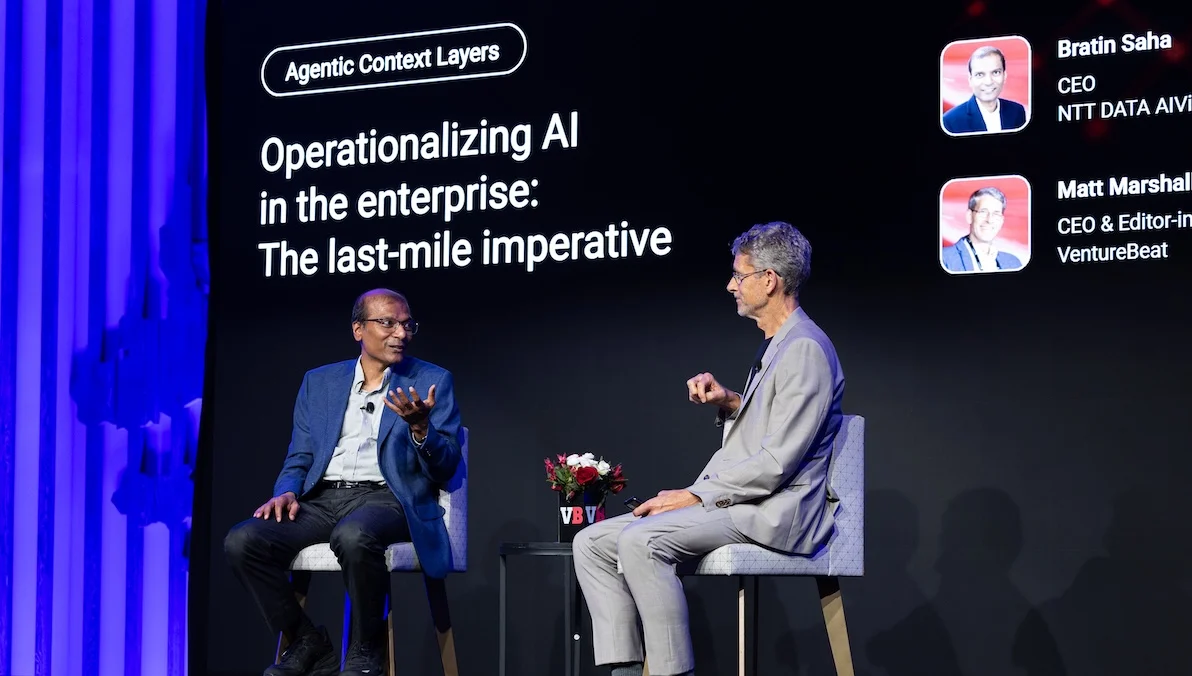
At the recent VB Transform 2026 conference, a pivotal discussion unfolded between Bratin Saha, CEO of NTT DATA AIVista, and Matt Marshall, CEO and editor-in-chief of VentureBeat. Their conversation zeroed in on a critical, yet often overlooked, hurdle in the widespread adoption of advanced Artificial Intelligence: the "last mile" challenge of operationalizing frontier models within regulated production environments. This isn’t merely about technological prowess; it’s about ensuring reliability, contextual understanding, robust guardrails, and ironclad security – the very elements that determine whether substantial AI investments translate into demonstrable enterprise value. The core of their dialogue addressed the pressing question echoing through boardrooms and innovation labs alike: how can organizations effectively convert the significant capital being poured into AI into concrete, measurable business outcomes?
Saha articulated a profound truth: "It’s not just a model, you’re building a system around the model." This statement encapsulates the essence of the last mile. It’s the intricate process of wrapping a powerful, yet often raw, frontier model within the unique data, established workflows, and essential guardrails of an enterprise. Without this meticulous integration, even the most sophisticated AI can falter. The implementation phase of enterprise AI projects frequently hits roadblocks due to issues like poor integration with existing IT infrastructure, critical gaps in domain-specific knowledge, a lack of robust governance frameworks, and ambiguity regarding ownership of AI-driven outcomes. Saha emphasized that true operationalization, or "last-mile specialization," transforms a generic, albeit capable, foundation model into a specialized enterprise agent. This agent is meticulously shaped by the organization’s specific domain workflows, its defined risk appetite, the nuances of its client classifications, its interpretations of complex regulatory landscapes, and its invaluable, often unwritten, institutional knowledge.
The inherent complexities of regulated industries, such as insurance, often present significant obstacles for frontier models operating in their raw, out-of-the-box state. Saha highlighted that while these models possess impressive general capabilities, they frequently fall short of the production-grade accuracy and reliability demanded by real-world insurance workflows. The intricate nature of processes like multinational insurance claims, which involve complex forms, handwritten annotations, and a multitude of decision points, poses a significant challenge. Frontier models, including advanced iterations like Fable 5, Opus 4.8, and even conceptual models like GPT-5.5, struggle to navigate this inherent complexity without specialized adaptation. This is where the concept of specialization becomes paramount. Saha’s core message is that the most substantial gains in AI effectiveness stem not from solely focusing on the foundation model itself, but from specializing the entire AI system surrounding it.
This comprehensive system specialization is achieved by integrating the customer’s proprietary data, their unique operational workflows, and, crucially, the "tribal knowledge" – the tacit understanding and practical expertise that often resides within experienced human workers and is rarely documented in formal operating procedures. "The biggest bang for the buck comes from the specialization and then these specialized guardrails," Saha asserted, underscoring the dual importance of tailoring the AI’s understanding and establishing robust control mechanisms. He further broke down this critical last-mile work into three fundamental components:
-
Capturing Enterprise Context: This involves the intricate process of extracting and making the organization’s unique context – its data, its operational nuances, its strategic objectives – readily consumable and understandable by AI systems. This goes beyond simply feeding data into a model; it requires structuring and presenting information in a way that aligns with the AI’s operational logic.
-
Optimizing Model Execution: To prevent costs from escalating uncontrollably, the system must intelligently run an ensemble of models. This means strategically deploying different models – perhaps a combination of high-power frontier models for complex reasoning and more cost-effective open-source models for simpler tasks – to achieve optimal performance and manage expenditure.
-
Implementing Specialized Guardrails: This is a critical layer of control. Specialized guardrails act as vigilant overseers, meticulously checking the AI’s outputs. When the model makes an error or deviates from acceptable parameters, these guardrails trigger a re-evaluation or a forced redo, ensuring that the AI operates within defined boundaries and maintains the required level of accuracy and compliance.
Intriguingly, Saha’s perspective challenges the conventional wisdom that heavily relies on fine-tuning foundation models for enterprise adoption. VentureBeat’s latest enterprise survey revealed that fine-tuning ranked last among companies’ priorities when selecting AI models. This suggests a broader shift in understanding, where the emphasis is moving away from altering the core model itself and towards building a sophisticated ecosystem around it. The true essence of the last mile, according to Saha, lies in leveraging domain knowledge and understanding the undocumented, proprietary workflows that define an organization’s competitive edge. "The last mile is about taking data that’s proprietary to you and using that to build a system around the model that can steer the model in the right way that can put the appropriate guardrails around it," he explained.
Ultimately, the successful deployment of enterprise AI is not about the act of deploying a technology in isolation, but about the seamless movement of a specific workflow from its current state (point A) to a desired future state (point B). This fundamental reorientation underscores NTT DATA’s strategic advantage: its ability to pair AI experts with seasoned subject domain experts. This collaborative approach is crucial because it involves direct engagement with human workers to understand the intricacies of how work is actually performed. "The only reason is because we go and talk to those human workers and we say, ‘How do you actually do the work,’" Saha elaborated. This deep understanding is then meticulously encoded into an intelligent agent.
For regulated industries like insurance, manufacturing, and others where precision and compliance are paramount, success hinges on a harmonious interplay of three critical elements: technology, domain expertise, and change management. Saha pointed out that, based on his extensive client engagements, technology itself is rarely the primary bottleneck. Instead, the real impediments often lie in the integration of domain knowledge and the effective management of organizational change that accompanies AI adoption.
For enterprises grappling with substantial AI budgets, Saha offers a clear directive: the true payoff lies not in the frontier model itself, but in the robust system and workflows built around it. "When you’re deploying AI in the enterprise, you’re not deploying a technology," he reiterated. "You are taking a workflow that exists and taking it from point A to point B." The inherent value is generated by the optimized workflow that is moved and improved, not solely by the model that facilitates this transition. This perspective necessitates a re-evaluation of where investment priorities should lie.
Saha’s assertion that "technology is not the bottleneck" redirects focus towards the critical importance of domain expertise and the meticulous change management processes that envelop the AI model. Furthermore, he advocates for the discipline of committing to all three elements in concert. Investments that are exclusively targeted at the AI model itself, without adequate consideration for domain context and change management, leave a significant portion of the potential return on investment unrealized.
Enterprises are not forced into an either/or choice between embedding AI into existing workflows or undertaking the formidable task of redesigning those workflows from scratch. NTT DATA perceives these as sequential stages within a broader strategic journey. "We are starting with embedding in the workflow because it’s easier change management," Saha explained. He noted that organizations running mission-critical operations are understandably hesitant to allow a vendor to disrupt established, functional processes midstream. "Once that happens, then we go into, how can we now reimagine this? And that really is where the biggest bang is." This phased approach allows for gradual adoption, builds confidence, and then opens the door for more transformative innovation.
A key strategic advantage of keeping the core intelligence within the surrounding system, rather than solely within the model, is the preservation of "swappability." This allows enterprises to readily adopt and benefit from evolving open-weight and open-source models as they mature and become more cost-effective or specialized. Saha’s team employs an ensemble approach that strategically mixes powerful frontier models with open-source alternatives. He anticipates a growing industry trend where organizations will leverage open-weight models for tasks where the cost of an error is relatively low, while reserving the sophisticated reasoning capabilities of frontier models for high-stakes applications where accuracy is paramount. "In many situations, especially in regulated industries where mistakes are very expensive, that last extra couple of percent matters," he emphasized.
This strategic philosophy extends to the platform architecture itself. While the generation of guardrails and the application of neurosymbolic models are designed to scale across diverse customer bases, the crucial process of capturing each organization’s unique "tribal knowledge" remains inherently bespoke. Saha pointed to NTT DATA’s extensive experience as one of the world’s largest third-party administrators in the insurance sector as a significant advantage in acquiring this specialized expertise. "The ability to take that knowledge and trust that has been built over 20 years is very hard to replicate instantly, and I do think that is a durable aspect of what we have," he concluded, highlighting the lasting competitive edge derived from deeply embedded institutional knowledge and trust.
