
 By Lina Irawan
The notion that oil flows could be higher during a period of heightened geopolitical tension and conflict than before it struck many as counterintuitive, raising immediate questions about the veracity of the official figures. The Strait of Hormuz, a narrow waterway between the Persian Gulf and the Arabian Sea, is a critical chokepoint for global oil transit, through which a significant portion of the world’s seaborne oil passes daily. Any disruption or perceived instability in this region typically sends crude oil prices soaring, reflecting supply fears.
Samir Madani, co-founder of TankerTrackers.com, a leading independent platform for tracking oil shipments using satellite imagery and AIS data, quickly debunked the Secretary’s claims. Madani, known for his meticulous data analysis, jokingly referred to Wright’s figures as "mathemagics," implying a manipulation or miscalculation of data. According to Madani, his firm’s independent analysis for Monday, August 31, 2026, indicated that only an estimated 9.14 million barrels of oil exited the Arabian Sea. This figure encompasses all volumes, including those transiting the Strait of Hormuz and alternative export pipelines, painting a starkly different picture from the 17 million barrels cited by Secretary Wright.
Madani elaborated on his findings in an interview with Fortune‘s Jordan Blum, underscoring the significant disparity. The discrepancy is not merely academic; it has tangible economic consequences. The persistent high price of oil, which has remained stubbornly above $95 per barrel, directly reflects ongoing market anxieties about supply, rather than a robust, record-breaking flow of crude. If, as the Secretary suggested, oil exports were at an all-time high, market dynamics would logically push prices lower, not keep them elevated. The perceived misleading nature of the White House’s statistics could erode trust in official data, making it harder for energy markets to accurately assess supply-demand balances and potentially fueling further price volatility. Accurate, transparent data on global energy flows is paramount for stability, especially in a volatile geopolitical climate.
THE MISSING WORKFORCE
‘Near-zero employment growth in August,’ Vanguard says
The U.S. labor market is flashing concerning signals, with new data from Vanguard’s extensive 401(k) database pointing to "near-zero employment growth in August." Adam Schickling, a Senior Economist at Vanguard, highlighted this trend based on data from 2,500 companies that utilize their retirement services, covering approximately 5 million workers. While retirement plan take-up isn’t a perfect proxy for new job creation, it offers a robust indication of hiring momentum within established businesses. The stagnation in August suggests a significant deceleration in the pace of hiring across a broad swathe of the American economy.
Even more troubling, this slowdown is occurring concurrently with a substantial number of individuals exiting the labor force altogether. Schickling noted a profound decline in the labor force participation rate for prime-age workers (those aged 25-54), which has fallen by approximately 50 basis points (0.5%) year-to-date. This represents one of the largest non-recessionary drops in this critical demographic in historical records. The prime-age labor force participation rate is a crucial indicator of the underlying health and engagement of the core working population, as it filters out demographic shifts from younger and older cohorts.
The economist explained that this exodus from the labor force has played a significant, albeit artificial, role in maintaining the current unemployment rate at a relatively stable 4.1%. In essence, if these workers were still actively seeking employment, the unemployment rate would be considerably higher. "The 25-54-year-old labor force participation rate has declined ~50bps [year to date], one of the largest non-recessionary drops in history," Schickling stated in his email. "This has helped keep the unemployment rate relatively stable despite a cumulative 833,000 decline in household employment since January. If prime-age participation had not fallen, we estimate that the current unemployment rate would be 4.4%."
This phenomenon creates a misleading picture of labor market strength, obscuring the underlying weakness. Potential reasons for this significant dropout include lingering post-pandemic shifts in priorities, increased childcare responsibilities, early retirement for some, or simply discouragement among job seekers. The implications are significant for future economic forecasts. Schickling predicts that this trend is likely to reverse in the coming months, with a wave of these workers re-entering the labor force. However, this re-entry is expected to precede an equivalent increase in available jobs, "creating upward pressure on the unemployment rate as these workers re-enter the labor force faster than they find jobs." Such a scenario could lead to a noticeable rise in the official unemployment rate, potentially impacting consumer confidence, wage growth, and overall economic sentiment. Policymakers will need to closely monitor these trends to understand the true state of the labor market and its broader economic implications.
QUOTE OF THE DAY
“The board doesn’t all get sacked because we did something silly.”
—James Dyson, upon the launch of his $499 toothbrush that features a camera so you can see inside your mouth as you brush. He told The Wall Street Journal he has no clue whether there is a market for such a product or how many he might sell.
This candid remark from Dyson founder James Dyson perfectly encapsulates the spirit of audacious innovation, even if it borders on the whimsical. Dyson, a brand synonymous with high-end, meticulously engineered, and often unconventional household appliances, is venturing into the personal care market with a luxury toothbrush boasting an integrated camera. Priced at a hefty $499, this device aims to transform oral hygiene by providing users with a real-time, visual feed of the inside of their mouth as they brush, presumably to ensure thorough cleaning and target neglected areas. The technology likely involves high-resolution imaging, possibly augmented reality, and AI-powered analysis delivered through a companion app.

Dyson’s comment, "The board doesn’t all get sacked because we did something silly," reveals a corporate culture that embraces risk and experimentation, a luxury afforded by the company’s established success in other categories like vacuum cleaners, hair dryers, and air purifiers. It also suggests an acknowledgment that not every groundbreaking product will be a runaway commercial success. Dyson’s honesty about not knowing the market size or potential sales figures for such a niche, premium product is refreshing but also highlights the inherent gamble in pushing technological boundaries into everyday items. While the market for a camera-equipped toothbrush might seem limited, Dyson has a track record of convincing consumers to pay a premium for products that promise superior performance and design, even for items previously considered mundane. The success of this new venture will depend heavily on whether consumers perceive a tangible benefit that justifies its steep price tag, or if it will be seen as an expensive gadget in search of a problem.
THE MARKETS
Stocks climb as bond yields catch their breath
After a relentless ascent that rattled global markets, the selloff in U.S. government bonds appears to be taking a temporary breather, offering a modest reprieve to equity investors. The yield on the benchmark 30-year Treasury bond, a key indicator of long-term borrowing costs, settled at 5.25%, retreating slightly from its recent peak of 5.31%. Similarly, the 10-year Treasury yield, a closely watched barometer for everything from mortgage rates to corporate debt, held steady at 4.78%, hovering around its record high but showing no immediate signs of further upward momentum.
This pause in the bond market’s upward yield trajectory provided a much-needed psychological boost to stock markets worldwide. In Asia and Europe, equities reacted by moving modestly upward, reflecting a cautious optimism that the worst of the bond market’s repricing might be temporarily over. The S&P 500 closed yesterday with gains, and U.S. futures point toward continued positive momentum this morning ahead of the New York market open. The inverse relationship between bond yields and stock valuations means that when yields stabilize or slightly decline, the relative attractiveness of equities improves, and the cost of capital for businesses potentially eases, contributing to a more favorable environment for stocks. While this may be a fleeting moment of calm, it allowed investors to catch their breath and reassess market conditions.
Ignore the national debt—this is normal, Deutsche Bank says
Amidst widespread market anxiety over spiraling government debt and its potential to destabilize global finances, Jim Reid, the global head of macro research at Deutsche Bank, offers a contrarian perspective. The current "worry of the day" for many investors revolves around the global selloff in government bonds, which has sent yields soaring, consequently making it significantly more expensive for governments to service their colossal debts. The U.S. national debt, for instance, has ballooned to an eye-watering $40 trillion, leading many to conclude that this massive pileup of liabilities is the primary driver behind investors demanding higher returns for lending to governments.
However, Reid argues that this common narrative is largely misplaced. While acknowledging the sheer scale of global debt, he posits that the current surge in yields is not primarily a direct market reaction to fiscal insolvency concerns. Instead, he attributes the phenomenon to a "continuation of the normalization after the financial repression of the 2010s." During that decade, central banks worldwide implemented unprecedented policies, such as quantitative easing and near-zero interest rates, effectively suppressing bond yields to stimulate economic recovery. This period, often termed "financial repression," artificially lowered borrowing costs for governments but distorted market pricing.
Reid’s "House View" at Deutsche Bank suggests that the current backdrop is inherently supportive of higher global yields due to three core factors: the supply-demand balance, the term premium, and the inflation outlook. The supply-demand dynamic reflects the sheer volume of new government bonds being issued to finance deficits, potentially outstripping investor demand at lower yields. The term premium, which is the additional compensation investors demand for the risk of holding longer-term bonds, had been severely compressed during the era of financial repression and is now returning to more historical levels. Finally, a persistently elevated inflation outlook means investors require higher nominal yields to ensure their real (inflation-adjusted) returns remain positive.
Despite his primary argument, Reid offers a crucial caveat: "That said, the higher yields move, the more uncomfortable the long-term fiscal trajectory looks for many countries." This acknowledges that while the immediate trigger for rising yields may not be debt levels, the sustained increase in borrowing costs will inevitably exacerbate the challenges of managing immense national debts, making future fiscal sustainability a growing concern. The longer yields remain elevated, the greater the pressure on government budgets, potentially leading to difficult choices regarding spending cuts or tax increases in the years to come.
**Never mind the bond yields, here’s the equities pivot***
Adding another layer to Deutsche Bank’s market analysis, George Saravelos, a colleague of Jim Reid, points to a remarkable shift in investor behavior: for the first time ever outside of the Great Financial Crisis (GFC), foreign equity inflows into the U.S. have surpassed those into fixed income. This "equities pivot" signifies a profound re-evaluation by international investors of where they see value and growth in the American economy.
Saravelos concisely explains this divergence: "Why do foreigners love U.S. equities but dislike U.S. bonds? Because the American private balance sheet is booming (AI, record profit margins), but the public sector balance sheet keeps worsening (6%+ deficits until the eye can see)." This analysis highlights a clear bifurcation within the U.S. economy. On one hand, the private sector, particularly driven by technological innovation like artificial intelligence and robust corporate profitability, is demonstrating extraordinary strength and attracting significant capital. U.S. companies are seen as global leaders, offering compelling growth prospects and strong returns, making their stocks highly attractive to international investors seeking alpha.
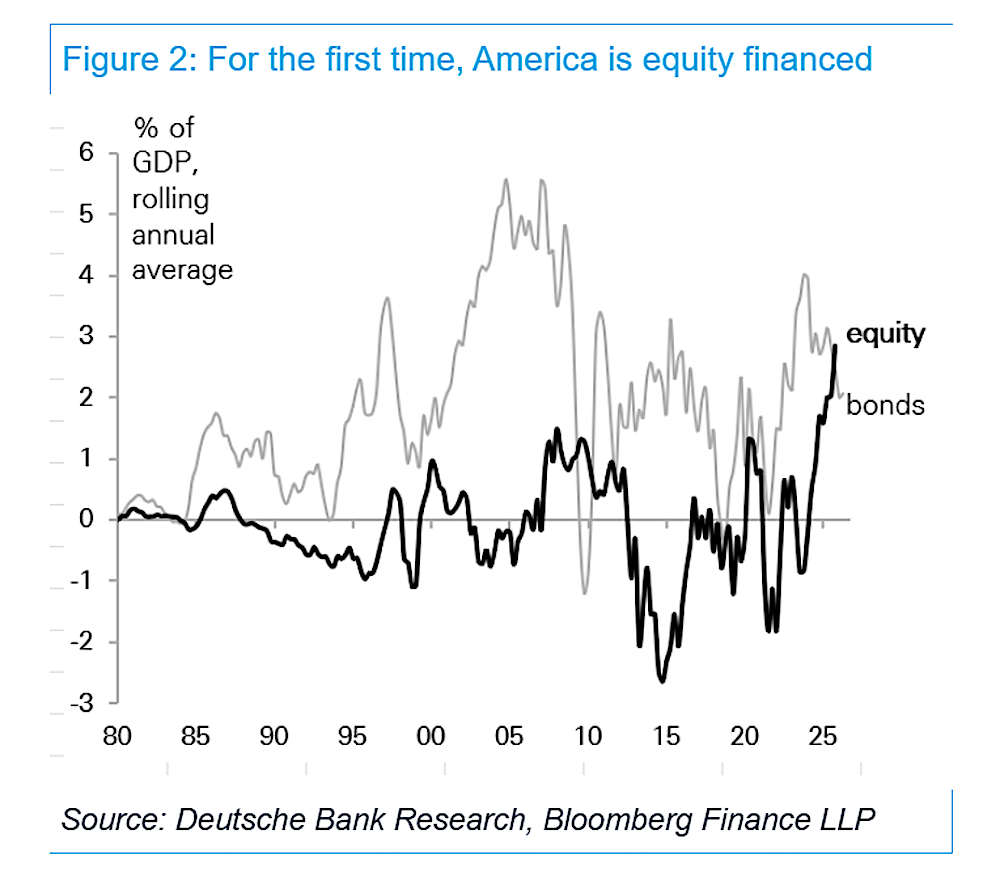
Conversely, the public sector’s financial health continues to deteriorate. The U.S. government is projected to run sustained budget deficits exceeding 6% of GDP for the foreseeable future, pushing the national debt ever higher. This fiscal imbalance, coupled with rising interest rates, makes U.S. government bonds less appealing to investors, who are increasingly wary of the long-term implications of unchecked public spending and burgeoning debt servicing costs. The preference for U.S. equities over bonds by foreign capital underscores a deep-seated belief in the dynamism and resilience of American businesses, even as concerns about the nation’s fiscal trajectory persist. This capital flow dynamic suggests that investors are distinguishing sharply between the private sector’s robust performance and the public sector’s fiscal challenges, pouring money into the former while shying away from the latter.
CHART OF THE DAY
Elon Musk’s Starlink already dominates space
Elon Musk’s ambitious satellite internet constellation, Starlink, has achieved an astonishing level of dominance in low Earth orbit, profoundly reshaping the landscape of space infrastructure. According to analysis by Deutsche Bank’s Marion Laboure and Camilla Siazon, Starlink now owns a staggering 54% of all operational satellites currently in orbit. This rapid expansion, fueled by SpaceX’s reusable rocket technology, has allowed Starlink to deploy thousands of satellites at an unprecedented pace, far outstripping competitors.
This orbital supremacy translates into significant market reach. Laboure and Siazon estimate that Starlink will boast approximately 17 million subscribers by the end of 2026. This growth trajectory highlights the company’s success in penetrating diverse markets, from remote rural areas lacking reliable broadband to maritime and aviation sectors, and even critical government and military applications. The Deutsche Bank analysts attribute Starlink’s competitive edge to two primary factors: its "ability to simultaneously increase speeds while cutting hardware prices." SpaceX’s vertically integrated model, from rocket manufacturing to satellite production and service delivery, enables continuous innovation, rapid deployment cycles, and cost efficiencies that other players struggle to match. The continuous upgrades to satellite technology and ground terminals, coupled with a strategic pricing model, have made Starlink a formidable force, making it "very hard for anyone else to compete" effectively on scale, speed, and cost. This dominance raises questions about orbital debris, spectrum allocation, and the future of space regulation, as one private entity controls such a significant portion of humanity’s access to near-Earth space.
NUMBER OF THE DAY: Foldable iPhone
$2,000-$2,500
This is the estimated price range for Apple’s highly anticipated foldable iPhone Ultra, a device that is expected to be unveiled on September 9th. Analysts from J.P. Morgan, led by Samik Chatterjee, project this premium price point, positioning the foldable iPhone at the very top tier of the smartphone market, even above existing flagship models. The high cost reflects the significant research and development investment in pioneering foldable screen technology, bespoke hinges, and Apple’s customary premium branding and materials.
However, despite the buzz, Chatterjee and his colleagues estimate that Apple will sell fewer than 10 million units of this inaugural foldable device. This conservative sales forecast is not necessarily a sign of anticipated failure, but rather an indication that the initial launch edition is primarily intended to serve as a "proof of concept." For Apple, this first foldable iPhone is less about immediate mass market penetration and more about establishing its presence in the burgeoning foldable segment, testing the technology with early adopters, gathering user feedback, and showcasing its engineering prowess. It marks Apple’s entry into a category already occupied by rivals like Samsung and Huawei, and its strategy appears to be a cautious, deliberate one, setting the stage for more widely available and potentially more affordable foldable models in subsequent generations. The "Ultra" moniker itself suggests a niche, aspirational product aimed at the most dedicated Apple enthusiasts and those willing to pay a substantial premium for cutting-edge innovation.
ONE MORE THING
Women and Millennials want a date to out-earn them—by a lot
A recent study into romantic partner preferences has unearthed a striking disconnect between financial aspirations and economic realities, particularly among American Millennials. The report, which surveyed individuals on their ideal partner’s income, revealed that U.S. Millennials (aged 30 to 45) hold the highest income expectations of any generation, desiring a romantic partner who earns a hefty $160,000 annually. This figure stands in stark contrast to the median annual earnings for individuals within that very age group, which currently sits at a significantly lower $72,020. This substantial gap highlights a growing economic pressure and a potential source of friction in modern relationships.
The data becomes even more revealing when broken down by gender, illustrating a pronounced disparity in financial expectations. Men, on average, expressed a preference for partners earning $101,000 a year, suggesting a desire for financial partnership and shared prosperity. However, women’s expectations were considerably higher, with an ideal partner income of $172,000 annually. This significant difference underscores a complex interplay of evolving gender roles, economic anxieties, and perhaps lingering traditional societal expectations.
Several factors could be contributing to these elevated financial aspirations. Millennials, in particular, have come of age in an era marked by rising student loan debt, escalating housing costs, and persistent inflationary pressures, making financial stability a paramount concern when seeking a life partner. The aspirational lifestyles frequently portrayed on social media might also influence these expectations, creating a perception of what constitutes a desirable standard of living. For women, while increasingly achieving professional success themselves, the higher income expectation for a male partner could reflect a continued emphasis on security, a desire for a comfortable lifestyle, or even a pragmatic response to the high cost of raising a family in today’s economic climate.
Conversely, these lofty expectations place immense pressure on men, especially given that the median income for their age cohort falls far short of what many women desire. This financial expectation gap could contribute to challenges in the dating market, potentially affecting relationship formation and marriage rates. It raises important questions about the sustainability of these ideals and how they will shape romantic dynamics and societal norms in the coming years. While financial compatibility is undoubtedly important, the study prompts a broader conversation about whether these increasingly ambitious income requirements are realistic and how they weigh against other crucial factors in a successful partnership, such as shared values, emotional connection, and mutual support.
