
 By Rifan Muazin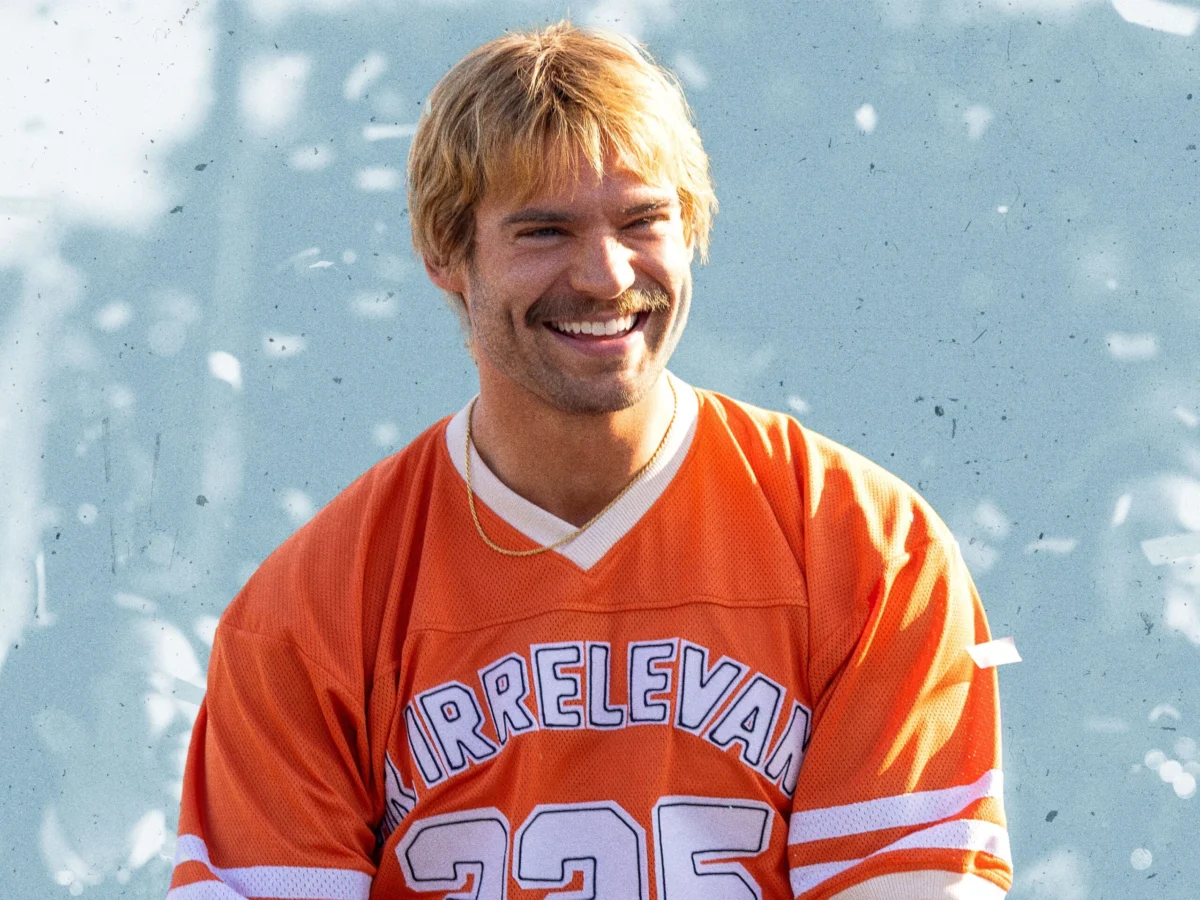
The cinematic world is currently fixated on David Corenswet as the new face of the DC Universe, stepping into the legendary red cape for James Gunn’s upcoming Superman. With his towering frame, chiseled jawline, and natural dark hair, Corenswet embodies the classic Clark Kent aesthetic that has defined the Man of Steel for generations. However, a series of leaked images and promotional stills from a different project have sent the internet into a frenzy, showcasing a side of the actor that is unrecognizable to those expecting a Kryptonian hero. In the upcoming biographical drama Mr. Irrelevant, Corenswet has traded his sleek, dark locks for a sun-bleached, sandy blonde mane and a rugged 1980s mustache, a transformation that highlights his versatility and commitment to the craft of character acting.
The film, directed by Jonathan Levine, tells the poignant and inspiring true story of John Tuggle, the New York Giants running back who earned the title of "Mr. Irrelevant" after being the final pick of the 1983 NFL Draft. While the moniker is often used as a playful jab in the sports world, Tuggle’s life and career were anything but irrelevant. To accurately portray a man who transitioned from the sun-soaked beaches of California to the gritty gridirons of the East Coast, Corenswet had to undergo a rigorous physical and aesthetic overhaul. The goal was not just to make him look like a professional athlete, but to capture the specific "80s surfer" essence that defined Tuggle’s public persona during his early years in the league.
Nikki Gooley, the makeup and hair designer for Mr. Irrelevant, recently spoke with GQ about the meticulous process of deconstructing Corenswet’s "leading man" polish to find the soul of an underdog. "John Tuggle had quite an ’80s surfer kind of feel; his hair was blonde from the sun and his skin was super bronzed," Gooley explained. This aesthetic was a direct reflection of Tuggle’s roots. A standout player at the University of California, Berkeley, Tuggle brought a West Coast sensibility to the New York Giants, standing out among the more traditional, clean-cut figures of the NFL at the time.
The responsibility of executing this vision fell largely on key hairstylist Chrissy Zemura. To ensure historical accuracy, Zemura immersed herself in archival footage, studying taped interviews from Tuggle’s early career and photographs from the "Mr. Irrelevant" parade. This parade, a tradition started by Paul Salata in 1976, honors the final draft pick with a week of festivities in Newport Beach, California. It was here that Tuggle’s California-cool look was most prominent—a center-parted fringe, sun-lightened hair, and an easygoing charm that masked the fierce competitor underneath.
Zemura’s technical approach involved more than just a simple dye job. To achieve the specific "sandy blonde" hue, she had to carefully lift Corenswet’s natural dark pigment without making the hair look bleached or artificial. The texture was equally important. "Back then, men did a lot more to their hair, but he was a footballer at the end of the day," Zemura noted. "He kind of just wore his hair how he wore his hair." To replicate this "effortless" look, she utilized Organic Suku’s styling cream, a product chosen for its ability to tame flyaways and provide structure without the heavy, "overdone" finish common in modern styling. In scenes where Tuggle was meant to look like he had just stepped off a beach or a practice field, Zemura incorporated sea salt sprays to encourage the hair’s natural wave and pattern.
The transformation was not merely cosmetic; it served as a psychological anchor for Corenswet. During the hours spent in the hair and makeup chair, the actor utilized the time to bridge the gap between himself and the character. Zemura recalls Corenswet repeating a specific mantra—"Tuggle, Tuggle, California"—to find the specific cadence and inflection of John’s accent. This vocal exercise, combined with the visual change in the mirror, allowed Corenswet to shed the weight of his other high-profile roles and inhabit the headspace of a man fighting for his place in the most competitive sports league in the world.
However, Mr. Irrelevant is more than a standard sports biopic. It is a story of immense triumph followed by a devastating personal battle. Shortly after his promising debut season, during which he was named the Giants’ Special Teams Player of the Year, Tuggle was diagnosed with angiosarcoma, a rare and aggressive form of cancer. The film follows this tragic turn of events, necessitating a second, much more somber transformation for Corenswet. As Tuggle undergoes treatment, the film depicts a ceremonious moment where he shaves his iconic blonde hair—first into a defiant mohawk and eventually into a complete buzz cut.
This narrative arc presented significant logistical challenges for the production team. Because films are rarely shot in chronological order, the hair department had to manage Corenswet’s physical appearance across multiple timelines simultaneously. "We had to keep two wigs on standby, which looked identical to his blonde shag cut," Zemura revealed. One of these wigs was specifically designated for scenes involving football equipment. The physics of a professional football helmet—designed to fit tightly and withstand high-impact collisions—are notoriously "unfriendly" to hairpieces. The friction between the interior padding of the helmet and the short, prickly hair of Corenswet’s actual buzz cut (maintained for the later scenes in the film) would have destroyed a standard lace-front wig.
To solve this, the team sacrificed one high-end wig entirely. "We had to use a specific wig that we just needed the ends and some of the hair in the front of the helmet," Zemura said. "So we just ruined one wig throughout the whole filming process." This "stunt wig" allowed the production to maintain visual continuity during intense action sequences on the field while preserving the "hero wig" for close-up emotional scenes.
The dedication to these details speaks to the larger trend in contemporary cinema where "invisible" craft—the work of hair, makeup, and costume designers—is essential for grounded storytelling. For Corenswet, Mr. Irrelevant represents a critical junction in his career. While Superman will undoubtedly catapult him into global superstardom, his portrayal of John Tuggle offers him the chance to demonstrate the range and vulnerability of a character actor. The contrast between the two roles is stark: one is an indestructible alien icon, the other a mortal man defined by his "irrelevance" who finds ultimate meaning in his struggle against both defenders on the field and a terminal illness off it.
The 1983 NFL Draft is often remembered as the "Year of the Quarterback," featuring legends like John Elway, Jim Kelly, and Dan Marino. John Tuggle was the 335th and final pick, a footnote in the history books of many, but a hero to those who knew him. He played in every game of his rookie season, a feat rarely accomplished by late-round picks, and his jersey number, 38, was later honored by the Giants in a moving tribute after his passing in 1986.
By capturing the specific aesthetic of the era—the "80s surfer" vibe that Nikki Gooley and Chrissy Zemura worked so hard to recreate—the film honors Tuggle’s spirit. It reminds the audience that before he was a patient or a statistic, he was a vibrant young man from California with sun-bleached hair and a dream. The early reactions to Corenswet’s blonde look suggest that the effort was well worth the cost of a ruined wig. Fans have praised the "lived-in" feel of the character, noting that Corenswet’s physical change helps strip away the "superhero" expectations, allowing the human story of John Tuggle to take center stage.
As the film moves toward its release, the buzz surrounding David Corenswet’s transformation continues to grow. It serves as a testament to the collaborative nature of filmmaking, where a stylist’s choice of sea salt spray or a makeup designer’s shade of bronze can be just as pivotal to a performance as the script itself. In Mr. Irrelevant, Corenswet isn’t just wearing a costume; he is wearing a history, a tragedy, and a legacy—one blonde strand at a time. Through this role, Corenswet proves that even the most "irrelevant" stories can be the most powerful when told with such meticulous care and profound empathy.
