
 By Lina Irawan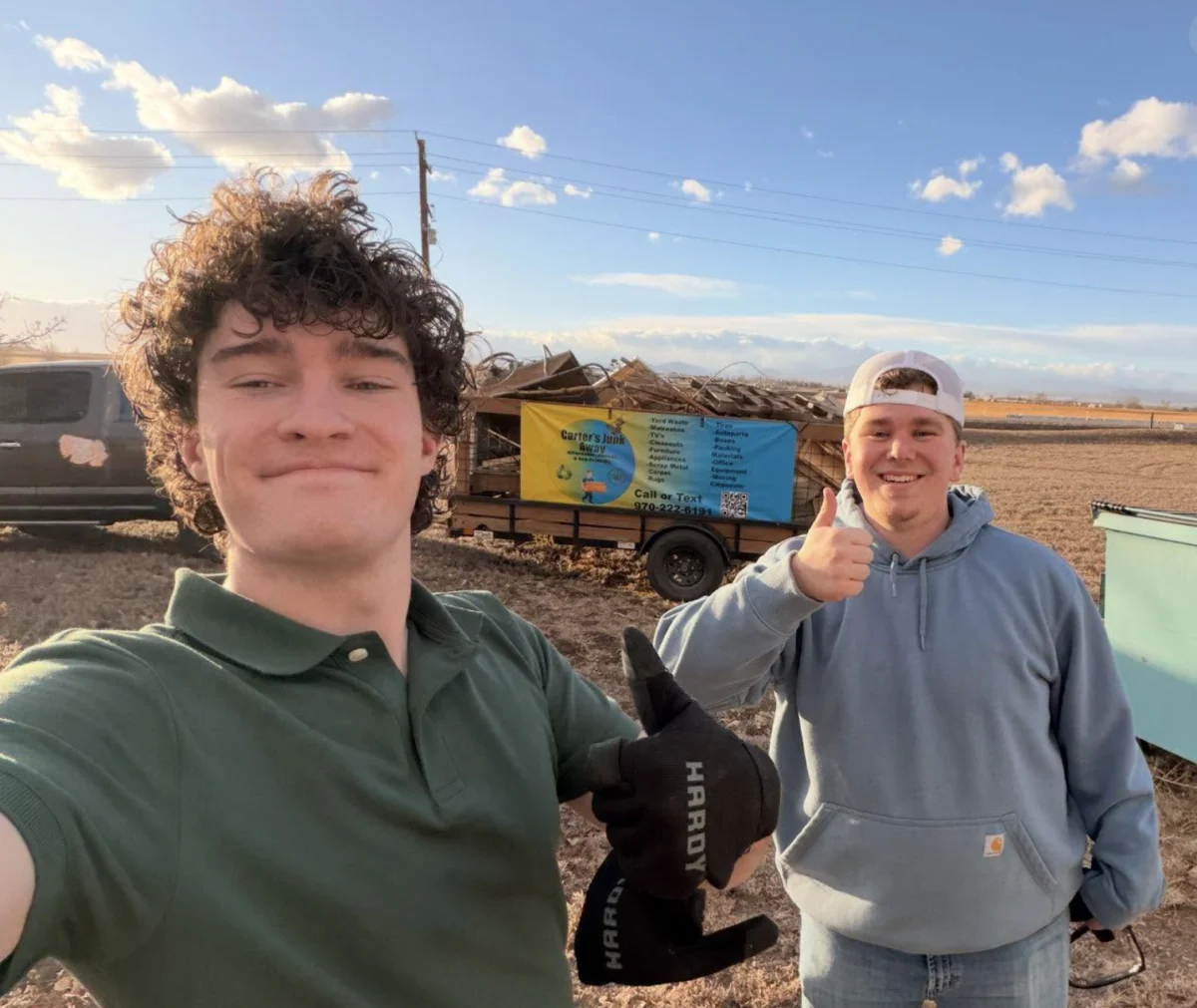
A new generation of entrepreneurs is rewriting the rulebook, eschewing traditional corporate ladders and college degrees in favor of building thriving blue-collar businesses, powered by digital savviness and a collaborative spirit. These young visionaries, often barely out of high school, are leveraging social media and technology to disrupt industries like junk removal and landscaping, proving that the path to financial independence can be paved with grit, innovation, and a smartphone.
One such trailblazer is Carter Grandbois, who at just 16 years old, stumbled upon an epiphany while working for a junk-removal operator in Johnstown, Colorado. The sight of his boss’s thick stack of cash in the truck’s center console ignited a spark. "That was kind of an eye-opener," Grandbois, now 18 and fully dedicated to his own enterprise, Carter’s Junk Away, recounted to Fortune. Days after that observation, he and his father invested in a trailer. Their very first job, completed in a mere 30 minutes, yielded a $500 payment – a tangible validation of his nascent entrepreneurial instinct.
Today, Carter’s Junk Away is a formidable operation, billing as much as $15,000 a month during peak seasons. Grandbois employs his high school friends as W-2 staff, a testament to his commitment to formalizing his growing business. However, his journey to profitability wasn’t linear. He candidly admits that true scalability and consistent earnings only materialized when he introduced rigorous systems: a proprietary pricing calculator, meticulous data tracking, and structured lead generation. Grandbois, with a touch of youthful exuberance, describes his approach as being "really into vibe-coding and creating software." This blend of intuitive understanding and systematic execution allows his teams to bid jobs "spot-on every single time," ensuring profitability. He proudly states that each completed job generates anywhere from $50 to $200 in profit without his direct physical presence on the truck, with overall job earnings ranging from $125 to $1,000. This shift from hands-on labor to strategic oversight, managing operations remotely, is the essence of his scaling success.
Grandbois isn’t content to merely hoard his hard-won knowledge. He champions a philosophy of sharing wealth and insights, particularly through social media. On TikTok, under the handle @american.junkremoval, he provides invaluable resources, including a universal pricing calculator accessible to anyone, and a more detailed "private junk-removal calculator" tailored for experienced businesses. When questioned about the potential of creating his own rivals by sharing such valuable tools, he remains unfazed. "That is one of the things with giving away stuff for free. You never know who’s watching the content. But at the end of the day, I know I’m doing something good for anyone else who’s trying to start." This collaborative spirit marks a distinct departure from older generations’ often guarded business practices. For Grandbois, the inspiration was clear: "it’s probably just like Instagram reels where you’re scrolling and you’re like, ‘That guy has a Lamborghini. That dude has a McLaren. Why can’t I have one of those?’" The aspirational imagery of social media serves as a powerful motivator, a modern-day equivalent to reading about corporate titans in Fortune magazine.
This phenomenon resonates deeply with Sam Pillar, the 44-year-old CEO and co-founder of Jobber, a home-services software company that empowers over 100,000 businesses and 400,000 service professionals. Pillar, whose company counts Grandbois as a client, observes a profound connection between the influencer economy and the burgeoning blue-collar entrepreneurial wave. "I think a lot of people would like to be influencers," he told Fortune, adding, "You kind of own your own business. You control everything." He sees significant overlaps between the life of a social media influencer and that of a burgeoning entrepreneur in blue-collar industries.
Pillar delves into the underlying motivations of Gen Z. While sidestepping a deep dive into the generation’s famously socialistic political identity, he notes that many young entrepreneurs in the blue-collar sector, often in their 20s, are "frustrated" by a perceived lack of opportunities to "participate in the upsides of capitalism" through traditional routes. Consequently, they are charting a new course, one that frequently bypasses the conventional four-year college path in favor of immediate earning potential, heavily amplified by social media. He offers a compelling, if unconventional, example: "One of my favorite ones is poop-scooping." Pillar explains that a driven 16 or 17-year-old could easily start such a service in a wealthy neighborhood, charging for a low-barrier-to-entry task. "They’re million-dollar businesses now. And they were started just in that kind of a way." This highlights the often-overlooked potential in seemingly humble services.
Another compelling narrative comes from Levi Boyd, the 20-year-old founder and CEO of Algo Landscaping. Boyd exemplifies the potent synergy between entrepreneurial drive and social media prowess. He started posting on Instagram around the same time his business hit its first $10,000 in revenue, an experience he credits with propelling him forward "further than anything." Unlike the older generation of contractors who often viewed competitors with animosity, Boyd actively engages with his online community, answering "every single comment, every single DM," and guiding newer operators through fundamental questions, from choosing the right lawnmower to strategic growth. He even seeks advice from more established creators, fostering a culture of mutual support.
Boyd starkly contrasts his approach with that of an older landscaper he apprenticed with as a teenager, who would "look at another landscaper and be like, ‘I hate that guy. Why is he working over here?’ Just pure hatred for for the other guys in the industry." This negative competitive mindset inspired Boyd to embrace the opposite. He has mentored numerous contractors he’s never met in person, including one operator in Chicago who transformed from having "nothing to a big truck, trailers, employees, fancy equipment. He’s doing basically what I do." Boyd attributes his benevolence to a simple truth: "There’s no shortage of work." His business growth underscores this philosophy, with revenues skyrocketing from roughly $28,000 (Canadian dollars) in year one, to $110,000 in year two, and an impressive $323,000 so far this year. His ambitious goal for next year? "I really want to do a million. That’s the goal. We’re gonna do a million next year, for sure."

Boyd’s journey also reflects a broader disillusionment with traditional higher education. A former finance major, he observed his friends from school pursuing "miserable" bank jobs, while he found greater fulfillment and financial success in landscaping. He dropped out after two years, finding college expensive and the learning experience unengaging. "I was just a good regurgitator," he quipped, "I wasn’t actually learning much, but yeah, I had a good GPA." He doesn’t regret his decision, asserting that he gains "way more applicable knowledge" from "scrolling on Instagram, honestly in a couple hours every day." This digital learning has tangible benefits; he learned how to apply a prominent logo to his trailer from Instagram, a move that subsequently landed him his "biggest contract to date" with a commercial property client.
Grandbois and Boyd are not isolated incidents but rather vanguards of a burgeoning movement toward small-business entrepreneurship. Data from the Census Bureau reveals that Americans filed an astounding 5.6 million new business applications last year, nearly double the pre-pandemic pace and marking the highest level on record. The Small Business Administration (SBA) highlights the immense economic impact of these ventures, accounting for 99.9% of all U.S. businesses, contributing to nearly nine out of ten net new jobs between 2023-2024, and employing 45.9% of private-sector workers. This surge is particularly significant given long-term labor-market trends, as noted by the Financial Times’ John Burn-Murdoch, which have shown non-college-educated young men to be the worst-performing cohort for decades. Grandbois and Boyd, therefore, represent either remarkable exceptions or, more likely, a potent sign of a transformative shift in the economic landscape.
This cultural recalibration also brings into focus the evolving expectations of young workers, as observed by Dr. Lee Bowes, who has helmed AmericaWorks, a for-profit workforce-placement organization, for nearly 40 years. Bowes notes that many young people entering her pipeline "don’t really, don’t have a specific goal in mind of what they care about, what their passion is for." They often become "churn," job-hopping every six months after pursuing degrees like communications, only to find a challenging job market. She finds them "very concerned" with remote work, ample vacation, and personal time, but often without a commensurate understanding that these privileges must be earned through dedication and effort. Bowes attributes "a lot of this is the problem of the parents as well," reflecting on her own upbringing by "very confused bohemians" who opened Boston’s first theater company.
Bowes, however, has found her own passion in helping former convicts reintegrate into the workforce, building prison-to-work pipelines for decades. "The best thing in the world is to see the reality of someone’s life being changed through work," she asserts, a belief born from her own experiences. She advocates for the transformative power of work, a message she’d readily share with Gen Z. She points to a practical employee, the daughter of immigrants, as an example of rare intentionality in choosing a major, lamenting the federal government’s stagnant approach to workforce placement, with Department of Labor frameworks unchanged since 1973.
The parental influence, which Bowes identifies as a key factor, is indeed undergoing a significant shift. Jobber’s Blue Collar Report reveals a dramatic reversal in attitudes. Just three years ago, 79% of Gen Z respondents reported their parents pushing them toward a four-year college degree, with only 5% considering vocational school. Today, a staggering 92% of parents with younger children say they would encourage a skilled-trade career if their child expressed interest. While long-term job stability remains a primary concern, 40% of Gen Z now express regret that they learned about the trades too late to seriously consider them. Levi Boyd’s parents embody this generational pivot. Initially "never really super financially literate," they urged him toward a four-year business degree, "They did not want me to mow lawns," he recalled. Yet, his success has likely shifted their perspective.
Scott Shaw, CEO of Lincoln Tech, a trade-school operator, has witnessed this evolution firsthand over his 22 years in the industry, following a decade in private equity. He identifies social media as the single most significant catalyst for change. Videos of welders and electricians sharing their daily work have proven more effective at recruitment than decades of institutional messaging. "I’m surprised that they attract so much attention," he admits, "but they’re educating folks." Shaw acknowledges America’s inherent entrepreneurial spirit, which historically channeled aspirations towards becoming a tech millionaire. Now, he observes, "People realize that going into the trades, you can be your own boss, too." This realization, shared by Grandbois at 16 and Boyd as he scaled his business, forms the core thesis of Sam Pillar’s Jobber. A recent Jobber survey of Gen Z workers confirms this trend, with 77% expressing a desire to become business owners, and nearly twice as many envisioning this through the trades (46%) rather than a college degree (24%).
However, this new path is not without its complexities and challenges. Grandbois, at 18, is betting on his youthful vigor for the physical demands of junk removal, a path that currently lacks traditional employer benefits like health insurance or a 401(k), representing a significant personal risk. Shaw also critiques the corporate sector, observing that "companies in general have lost the skill of onboarding, training, mentoring people." He argues that the prevalent retention crisis is often a failure of employers, not workers, pushing many Gen Z individuals to opt out of traditional corporate structures altogether.
Despite these hurdles, the entrepreneurial spirit of Grandbois and Boyd continues to innovate. Grandbois, though he may not yet own a Lamborghini, has invested wisely, acquiring a lightly used Ford F-250. His business has also diversified into "junk consulting," coaching others interested in the field. He estimates this coaching now accounts for 50% of his business, generating approximately $40,000 this year, and notably attracting "a bunch of 40-year-old dads who are also interested in starting a business like this," thanks to social media.
Boyd, meanwhile, is strategically engineering his own obsolescence from fieldwork. An avid user of AI tools, including Jobber’s AI receptionist, he aims to "automate this whole thing and be completely separated from it." He’s transitioning Algo Landscaping from installation projects to recurring commercial maintenance contracts, with the ambitious goal of fully removing himself from day-to-day operations within an estimated two and a half years. He acknowledges that the challenge isn’t merely scaling, but the mental shift required to step back from the work that initially generated his wealth. "It’s more with your head than it is with your hands," he concludes, encapsulating the sophisticated, strategic evolution of these young entrepreneurs who are not just doing blue-collar work, but redefining it.
