
 By admin
On a recent weekday evening, the southbound Aqua Line metro train in Mumbai experienced a near-total exodus of passengers a couple of stations before its ultimate destination. The scene upon disembarking was starkly reminiscent of a desolate Soviet-era structure, a far cry from the usual throng of people that characterizes this bustling Indian metropolis. This newly inaugurated, fully underground metro line, connecting Mumbai’s historic Cuffe Parade business district with modern commercial centers like BKC and the northern suburban airport terminals, opened its doors last year with ambitious projections. The 33.5-kilometer (20.8-mile) corridor was envisioned to alleviate the chronic congestion plaguing India’s financial capital, with an estimated daily ridership of nearly 1.5 million passengers. However, current figures suggest that the actual number of daily travelers is a mere fraction of this projection, estimated to be around one-tenth. "Not a lot of people are using the line. It’s too expensive," a ticketing executive at the Cuffe Parade station candidly admitted to the BBC.
This sparse ridership on the Aqua Line is emblematic of a broader challenge confronting the rapid and extensive expansion of India’s metro network. Since 2014, the government under Prime Minister Narendra Modi has allocated over $26 billion towards developing metro connectivity across almost two dozen Indian cities. The sheer scale of this undertaking is impressive; the metro network has quadrupled in size, growing from under 300 kilometers to exceeding 1,000 kilometers by 2025. Concurrently, average daily ridership has nearly quadrupled, climbing from three million to over 11 million passengers in the past decade. Yet, these impressive aggregate statistics mask a more concerning reality when scrutinized more closely.
Experts widely agree that most metro systems across India are falling significantly short of the ridership figures that were forecast during their initial planning phases. A comprehensive report published in 2023 by the Indian Institute of Technology Delhi revealed that ridership on various corridors hovered at a mere 25-35% of projected levels. One of the study’s authors, speaking anonymously to the BBC, indicated that these numbers are unlikely to have seen substantial improvement in 2024 and 2025. Supporting this assertion, research from the Observer Research Foundation (ORF) think tank highlights even more stark figures, with ridership in some Tier-3 cities, such as Kanpur, reaching as low as 2% of projected estimates. In the southern city of Chennai, the first phase of its metro saw ridership at only 37% of its anticipated figures. Data shared by the Institute for Transportation and Development Policy (ITDP) with the BBC further corroborates these findings, showing actual ridership between 20-50% in western Indian cities like Pune and Nagpur.
The national capital, Delhi, boasting India’s most extensive metro network, appears to be an exception, with usage figures marginally exceeding projections. However, transport experts Aditya Rane of ITDP and Ashish Verma of the Sustainable Transportation Lab at the Indian Institute of Science in Bengaluru suggest this anomaly might be attributed to a methodological shift. They point out that Delhi’s metro authority has begun counting passenger interchanges between different lines as separate trips, artificially inflating the overall ridership numbers.
The persistent question then arises: why is metro travel struggling to gain traction in a nation where car ownership remains relatively low and existing public transportation systems are often overcrowded and strained? The answer, according to experts, lies in a complex interplay of factors. Ashish Verma explains that a primary contributor is the often inaccurate, and sometimes inflated, demand projections made by consultants. "It is a complex task [to project demand], and figures are sometimes exaggerated to show the project is economically viable," he stated. Verma further elaborated that these forecasts are frequently based on "offered capacity," such as the number of coaches per train or the frequency of services, which have not always materialized in practice. For instance, in Bengaluru, peak-hour train frequencies on its busiest lines can be five minutes or more, while on newer lines, this interval can extend to 25 minutes. In comparison, the world’s busiest metro systems typically operate with nine coaches and a train frequency of every 90 seconds, according to data from the Sustainable Transportation Lab.
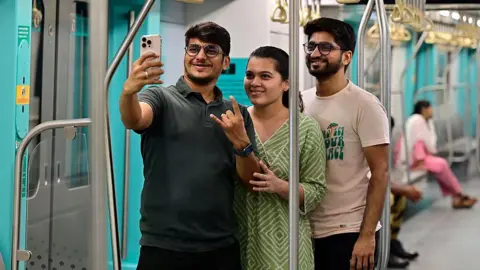
Affordability is another critical barrier to widespread metro adoption. A single journey on Mumbai’s Aqua Line can cost between 10 and 70 rupees (£0.08-£0.56). This is in stark contrast to a three-month unlimited travel pass on the local Mumbai suburban railway, which costs a significantly more economical 590 rupees. Aditya Rane highlights that the integrated journey cost for Indian metro systems can consume as much as 20% of a lower-income worker’s income, exceeding the global benchmark of 10-15%. Verma observes a growing trend towards reducing subsidies, a strategy he argues might be counterproductive in a price-sensitive economy like India’s. The public’s reaction to fare hikes was evident when Bengaluru metro increased its fares last year, resulting in a reported 13% drop in ridership, according to data compiled by Greenpeace. "Even the London Tube till today is heavily subsidised. Because there is a purpose. You are trying to provide sustainable mobility and decongest the city," Verma asserts, drawing a parallel to the subsidized nature of established global metro systems.
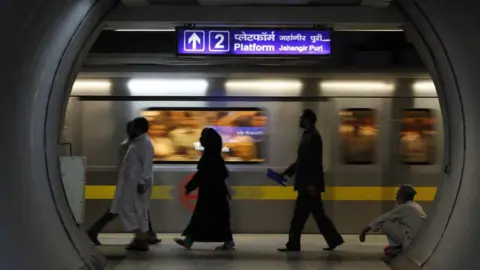
Beyond demand projections and fare structures, other significant issues are contributing to suppressed ridership, including inadequate network planning and a lack of effective last-mile connectivity. Nandan Dawda, a Fellow at ORF’s Urban Studies programme, emphasizes that commuters will only opt for public transport when waiting times are minimized. In India, a significant challenge is the insufficient number of feeder buses to facilitate seamless last-mile travel from metro stations to final destinations. Furthermore, transit times between different metro lines can be excessively long and cumbersome. At Delhi’s Hauz Khas station, for example, transferring between lines can consume as much as 15-20 minutes. Dawda attributes this inefficiency to "institutional disaggregation," where different metro lines and bus networks within the same city are often managed by disparate operators working in isolation, hindering necessary operational integration.
Compounding these challenges are concerns about the quality of pedestrian access to metro stations and, crucially, the safety of women commuters. Verma points out that "Access and approach to and from metro stations to other destinations has to be convenient to support the use of public transport." He illustrates this with a hypothetical scenario: "If I am a tourist even in a city like Delhi, I can’t drag my bag to the metro easily and walk to my hotel 500m away." For residents like Chetna Yadav, a 40-year-old living in north Delhi, safety is a paramount concern. "If I am coming home after sunset, I cannot rely on the metro. The station is about 15km from where I live and when I reach the final stop at night, it is next to impossible to get a cab home. I have been stuck in that situation a few times," she recounted.
Despite these pervasive issues, experts anticipate a gradual, incremental increase in metro usage. The escalating problems of traffic congestion, air pollution, parking scarcity, and road safety in many Indian cities are reaching a critical tipping point. Consequently, there are growing calls for measures such as congestion pricing for private vehicles. However, without the promise of more affordable and seamless metro journeys, a rapid and substantial surge in ridership is unlikely. Aditya Rane concludes that "The systems most likely to improve strongly are the ones that get bus integration, station access and fare integration right. Without that, India may continue to build metros that are operationally useful but still underperform against their original projections."
Additional reporting by Nikita Yadav.
