 By admin

Meta AI has unveiled its latest artificial intelligence model, Muse Spark 1.3, an advancement that promises significantly enhanced speed and performance, particularly in complex agentic tasks. This latest iteration, officially announced yesterday, builds upon the foundation of its predecessor, Muse Spark 1.2, and is already generating buzz for its competitive standing on third-party benchmarks. Mark Zuckerberg, Meta’s co-founder and CEO, heralded the release on X, describing it as Meta’s "biggest jump yet" in coding and agentic capabilities and noting its "frontier performance almost too cheap to meter."
The claims of substantial improvement are well-supported by internal evaluations and independent benchmarks. Muse Spark 1.3 demonstrates notable gains over the previous month’s 1.2 release, especially in its ability to handle long-running agent tasks, a critical factor for sophisticated AI applications. The version now accessible to developers is positioned as one of the most compelling price-performance offerings near the pinnacle of independent model rankings, a testament to Meta’s rapid development cycle.
However, the full extent of Muse Spark 1.3’s capabilities is nuanced. The most impressive benchmark results reported by Meta stem from its "max reasoning" configuration. This premium version, however, is still undergoing additional safety testing and is slated for release "shortly." The independent benchmarking firm Artificial Analysis, which evaluated the "max" variant during a limited partner preview, currently lists no API provider for this specific configuration, underscoring its experimental nature.
The version broadly rolling out this week, accessible through Meta’s Muse Code harness and the Meta Model API, utilizes the company’s previously established reasoning settings, including the "xhigh" configuration. This distinction is crucial for enterprise adoption, shifting the focus from theoretical frontier capabilities to the practical performance and cost-effectiveness of the currently deployable model. The core enterprise question, therefore, is not whether Muse Spark 1.3 can reach frontier territory, but rather how close the version readily available today gets, and at what real-world cost.
The currently shipping model, while highly capable, does not consistently lead the pack in all benchmarks. Meta has been transparent in disclosing results for both configurations in its underlying evaluation reports, ensuring that the deployable model’s performance is not obscured by the promise of future enhancements. Nevertheless, the company’s launch materials prominently feature the "max" variant, and some of its most significant benchmark scores are attributed to this configuration.
For instance, Meta reports GDPval-AA v2 scores of 1,754 Elo for the "max" configuration versus 1,709 for "xhigh," and OSWorld 2.0 scores of 66.9 compared to 57.2. Similarly, JobBench scores show a divergence, with "max" achieving 64.9 against "xhigh"’s 61.2. These figures highlight a tangible performance gap between the two versions.
However, on certain tests, the distinction is negligible or even reversed. DeepSearchQA scores are tied at 89.4, and on Terminal-Bench 2.1, the "xhigh" configuration scores 89.2, slightly outperforming the "max" version’s 88.8. This indicates that the performance edge of the "max" configuration is not uniform across all tasks.
According to Artificial Analysis, Muse Spark 1.3 "max" achieves an Intelligence Index score of 62. The shipping "xhigh" version scores 61, a score that ties it with other notable models like GPT-5.6 Sol max, Grok 4.6 high, and Claude Opus 5 high. Despite this strong performance, Anthropic continues to hold the top positions on the leaderboard, with Claude Fable 5.1 reaching 66 at "max" and 65 at "xhigh," and Claude Opus 5 achieving 63 at both "max" and "xhigh" configurations. This positions Muse Spark 1.3 "xhigh" firmly within the frontier cluster but not as the definitive leader.
This represents a significant leap from Muse Spark 1.2. VentureBeat’s previous coverage noted that while Muse Spark 1.2 was a credible coding challenger, it generally lagged behind Anthropic’s top-tier models. For example, Muse Spark 1.2 scored 82.9% on Terminal-Bench 2.1, falling short of Opus 5’s 86.7%, and also trailed Opus in other key coding comparisons presented by Meta. With the 1.3 release, Meta is no longer just participating; it is actively trading wins with industry leaders like OpenAI and Anthropic on several coding and agentic evaluations.
Beyond raw performance, Meta emphasizes that Muse Spark 1.3 has been engineered for improved usability and efficiency. The model is now trained to manage multiple workflows within extended conversational threads, effectively gather context using tools, identify gaps in its own planning processes, and proactively seek user clarification when necessary, ensuring confirmation before executing critical actions. Internal comparisons by Meta engineers suggest that this optimization has led to approximately 20% fewer tool calls and 25% fewer tokens consumed during coding tasks compared to Muse Spark 1.2. For enterprises that rely on thousands or even millions of agent interactions, these behavioral improvements could prove more impactful than marginal gains on leaderboards.
Zuckerberg’s assertion of Muse Spark 1.3 being "almost too cheap to meter" does not stem from a reduction in API pricing. Meta has maintained the existing Standard pricing for Muse Spark 1.3, mirroring that of Muse Spark 1.2: $1.25 per million input tokens, $4.25 per million output tokens, and $0.15 per million cached input tokens. This pricing structure places it competitively, but not at the absolute lowest tier when compared to some other models.

| Model | Input ($/1M) | Output ($/1M) | Total ($/1M) | Source |
|---|---|---|---|---|
| Muse Spark 1.2 / 1.3 Contributor | $0.10 | $0.20 | $0.30 | Meta |
| MiMo-V2.5 Flash | $0.10 | $0.30 | $0.40 | Xiaomi |
| DeepSeek-V4-Flash – off-peak | $0.22 | $0.66 | $0.88 | DeepSeek |
| GPT-5.6 Luna | $0.20 | $1.20 | $1.40 | OpenAI |
| MiniMax-M3 | $0.30 | $1.20 | $1.50 | MiniMax |
| LongCat-2.0 – limited-time promo | $0.30 | $1.20 | $1.50 | LongCat |
| DeepSeek-V4-Flash – peak hours | $0.44 | $1.32 | $1.76 | DeepSeek |
| MiMo-V2.5 | $0.40 | $2.00 | $2.40 | Xiaomi |
| DeepSeek-V4-Pro – off-peak | $0.66 | $1.98 | $2.64 | DeepSeek |
| LongCat-2.0 – standard | $0.75 | $2.95 | $3.70 | LongCat |
| MiMo-V2.5 Pro (≤256K) | $1.00 | $3.00 | $4.00 | Xiaomi |
| Gemini 3.7 Flash – through Dec. 31, 2026 | $0.75 | $3.75 | $4.50 | |
| Gemini 3.8 Flash – through Dec. 31, 2026 | $0.75 | $3.75 | $4.50 | |
| DeepSeek-V4-Pro – peak hours | $1.32 | $3.96 | $5.28 | DeepSeek |
| Muse Spark 1.1 / 1.2 / 1.3 | $1.25 | $4.25 | $5.50 | Meta |
| GLM-5.3 | $1.40 | $4.40 | $5.80 | Z.AI |
| Grok 4.6 – <200K prompt tokens | $2.00 | $6.00 | $8.00 | xAI |
| MiMo-V2.5 Pro (>256K) | $2.00 | $6.00 | $8.00 | Xiaomi |
| Qwen3.8-Max | $2.00 | $6.00 | $8.00 | QwenCloud |
| Gemini 3.7 Flash – starting Jan. 1, 2027 | $1.50 | $7.50 | $9.00 | |
| Gemini 3.8 Flash – starting Jan. 1, 2027 | $1.50 | $7.50 | $9.00 | |
| GPT-5.6 Terra | $2.00 | $12.00 | $14.00 | OpenAI |
| Grok 4.6 – ≥200K prompt tokens | $4.00 | $12.00 | $16.00 | xAI |
| GPT-5.4 | $2.50 | $15.00 | $17.50 | OpenAI |
| Kimi K3 | $3.00 | $15.00 | $18.00 | Moonshot AI |
| Claude Opus 5 | $5.00 | $25.00 | $30.00 | Anthropic |
| Sakana Fugu Ultra (≤272K) | $5.00 | $30.00 | $35.00 | Sakana AI |
| GPT-5.6 Sol – Standard mode | $5.00 | $30.00 | $35.00 | OpenAI |
| Claude Fable 5 / Claude Mythos 5 | $10.00 | $50.00 | $60.00 | Anthropic |
| Claude Fable 5.1 / Claude Mythos 5.1 | $10.00 | $50.00 | $60.00 | Anthropic |
| GPT-5.6 Sol – Fast mode | $10.00 | $60.00 | $70.00 | OpenAI |
Zuckerberg’s "almost too cheap to meter" remark likely refers not to the per-token cost, but to the perceived value and efficiency gained by developers utilizing Muse Spark 1.3 for complex tasks. Artificial Analysis provides data to support this argument, albeit with a complication. The firm measures Muse Spark 1.3 "xhigh" at 235.2 output tokens per second and estimates a cost of $0.55 per Intelligence Index task. At an Intelligence Index score of 61, this translates to the lowest cost per task among models evaluated at that intelligence level.
| Intelligence Index vs. Cost to Run Artificial Analysis Intelligence Index (3 Sep -26) |
|---|
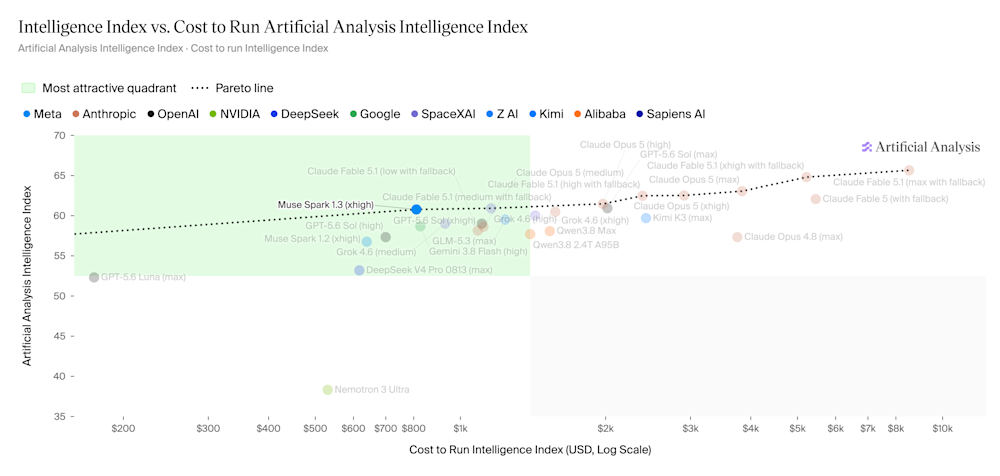 |
In comparison, Muse Spark 1.2 cost only $0.40 per task while scoring 57 on the Intelligence Index. This means that despite the unchanged per-token pricing, the cost of completing an average task, as measured by Artificial Analysis, has increased from 1.2 to 1.3. This rise is primarily attributed by the firm to increased input-token consumption on agentic evaluations. This observation does not directly contradict Meta’s claim of 25% lower token use, as Meta’s comparison focuses on its internal coding workflows, whereas Artificial Analysis measures a broader spectrum of reasoning and agentic tasks. However, it illustrates the complexity of "cheapness" in AI, where token rates, reasoning effort, interaction turns, tool calls, and retries all contribute to the ultimate cost of task completion, particularly when models operate as agents.
Meta also continues to offer its unusually low-priced Contributor tier, priced at $0.10 per million input tokens and $0.20 per million output tokens. This tier requires users to grant Meta permission to use their prompts and completions for training purposes. As previously noted by VentureBeat with Muse Spark 1.2, this tier may be attractive for prototyping but presents significant data governance considerations for enterprises handling proprietary code or sensitive internal information.
Meta’s Chief AI Officer, Alexandr Wang, expressed a more assertive sentiment regarding the release. Following Artificial Analysis’s posting of Muse Spark results, Wang reposted them on X, provocatively asking, "i really hate to say it, but… gemini who? 🤯" This jab was particularly pointed given that Google launched its Gemini 3.8 Flash on the same day, targeting similar workloads such as long-horizon software engineering, autonomous agents, and multi-step professional reasoning. Google has positioned Gemini 3.8 as its most advanced reasoning and coding Flash model to date, marking its third Flash release in just six weeks.
Independent benchmarks offer some support for Wang’s claim, though not a decisive victory. Artificial Analysis scores Muse Spark 1.3 "xhigh" at 61 on the Intelligence Index with a cost of $0.55 per task. This compares to Gemini 3.8 Flash "high" at a score of 59 and a cost of $0.58 per task. In this specific comparison, Meta’s model edges out Google’s on both intelligence and task cost.
However, Google holds a clear advantage in throughput. Artificial Analysis measures Gemini 3.8 Flash "high" at approximately 305 output tokens per second, significantly faster than Muse Spark’s 235 tokens per second – a difference of about 30%. Furthermore, Gemini currently boasts a lower raw API sticker price. Google is offering an introductory rate of $0.75 per million input tokens and $3.75 per million output tokens, compared to Meta’s $1.25 and $4.25 respectively. It’s important to note that this promotional Google pricing is set to expire on December 31, after which it will increase to $1.50 per million input tokens and $7.50 per million output tokens.
This dynamic presents a compelling snapshot of the increasingly competitive economics of frontier AI models. Currently, Meta holds a narrow lead in this independent comparison, with two Intelligence Index points and a three-cent advantage per benchmark task. Google, on the other hand, offers substantially higher output throughput and more affordable raw token costs during its launch promotion. Wang’s "gemini who?" quip serves as spirited executive banter. For an enterprise architect, the practical answer suggests Gemini is the faster option, while Muse Spark, by this independent measure, is currently the slightly stronger, albeit more effort-intensive, agent.
Perhaps the most consequential aspect for many developers lies in Meta’s evolving stance on open-weight models. When Meta launched Muse Code and Muse Spark 1.2 in August, VentureBeat observed a significant departure from the open-weight strategy that had propelled Llama to ubiquity. Muse Code and Spark 1.2 were proprietary, API-served products, a striking shift for a company that had long championed open AI as the path forward.
Meta, however, altered its course again just five days later. On August 10, the company released the 30-billion-parameter Muse Glimmer under an Apache 2.0 license. Zuckerberg also stated that Meta planned to "open the weights for Muse Spark 1.2" in the coming weeks, a plan also reported by Reuters.
Now, with the release of Muse Spark 1.3 as another proprietary model, the roadmap for open-weight availability has become less clear. Meta’s latest announcement no longer specifies Muse Spark 1.2 but refers to its roadmap including "the Muse Spark open weights release," without providing details on the version, release date, model size, or license. Zuckerberg’s X post similarly mentioned "Muse Spark open weights releases" coming soon.
For development teams that have standardized on Llama due to the benefits of downloadable weights enabling self-hosting, customization, and control over inference economics, this ambiguity may carry more weight than incremental benchmark gains. Muse Spark 1.3 demonstrates Meta’s ability to rapidly iterate on proprietary frontier models. The currently available "xhigh" configuration is fast, competitively priced, and significantly closer to the top of independent rankings than its predecessors. The "max" preview hints at Meta’s capacity to push the model family further when more reasoning compute is allocated. The next critical challenge for Meta is to translate this impressive development pace into a predictable roadmap for enterprises and to deliver on its promised open-weight Spark model.
