
 By admin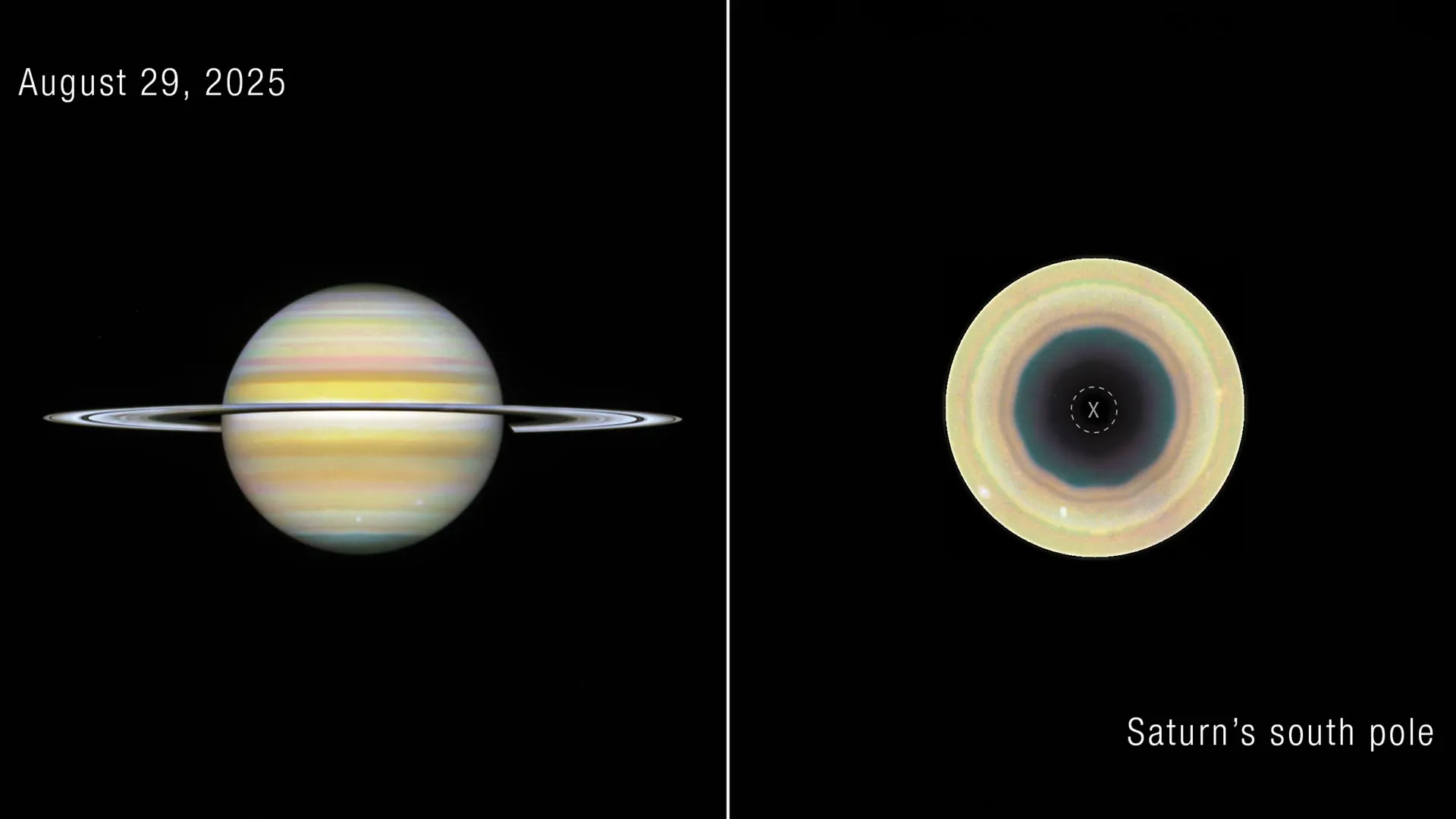
This groundbreaking observation marks the first instance scientists have documented a large, regularly shaped jet pattern within Saturn’s southern hemisphere. While the newly identified decagonal structure shares some superficial resemblances with Saturn’s iconic northern hexagon, crucial distinctions underscore that researchers are likely witnessing a unique and dynamically evolving atmospheric phenomenon. The remarkable findings, which promise to reshape our understanding of gas giant atmospheric physics, were meticulously detailed and published in the esteemed journal Science Advances.
Saturn, often dubbed the "Jewel of the Solar System" for its magnificent ring system, is also a planet of profound atmospheric mysteries. Its atmosphere is a turbulent, ever-shifting canvas of storms, belts, and zones, driven by powerful winds that can reach speeds of up to 1,800 kilometers per hour (1,100 mph). Among its most enigmatic features is the northern polar hexagon, a colossal, six-sided jet stream that has mystified scientists since its discovery by the Voyager probes in the early 1980s. This hexagon, wider than two Earths, is a remarkably stable, long-lived vortex, seemingly anchored to the planet’s north pole and exhibiting little variation over decades of observation. Its very existence challenges conventional fluid dynamics models, making it a prime target for atmospheric research. The northern hexagon’s stability and persistence have led scientists to ponder whether a similar, perhaps symmetrical, structure might exist at Saturn’s opposite pole. For years, this question remained unanswered, fueling a persistent search across decades of telescopic data.
The emergence of this new southern decagon provides a compelling counterpoint to its northern cousin. Researchers, leveraging years of archival data from the Hubble Space Telescope, meticulously reconstructed the feature’s development, tracing its subtle genesis back to observations in 2023. Earlier images, initially showing only faint, undulating patterns, gradually revealed the structure coalescing into the much clearer, well-defined decagonal shape observed more recently. This evolutionary aspect is key; unlike the seemingly static northern hexagon, the southern decagon appears to be strengthening and changing, offering an unprecedented opportunity to witness the birth and maturation of a giant atmospheric pattern in real-time.
These crucial observations are a testament to the longevity and strategic vision of Hubble’s Outer Planet Atmospheres Legacy (OPAL) program. For over a decade, OPAL has systematically captured annual, high-resolution images of the outer planets—Jupiter, Saturn, Uranus, and Neptune—creating an invaluable long-term dataset that allows scientists to track seasonal shifts, monitor transient storms, and identify subtle, gradually developing atmospheric patterns. "We’ve never seen anything quite like this in Saturn’s southern hemisphere," commented Amy Simon, a study co-author and the principal investigator for the OPAL program at NASA’s Goddard Space Flight Center in Greenbelt, Maryland. "The northern hexagon has been there every time we’ve looked for more than 40 years. This feature is different—it appears to be strengthening, giving us the rare opportunity to watch a giant atmospheric pattern develop." This distinction underscores the dynamic nature of the southern feature compared to the northern hexagon’s steadfast stability, hinting at potentially different underlying mechanisms.
Saturn’s unique seasonal cycle played an instrumental role in the decagon’s discovery. With an axial tilt of 26.7 degrees, similar to Earth’s, Saturn experiences pronounced seasons, though each season lasts for approximately seven Earth years due to its nearly 30-year orbital period around the Sun. As Saturn transitioned through its seasonal cycle, its south pole gradually emerged from the prolonged darkness of winter, becoming increasingly illuminated and visible from Earth. It was during this period of increasing visibility that astronomers, both professional and amateur, began to recognize the unusual structure.
The initial recognition of the decagon highlights the increasingly vital role of citizen science and collaborative astronomy in modern discovery. Study lead author Agustín Sánchez-Lavega, a distinguished researcher at the University of the Basque Country in Spain, leads the Planetary Virtual Observatory Laboratory. This innovative online platform serves as a global repository for ground-based images of solar system planets, submitted by a vast network of dedicated observers worldwide. It was within this rich dataset that the first hints of the decagon began to appear. In images from 2024, Sánchez-Lavega, working alongside experienced amateur astronomers Trevor Barry and Jean-Paul Oger, noticed a faint, wavy band subtly emerging near Saturn’s south pole. As more ground-based observations poured in during 2025, the evidence grew stronger, unequivocally indicating that the feature had developed into a distinct decagonal shape.
Upon this initial detection, researchers swiftly turned to the unparalleled capabilities of the Hubble Space Telescope for a more detailed and definitive view. Observing from its vantage point in Earth orbit, Hubble bypasses the atmospheric blurring and distortion that can plague ground-based telescopes, capturing images of exquisite sharpness and clarity. This allowed scientists to obtain complete, high-resolution views across full rotations of Saturn, revealing the decagon in unprecedented detail. Sánchez-Lavega articulated the long-standing scientific pursuit: "Given Saturn’s symmetry in its north-south jet stream system, we have been searching for a counterpart to Saturn’s northern hexagon on the south pole in Hubble images since 1990." The expectation of symmetry is rooted in the fundamental principles of fluid dynamics governing planetary atmospheres, where similar forces often create analogous patterns at opposing poles.
However, a crucial piece of the puzzle came from another iconic mission: NASA’s Cassini spacecraft, which orbited Saturn for an incredible 13 years between 2004 and 2017, providing an unparalleled close-up study of the ringed planet. Sánchez-Lavega noted, "Images from NASA’s Cassini spacecraft… showed no inkling of a long-lived formation, either." The absence of a stable, long-term structure in Cassini’s extensive dataset strongly suggests that the southern decagon is a relatively recent phenomenon, solidifying the idea that this is an "evolving" feature, unlike the ancient northern hexagon. The subsequent analysis of Hubble’s historical data confirmed the feature’s presence, definitively tracing its nascent stages back to 2023. This multi-observatory approach, combining amateur, ground-based professional, and space-based telescope data, proved indispensable for both discovery and contextualization.
Further observations have unveiled the decagon as a deep atmospheric structure, extending far beyond the superficial cloud tops. It lies nestled within one of Saturn’s powerful, high-speed jet streams, which are akin to the Earth’s jet streams but operate on a vastly larger scale within the planet’s gaseous envelope. The fact that the decagon is not merely a transient surface pattern but a vertically extended structure implies that it is deeply coupled with the complex dynamics of Saturn’s lower and middle atmosphere. This depth is critical because it suggests that whatever mechanism is driving this decagon is influencing significant portions of the planet’s atmospheric column.
Intriguingly, the apparent location and subtle characteristics of the decagon shift slightly depending on the specific wavelength of light used by Hubble. Different wavelengths penetrate to varying depths within Saturn’s atmosphere, acting as spectroscopic "probes" for distinct altitude layers. For instance, visible light might capture features at the main cloud decks, while ultraviolet light could reveal hazes higher in the stratosphere, and infrared wavelengths might peer into deeper atmospheric regions. These small shifts in the decagon’s apparent position across different wavelengths provide astronomers with a powerful diagnostic tool, allowing them to map its vertical extent and understand how its shape and intensity might vary through different atmospheric layers.
"The most intriguing part to me is that this seems to have just formed recently," remarked Amy Simon, articulating the central enigma. "The question is, why did it suddenly form now when we haven’t seen one before?" This question lies at the heart of future research. Scientists are currently grappling with what might have triggered the decagon’s formation and whether it will endure as a stable, long-lived feature, mirroring the northern hexagon, or if it represents a more transient, dynamic phase in Saturn’s atmospheric evolution.
To unravel these mysteries, the research team emphasizes the necessity of continued, multi-faceted observations. The Hubble Space Telescope will remain a critical asset for its long-term monitoring capabilities in visible and ultraviolet light. However, the unique infrared capabilities of NASA’s James Webb Space Telescope (JWST) will be invaluable, allowing scientists to probe even deeper into Saturn’s atmosphere, potentially revealing the heat distribution and chemical composition associated with the decagon. Complementing these observational efforts, sophisticated computer modeling and numerical simulations will be essential. These models, based on the principles of fluid dynamics, can help scientists explore various scenarios for the decagon’s formation, predict its potential evolution, and determine the intricate interplay of forces that might be sustaining it. This combined approach will be crucial to understanding how the structure formed, how long it might survive, and the extent to which it resembles or differs from Saturn’s long-lasting northern hexagon.
Hubble’s remarkable operational history, spanning over three decades, has endowed astronomers with an unparalleled ability to track and analyze changes on planets and other celestial objects over extended periods. Unlike fleeting flyby missions, which provide only isolated snapshots, programs like OPAL exemplify the profound value of sustained, repeated observations. These continuous datasets are not just collections of images; they are chronicles of planetary evolution, enabling scientists to monitor gradual seasonal shifts, follow the life cycles of temporary storms, and, as in the case of the southern decagon, identify and study atmospheric patterns that develop and evolve over years.
"When we started the OPAL program, we expected compelling surprises, but we didn’t know what to expect specifically," said Mike Wong, a study co-author at the University of California, Berkeley. His sentiment underscores the serendipitous yet profoundly rewarding nature of long-term scientific endeavors. "A lot of the discoveries we see coming from OPAL are not just based on one observation, but on years and years of data. Regular observations over time are enabling a lot of new findings." This commitment to sustained observation is fundamental to unlocking the secrets of dynamic planetary systems.
Researchers will continue their vigilant monitoring of Saturn, eager to discern whether the southern decagon will stabilize into a permanent, long-lived feature akin to the northern hexagon or whether its evolving nature portends a more ephemeral existence. Future observations hold the key to explaining the precise mechanisms that power this colossal wave and, more broadly, what it can teach scientists about the fundamental atmospheric behavior of giant planets across our solar system. Insights gained from studying Saturn’s extreme atmospheric dynamics can also provide broader implications for understanding fluid dynamics and weather patterns on Earth, illuminating universal principles that govern atmospheric systems on worlds vastly different from our own. The decagon on Saturn’s south pole stands as a vibrant testament to the dynamic and still largely mysterious nature of our cosmic neighborhood, promising a new era of discovery in planetary science.
