
 By admin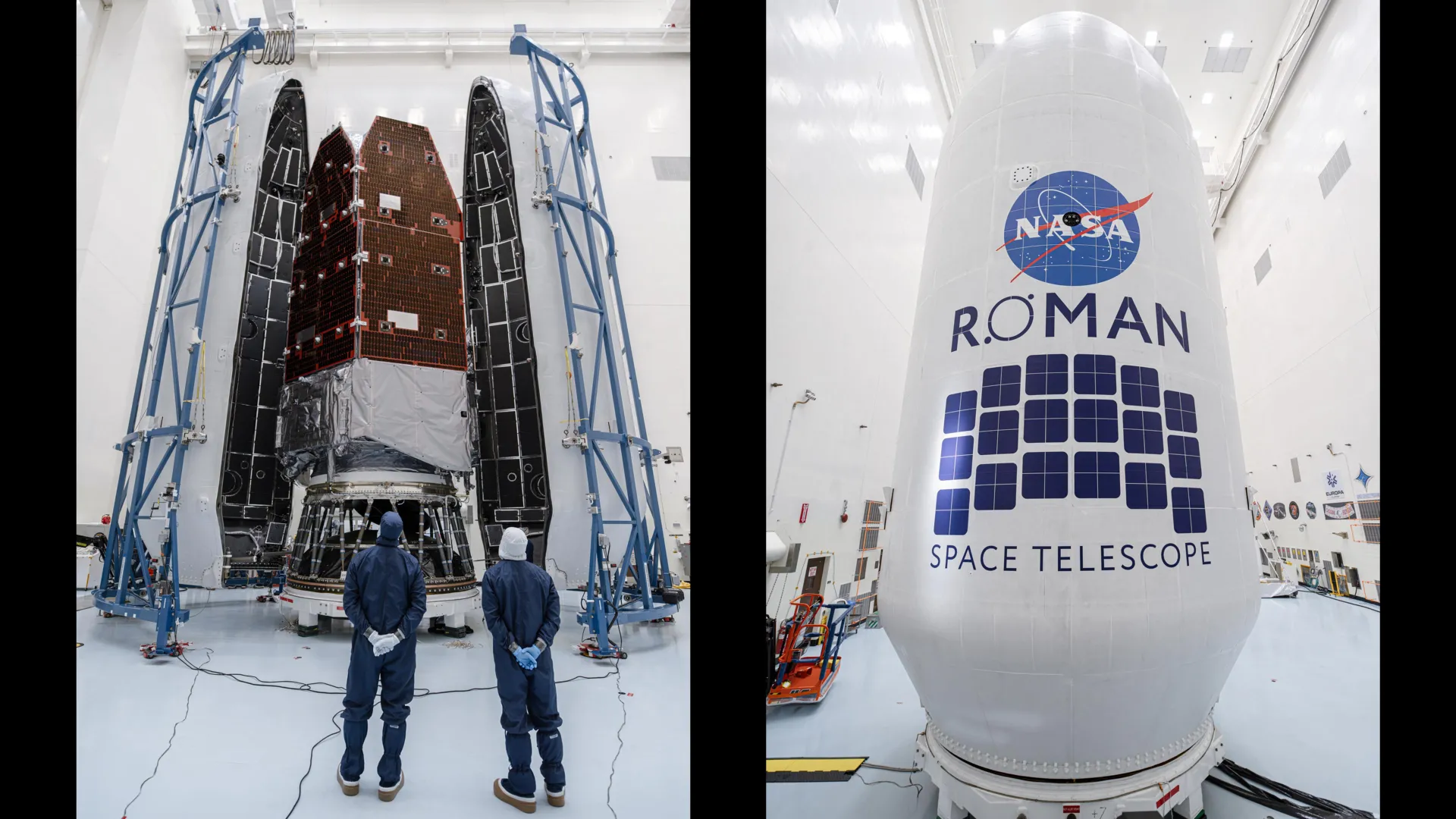
The fairing, a colossal shell standing an impressive 43 feet tall, serves as the spacecraft’s vital shield. Its primary role is to safeguard Roman from the moment it is enclosed until it is safely beyond the densest parts of Earth’s atmosphere. This protective cocoon is not merely a cover; it’s a precisely engineered environment designed to protect Roman from the myriad stresses encountered both on the ground and during the violent ascent into space. Within the PHSF, a state-of-the-art cleanroom facility, the fairing also maintains a meticulously controlled environment, shielding the sensitive telescope from contamination, temperature fluctuations, and humidity variations as it is prepared for integration with the launch vehicle and subsequent transport to the launch pad. The decision to use the SpaceX Falcon Heavy, one of the most powerful operational rockets in the world, underscores the scientific community’s high expectations for Roman and the payload’s substantial mass and precise orbital insertion requirements.
A Protective Shell for the Ride to Space: Engineering for Extremes
Launch exposes spacecraft to an array of extreme conditions that could irreparably damage sensitive optical instruments and detectors. As the Falcon Heavy rockets skyward, Roman will endure powerful acoustic loads, intense aerodynamic pressure, and significant heating. The fairing is engineered to mitigate these formidable stresses. During liftoff, the sheer power of the rocket engines generates sound waves so intense they can induce severe vibrations throughout the payload. The fairing acts as an acoustic dampener, designed with materials and structures to absorb and deflect these energy waves, preventing them from reaching the telescope’s delicate components.
The ascent through Earth’s atmosphere also subjects the rocket and its payload to immense aerodynamic forces. The peak dynamic pressure, known as "Max-Q," is a critical phase where the combination of the rocket’s speed and atmospheric density creates the greatest mechanical stress. The fairing’s robust structure is built to withstand these pressures, maintaining its integrity and ensuring Roman remains shielded from the turbulent airflow. Furthermore, friction with the atmosphere generates considerable heat, particularly on the fairing’s outer surface. Specialized thermal protection systems integrated into the fairing prevent this heat from transferring to the observatory, maintaining its internal temperature within precise operational limits. The fairing, along with specialized ground support equipment, also maintains a pristine, climate-controlled environment, crucial for preventing dust or moisture from contaminating Roman’s mirrors and instruments, which are designed to detect faint infrared light from billions of light-years away.
Once the Falcon Heavy has climbed high enough—typically several minutes after liftoff, at altitudes where the surrounding atmosphere is too thin to pose a threat—the fairing becomes redundant. At this precise moment, an intricate sequence of events is triggered: pyrotechnic devices, often small explosive bolts, sever the connections holding the two halves of the fairing together. Simultaneously, pneumatic systems or springs push the halves outward, allowing them to gracefully separate and fall away from the accelerating second stage and its precious cargo. This separation is meticulously timed to ensure Roman is fully exposed to space only when it is safe to do so. A notable aspect of SpaceX’s operations is its commitment to recovering both fairing sections after they return to Earth, a pioneering effort aimed at reducing launch costs and increasing reusability in spaceflight, aligning with broader sustainability goals in the aerospace industry.
Roman’s Deep Space Destination: The Sun-Earth Lagrange Point 2 (L2)
After fairing separation, Roman will continue its journey towards Sun-Earth Lagrange point 2 (L2). This particular location in space is not just a random point; it is one of five gravitationally stable regions within the Sun-Earth system, where the gravitational influences of the two massive bodies, combined with the orbital motion of the system, create pockets of equilibrium. At L2, the gravitational pull of the Sun and Earth precisely balances the centrifugal force of a spacecraft’s orbit, allowing it to maintain a relatively stable position with minimal fuel expenditure for station-keeping.
L2 is exceptionally useful for powerful space observatories like Roman, as well as the James Webb Space Telescope (JWST) and the European Space Agency’s Euclid mission, because it provides an extraordinarily favorable environment for continuous observation of the universe. From L2, Roman will enjoy an unobstructed view of deep space, free from the occultation of the Earth and Moon, which would periodically block its view if it were in low-Earth orbit. This stable vantage point also allows for a consistent thermal environment, as the Sun, Earth, and Moon are generally in the same direction, making it easier to shade the telescope’s sensitive instruments and maintain them at their frigid operating temperatures. This thermal stability is crucial for Roman’s infrared instruments, which must be kept extremely cold to detect the faint heat signals from distant celestial objects without interference from the telescope’s own warmth. Roman will not sit precisely at L2 but will orbit it in a large "halo orbit," ensuring it avoids Earth’s shadow and maintains continuous communication with ground stations.
Final Preparations for Falcon Heavy: Orchestrating a Complex Launch
Before the grand spectacle of launch, a series of intricate logistical and technical steps must be completed. Once encapsulated within its fairing, the Roman observatory, now a sealed unit, will be carefully transported from the Payload Hazardous Servicing Facility to SpaceX’s hangar at Launch Pad 39A. This transport is a delicate operation, requiring specialized vehicles and handling procedures to ensure the integrity of the payload.
At the hangar, the encapsulated Roman observatory will undergo the crucial process of being integrated with the Falcon Heavy rocket. This involves attaching the fairing, which now contains the telescope, to the rocket’s second stage. This precise mating operation ensures all mechanical and electrical interfaces are secure, allowing for data transfer and power supply during the pre-launch phase. Once fully assembled, the formidable Falcon Heavy, now standing at an imposing height of over 230 feet with its payload, will be moved to the iconic Launch Complex 39A. This historic pad, once the launch site for Apollo missions and Space Shuttle flights, has been meticulously upgraded by SpaceX to accommodate the immense power of the Falcon Heavy. The rollout to the pad is a slow, carefully choreographed event, with the rocket transported horizontally on a massive transporter-erector, then slowly raised vertical on the pad.
NASA and SpaceX are targeting no earlier than 7:26 a.m. EDT on Sunday, August 30, for liftoff. This specific launch window is not arbitrary; it is carefully calculated based on orbital mechanics, ensuring Roman can be precisely inserted into its translunar trajectory towards L2. Factors such as the Earth’s rotation, the position of the Moon, and the availability of tracking stations around the globe all contribute to defining these narrow launch windows. The collaboration between NASA and SpaceX is a cornerstone of this mission, with teams from both organizations working in lockstep to ensure every aspect of the launch preparations meets stringent safety and performance standards.
Thousands of New Worlds Could Be Waiting: Roman’s Exoplanet Quest
Once Roman begins its science operations, researchers anticipate a revolutionary era in exoplanet discovery. The telescope is expected to discover thousands of exoplanets—planets orbiting stars beyond our solar system—primarily through its groundbreaking use of the gravitational microlensing technique. This method capitalizes on a prediction of Einstein’s theory of general relativity: when a foreground star (or planet) passes in front of a more distant background star, its gravity acts like a lens, bending and magnifying the light from the background star. Roman’s ultra-sensitive, wide-field camera will continuously monitor millions of stars in the crowded central bulge of our Milky Way galaxy, patiently waiting for these rare and fleeting microlensing events.
Unlike other prominent exoplanet detection methods like the transit method (which favors planets close to their stars and aligned edge-on to us) or the radial velocity method (which is more sensitive to massive planets close to their stars), microlensing is uniquely powerful for finding planets that are further out from their host stars, in colder regions, including potential "rogue" planets that have been ejected from their star systems and wander freely through the galaxy. This capability will allow Roman to build a statistical census of exoplanets across a vast range of distances from their stars and masses, including many terrestrial-sized planets. Studying such a large and diverse population of exoplanets will provide astronomers with unprecedented data to determine how common different types of planetary systems are throughout the galaxy. It will shed light on planetary formation theories, revealing whether systems like our own Solar System are typical or rare, and crucially, whether some distant worlds harbor conditions that could resemble planets closer to home, potentially within habitable zones. The data gathered will be made publicly available, enabling a global community of scientists to participate in analyzing and interpreting Roman’s groundbreaking discoveries through its Guest Observer Program.
Unveiling the Cosmos’ Greatest Mysteries: Dark Matter and Dark Energy
Beyond exoplanets, Roman is poised to make transformative contributions to two of the biggest, most enigmatic mysteries in modern cosmology: dark matter and dark energy. These invisible components constitute approximately 95% of the universe’s mass and energy density, yet their true nature remains largely unknown.
Dark matter cannot be seen directly, as it does not emit, absorb, or reflect light, making it entirely undetectable by conventional telescopes. However, its pervasive gravitational influence is undeniable. Evidence for dark matter stems from observations of galaxy rotation curves (galaxies rotate faster than visible matter alone can explain), the gravitational lensing of distant galaxies, and the patterns observed in the cosmic microwave background radiation. Roman will investigate dark matter primarily through weak gravitational lensing and large-scale galaxy surveys. Its wide-field infrared camera will meticulously map the distribution of galaxies and matter across vast swathes of the cosmos over billions of light-years. By observing how the light from distant galaxies is subtly distorted by the gravitational pull of intervening mass—including dark matter—Roman will create a 3D map of the universe’s dark matter scaffold. This map will allow scientists to test different models of dark matter and understand how it has shaped the formation and evolution of galaxies and large-scale cosmic structures.
Dark energy is an even more mysterious phenomenon, a term scientists use to describe whatever force is driving the universe to expand at an accelerating rate. Its discovery in the late 1990s revolutionized cosmology, posing a profound challenge to our understanding of physics. Roman will tackle dark energy through multiple, complementary observational techniques. It will conduct precise measurements of Type Ia supernovae, which are "standard candles"—exploding stars with a consistent intrinsic brightness. By observing these supernovae at various distances, Roman can determine how the universe’s expansion rate has changed over cosmic time, providing crucial data to constrain the properties of dark energy. Roman will also map the distribution of galaxies to detect Baryon Acoustic Oscillations (BAO), subtle imprints in the large-scale structure of the universe that act as "standard rulers." Measuring these rulers at different epochs of cosmic history will provide another independent way to track the expansion history of the universe and understand the nature of dark energy. Combined with its weak lensing measurements, Roman’s data will offer powerful constraints on the equation of state of dark energy, helping scientists discern whether it is a constant cosmological constant, a dynamic field, or perhaps a sign that our understanding of gravity itself needs revision.
By surveying huge areas of the sky with unparalleled sensitivity and precision, Roman could give researchers new and crucial clues about both dark matter and dark energy. Its observations will ultimately help scientists better understand how the universe evolved from the Big Bang to its present state and why its expansion has dramatically sped up over time, shaping the ultimate fate of the cosmos. Roman’s wide-field view and infrared capabilities make it uniquely complementary to missions like the James Webb Space Telescope (which excels at deep, narrow-field observations) and ground-based observatories like the Vera C. Rubin Observatory. The legacy of Nancy Grace Roman, often referred to as the "Mother of Hubble" for her pivotal role in developing the Hubble Space Telescope, lives on in this new observatory, promising to push the boundaries of human knowledge and inspire future generations of explorers and scientists.
