
 By admin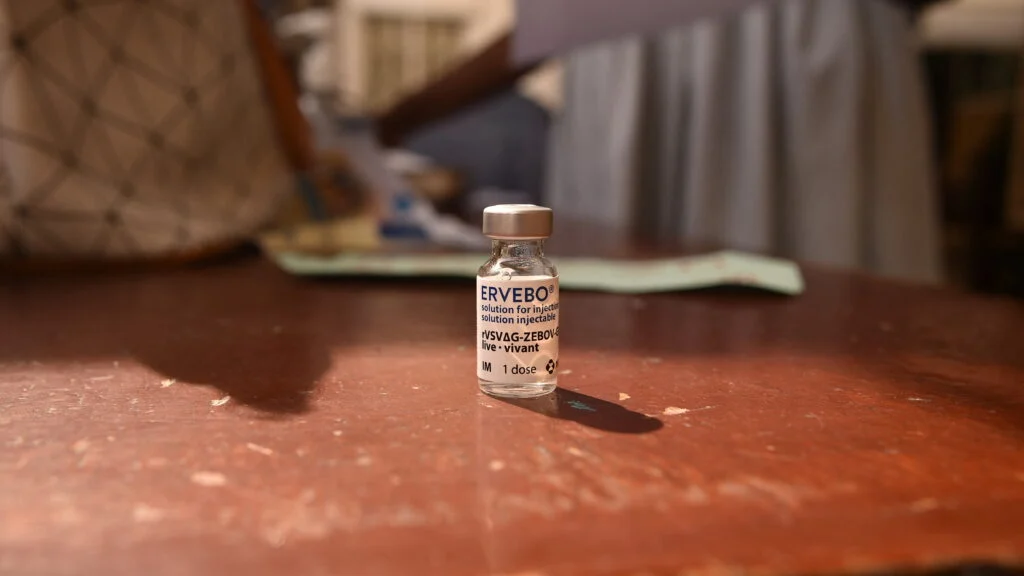
New data from a study in humans provides additional support to the idea that Merck’s Ebola vaccine Ervebo, licensed specifically to target the Zaire species of ebolaviruses, could also offer some protection against another species currently circulating in a rapidly expanding outbreak in the Democratic Republic of the Congo (DRC). The new paper, published Wednesday in the New England Journal of Medicine (NEJM) after previously having been posted online before peer review, is one of a growing number of studies pointing to the possibility that the vaccine could be used to target the Bundibugyo species of ebolaviruses. This finding comes at a critical juncture for the DRC, which is currently grappling with a severe public health crisis that threatens to destabilize the region further.
The research is fueling an increase in calls to study the use of Ervebo within the outbreak zone, a proposal that the World Health Organization (WHO) has met with lukewarm support to date. While the WHO’s vaccination efforts have prioritized the development and testing of Bundibugyo-specific vaccines, those candidates remain months away from being ready for clinical trials in the field. The delay between laboratory readiness and field deployment has created a strategic vacuum that some experts believe could be filled by Ervebo, despite its primary design for the Zaire strain. In an email Wednesday, the WHO confirmed that its vaccines expert panel committee, the Strategic Advisory Group of Experts on Immunization (SAGE), would study the idea further at its next scheduled meeting in early October.
The urgency of the situation is underscored by the scale of the current outbreak. As of Monday, the confirmed case count in the northeastern part of the DRC was nearing 2,500, with nearly 1,000 deaths recorded. These staggering figures make this the third-largest Ebola outbreak on record and the fastest-growing to date. The epicenter of the crisis is located in a region already ravaged by decades of conflict, political instability, and mass displacement. These factors, combined with a deep-seated distrust of outside medical intervention, have created a "perfect storm" for viral transmission. WHO Director-General Tedros Adhanom Ghebreyesus recently noted that the prevailing violence and war in the region are sometimes greater impediments to containment than the virus itself.
Against this backdrop, the scientific community is debating whether a "good enough" existing tool is better than a "perfect" tool that has not yet arrived. Edouard Lhomme, the first author of the NEJM study and a professor at the University of Bordeaux, France, emphasized that the time for debate has passed. "I believe we have now reached the point where this question should no longer be debated; it should be tested in a carefully designed prospective clinical study," Lhomme told STAT. He argued that pandemic preparedness is not just about the next generation of technology, but about maximizing the utility of the tools already in the global arsenal to save lives in real-time.
Evidence suggests that such a study may already be in the planning stages. Reports from Bloomberg indicate that the Africa Centers for Disease Control and Prevention (Africa CDC) is organizing a trial to test a two-dose vaccine regimen specifically for healthcare workers on the front lines. This effort is being supported by Médecins Sans Frontières (MSF), also known as Doctors Without Borders. The proposed trial appears to be modeled after primate studies conducted over a decade ago, which demonstrated that animals inoculated with vaccines for the Zaire and Sudan species showed significantly higher survival rates when exposed to lethal doses of the Bundibugyo virus.
The technical logistics of such a trial involve collaboration with IAVI, a nongovernmental organization developing an experimental Sudan virus vaccine. IAVI’s candidate uses the same rVSV (recombinant vesicular stomatitis virus) platform as Merck’s Ervebo. By combining elements of these vaccines, researchers hope to elicit a broader immune response. IAVI has indicated it is ready to supply doses of its investigational vaccine for the trial, provided there is alignment among DRC authorities and collaborating partners.
However, the path to implementation is fraught with institutional caution. An international stockpile of 500,000 Ervebo doses, managed by UNICEF, the WHO, and other partners, exists for emergency use. Merck has echoed the WHO’s concerns, stating that the evidence for cross-protection against Bundibugyo remains "very limited." The company noted that doses from the stockpile can only be released at the request of UNICEF, and the WHO has warned that deploying a Zaire-specific vaccine for a Bundibugyo outbreak could backfire.
The WHO’s primary concern is the risk of a "false sense of security." If communities and responders believe they are fully protected by a vaccine that only offers partial cross-protection, they might relax essential infection-prevention measures, such as safe burial practices and the use of personal protective equipment. Furthermore, if vaccinated individuals still contract the virus and die, it could severely damage public confidence in Ebola vaccines, making it harder to control future outbreaks of the Zaire strain where the vaccine is highly effective.
Despite these concerns, the empirical data continues to mount. Multiple research groups have been analyzing blood samples from individuals who received Ervebo during previous Zaire outbreaks in the DRC. While the results are not entirely uniform, a clear trend has emerged: Ervebo appears to trigger the production of antibodies that can recognize and potentially neutralize the Bundibugyo virus in some individuals. This "cross-reactivity" is the scientific basis for the hope that Ervebo could mitigate the severity of the disease, even if it does not prevent infection entirely.
The historical context of the region provides a unique natural experiment. The current Bundibugyo outbreak is occurring in an area that was previously hit by a massive Zaire ebolavirus outbreak between 2018 and 2020. During that period, more than 300,000 people were vaccinated with Ervebo. A commentary published in The Lancet highlighted that of the 1,000 confirmed cases in the current outbreak for whom vaccination status was known, only nine had received Ervebo in the past—and all nine survived. In contrast, none of the 242 fatal cases analyzed had been vaccinated.
Further anecdotal evidence from the field involves a cluster of eight healthcare workers who were exposed to the virus while operating on a pregnant woman whose Ebola status was unknown at the time. Of those eight, three had been previously vaccinated with Ervebo; all three survived. The five who had not been vaccinated succumbed to the virus. While these numbers are small, they provide a compelling signal that the vaccine may offer a survival advantage. Experts like Jean-Jacques Muyembe-Tamfum, a legendary figure in Ebola research in the DRC, argue that even partial protection could be transformative, drawing parallels to the latest malaria vaccines which, despite not being 100% effective, have significantly reduced the disease burden.
Isaac Bogoch, an infectious disease specialist at the University of Toronto, has used mathematical modeling to analyze the potential impact of Ervebo. He notes that while Phase 1 trials for a specific Bundibugyo vaccine are underway at the University of Oxford, those results are not immediate. "Trials evaluating [Ervebo’s] effectiveness against Bundibugyo virus should be pursued in parallel, particularly given their immediate availability," Bogoch said. His modeling, however, also highlights the logistical hurdles of "ring vaccination"—the strategy of vaccinating contacts of confirmed cases. In the current DRC outbreak, many cases are only detected after the patient has died, making contact tracing nearly impossible. The WHO recently reported that two-thirds of deaths in this outbreak occurred in the community rather than in treatment centers.
Bogoch’s research warns that if case detection remains low, even a biologically active vaccine might appear ineffective at the population level. Paradoxically, if the DRC manages to improve its contact tracing and case detection, those public health measures themselves might do more to contain the virus than the vaccine, potentially masking the vaccine’s actual contribution. Bogoch suggests that in such a volatile environment, a community-wide vaccination approach might yield better results than the targeted ring strategy.
The debate over Ervebo’s use against Bundibugyo represents a broader tension in global health: the balance between rigorous clinical evidence and the moral obligation to act during a crisis. As the death toll in the DRC continues to rise and the virus spreads through displaced and vulnerable populations, the pressure on the WHO and its partners to authorize a trial will likely intensify. For the researchers and frontline workers in the DRC, the question is no longer whether the vaccine is perfect, but whether it is enough to turn the tide in one of the most challenging humanitarian environments on earth. If the signals of cross-protection observed in recent weeks prove genuine, the decision to test Ervebo now could be the difference between a contained outbreak and a regional catastrophe.
