
 By admin
The enduring unpredictability of engaging with U.S. President Donald Trump was starkly underscored during his recent two-day visit to Ireland, culminating in a singular global headline that few could have anticipated: his pronounced desire for a unified Ireland. As the reverberations of these pronouncements rippled across the island and into Great Britain, a palpable uncertainty emerged regarding the true intent behind the President’s remarks – whether they signaled a deliberate shift in U.S. foreign policy or were merely an impromptu utterance from a leader known for his candid, often unscripted, interactions with the press.
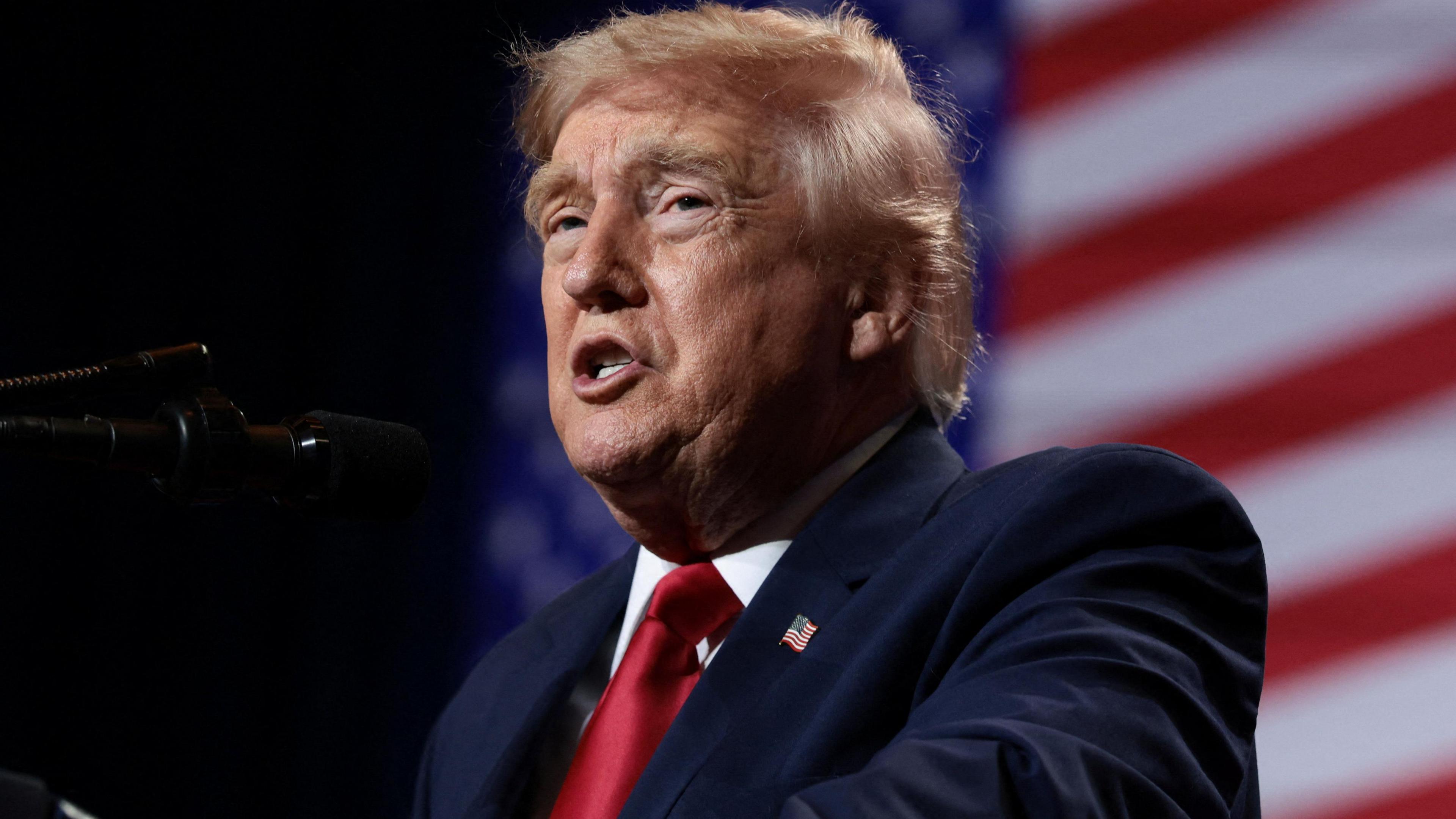
The visit, initially framed as a diplomatic engagement with Ireland, quickly took a turn towards the deeply complex and historically sensitive issue of the island’s partition. President Trump, during a press conference, articulated his wish to see a united Ireland, a statement that immediately ignited a firestorm of discussion and speculation. This sentiment was not confined to a single instance; he reiterated his vision for a unified Ireland later in his visit during a speech delivered at the U.S. Ambassador’s residence. This repetition suggested a potential awareness of the significant impact his initial remarks had generated, perhaps even a calculated effort to amplify the message.
The speech itself, billed as a focused address to Irish and Irish American business leaders, deviated significantly from its intended scope. Stretching to nearly twice its scheduled length, the address largely veered into domestic U.S. political matters, a characteristic of President Trump’s distinctive speaking style, which he himself describes as "the weave." This approach involves a fluid, often tangential, movement between disparate topics, departing from prepared remarks before eventually returning to the core subject. During this particular address, the President lauded his perceived accomplishments, including his efforts to curb illegal immigration, negotiate trade deals, and bolster defense production. He also reiterated his criticisms of the United Kingdom’s perceived lack of support for his military operations in Iran, demonstrating his propensity to intertwine foreign policy discussions with his own agenda and grievances.
The question of the intended audience for these pronouncements looms large. Was President Trump primarily addressing the assembled business leaders in Dublin, or was he simultaneously aiming his message at a domestic U.S. audience, many of whom would have been tuning in in the early hours of the morning? The timing of the visit, with the crucial midterm elections in the U.S. fast approaching in November, cannot be overlooked. The Republican party, facing significant pressure due to the President’s policies, risked losing control of one or both houses of Congress.
The Irish-American community, a significant demographic in the United States, with roughly one-tenth of the U.S. population claiming Irish heritage, presents a complex electoral landscape. This group is not a monolithic voting bloc, and their allegiances can be influenced by a variety of factors, including their stance on issues such as a unified Ireland. Some of these voters, particularly independent or swing voters who have historically shifted their support between the Republican and Democratic parties, might be receptive to a candidate who expresses support for Irish unification. In the current political climate, where the pursuit of every vote is paramount, it is plausible that President Trump’s rhetoric was at least partly motivated by a strategic calculation to appeal to this segment of the electorate.
To contextualize the significance of presidential engagement with the peace process in Ireland, one can look back at the successful efforts of former President Bill Clinton. During his presidential campaigns, Clinton garnered substantial support from Irish Americans by pledging his commitment to the Northern Ireland peace process. His subsequent engagement with the issue, which played a pivotal role in the foundational stages of the Good Friday Agreement, demonstrated the potent impact of a U.S. president actively participating in diplomatic resolutions. However, the political landscape of both America and Ireland has evolved considerably since the Clinton era. American politics, in particular, has become increasingly polarized, a trend that shows no signs of abating and is likely to be a defining characteristic of the upcoming November election campaigns.
In the wake of President Trump’s remarks on Irish unification, former Republican Congressman Mick Mulvaney, who served as Trump’s special envoy to Northern Ireland during his first term, offered a cautionary perspective. Mulvaney advised against overinterpreting the President’s statements, asserting that they did not signify a fundamental shift in U.S. foreign policy. He emphasized the continued U.S. commitment to the Good Friday Agreement, a sentiment echoed by Democratic Congressman Brendan Boyle, who affirmed the bipartisan consensus supporting the agreement and its enduring significance. While both Mulvaney and Boyle acknowledged the President’s assertion that unification might eventually occur, they clarified that this did not translate into an immediate U.S. initiative to actively pursue such an outcome.
The implications of President Trump’s comments extend beyond the immediate diplomatic sphere, touching upon the intricate web of historical narratives and political aspirations that define Ireland. The partition of Ireland in 1921, following the Irish War of Independence, created Northern Ireland as a distinct entity within the United Kingdom, while the rest of the island gained independence as the Irish Free State, later the Republic of Ireland. This division has been a source of enduring political and social tension, particularly in Northern Ireland, where a significant portion of the population has historically identified as British and unionist, while another substantial segment has identified as Irish and nationalist, advocating for a united Ireland. The Good Friday Agreement, signed in 1998, was a landmark achievement that largely brought an end to the decades of sectarian violence known as the Troubles, establishing a framework for power-sharing and cross-border cooperation. It also enshrined the principle that Northern Ireland’s constitutional status could only change with the consent of its people.

President Trump’s casual articulation of a desire for a unified Ireland, devoid of the nuanced diplomatic language typically employed in such sensitive matters, risked unsettling the delicate balance established by the Good Friday Agreement. While his supporters might view his directness as a sign of authenticity and a willingness to confront complex issues, critics voiced concerns that such pronouncements could inadvertently reignite historical divisions or create instability. The British government, in particular, would likely view any perceived U.S. endorsement of unification with apprehension, given the historical complexities and the potential impact on the United Kingdom’s territorial integrity.
The economic dimension of President Trump’s visit also warrants consideration. The President’s engagement with Irish and Irish American business leaders highlighted the strong economic ties between the United States and Ireland. Ireland has become a significant gateway for American businesses seeking to access the European Union market, benefiting from its educated workforce, favorable tax regime, and membership in the EU. U.S. foreign direct investment in Ireland has been substantial, creating numerous jobs and contributing significantly to the Irish economy. During his visit, President Trump likely sought to reinforce these economic partnerships, emphasizing the benefits of strong bilateral trade relations. However, the broader geopolitical context, including Brexit and evolving global trade dynamics, also shapes the economic landscape, adding another layer of complexity to these discussions.
The cultural significance of the visit also played a role. The deep historical and cultural connections between the United States and Ireland are undeniable, with a vast diaspora of Irish descent in America. Presidential visits to Ireland are often imbued with a sense of homecoming and shared heritage, providing an opportunity for leaders to connect with this influential constituency. President Trump’s own background, with some distant Irish ancestry, likely amplified this aspect of the visit, allowing him to tap into a sense of shared identity and historical affinity.

However, the ultimate impact of President Trump’s Irish visit, particularly his remarks on unification, will likely be assessed over time. While his unconventional approach to diplomacy often generates headlines and sparks debate, the long-term consequences of his pronouncements on the delicate peace process in Northern Ireland remain to be seen. Political leaders in Ireland, both North and South, will undoubtedly be hoping that future discussions, including the anticipated golf outing, will focus on matters less fraught with historical and political sensitivity, allowing for a more predictable and less volatile diplomatic engagement. The challenge for Irish political leaders will be to navigate the complex relationship with the United States, particularly under an administration known for its unpredictable foreign policy pronouncements, while safeguarding the progress achieved in peace and stability on the island of Ireland. The legacy of this visit may well hinge on whether President Trump’s words prove to be a fleeting rhetorical flourish or a catalyst for deeper, more sustained dialogue on the island’s future.
