
 By Titik Puspa
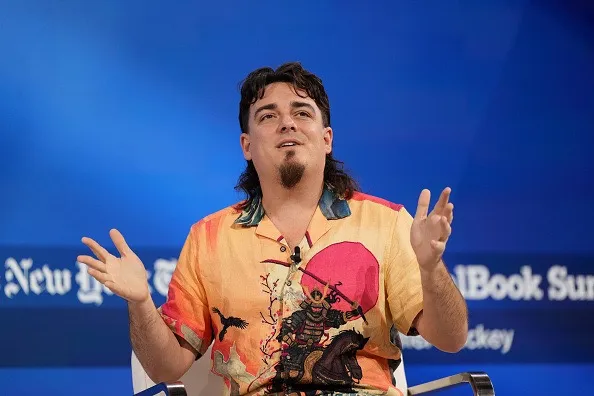
The rapid acceleration of artificial intelligence is fundamentally altering the landscape of cyber warfare, creating a perilous chasm between offensive capabilities and defensive infrastructures. This alarming reality was articulated with stark urgency by Palmer Luckey, the visionary founder of Oculus and co-founder of Anduril Industries, during his address at The New York Times DealBook Summit on Wednesday. In the wake of a series of high-profile technology outages that have disrupted critical services and underscored vulnerabilities, Luckey painted a grim picture: legacy systems are proving woefully inadequate against the sophisticated, AI-driven threats emerging today. The time for incremental updates has passed; a radical and swift reevaluation of our cybersecurity posture is not just advisable, but an existential imperative.
"We’re seeing the natural effects of a lot of these advanced AI tools allowing for the creation of various exploits," Luckey stated, his words resonating with a profound concern for the current state of digital security. This sentiment comes at a time when the very tools that are driving innovation in various sectors are also being weaponized by malicious actors. The proliferation of AI, with its capacity for rapid learning, pattern recognition, and autonomous operation, has dramatically lowered the barrier to entry for sophisticated cyberattacks. What once required extensive human expertise and considerable resources can now be automated and amplified by AI, allowing for the discovery and exploitation of vulnerabilities at an unprecedented scale and speed.
While many government officials and cybersecurity experts have pointed to the recent spate of technical disruptions as a direct consequence of companies scrambling to patch newly discovered AI-generated vulnerabilities, Luckey’s analysis delves deeper. He emphasizes that the core issue lies not just in the immediate patching efforts, but in the fundamental fragility of the underlying technological architecture that many organizations, including vital government agencies and critical infrastructure providers, still rely upon. These "outdated technology systems," as Luckey describes them, are characterized by legacy code, infrequent updates, and architectural designs that were never conceived to withstand the onslaught of AI-powered adversarial capabilities.
The United States, in particular, is finding itself on the defensive as its adversaries are adeptly exploiting this critical mismatch between burgeoning offensive power and lagging defensive capabilities. Luckey elaborated that these attacks are strategically orchestrated and financially motivated, with a notable increase in activity attributed to North Korea. This observation is particularly significant, as it highlights how state-sponsored actors are leveraging AI to achieve both geopolitical objectives and to circumvent international sanctions through illicit financial activities. The ability of AI to automate the identification of financial transaction vulnerabilities, to generate sophisticated phishing campaigns that mimic legitimate communications with uncanny accuracy, and to exploit weaknesses in global financial networks presents a formidable challenge.
The gravity of the situation was underscored by a candid exchange with the interviewer, Andrew Ross Sorkin. Sorkin revealed that U.S. Vice President J.D. Vance had been compelled to cancel his appearance at the conference due to the ongoing technological disruptions, citing the need to attend urgent meetings addressing the very matters Luckey was discussing. This executive-level response signals the pervasive and disruptive nature of these AI-driven cyber threats, impacting even the highest echelons of government and national security. The fact that a Vice President’s schedule must be reshuffled to address cybersecurity concerns speaks volumes about the immediate and escalating threat level.
When pressed by Sorkin on the level of concern warranted by this evolving threat landscape, Luckey offered a nuanced yet ominous response: "It depends on how well prepared you are." This simple statement encapsulates the bifurcated reality of the current cybersecurity environment. Those organizations and nations that have proactively invested in modern, AI-resilient defenses, and have adopted agile security practices, may be better positioned to weather the storm. However, for the vast majority that remain tethered to outdated systems, the outlook is considerably bleaker. He followed this by a chilling prophecy: "You guys are going to find out what’s going on soon enough." This veiled warning suggests that the full impact of these advanced cyberattacks has yet to be realized by the public at large, and that a significant reckoning may be on the horizon.
Despite the dire warnings, Luckey also presented a more optimistic, albeit conditional, outlook. He argued that AI, while a powerful tool for attackers, also holds the potential to be a decisive advantage for defenders. The key, however, lies in the speed of adoption and implementation. "In the long run, the advantages are going to accrue to the side that is most effectively using AI for defense," he posited. This statement points to a future where AI-powered defense systems can detect, analyze, and neutralize threats in real-time, far exceeding human capabilities. Machine learning algorithms can be trained to identify anomalous behavior, predict potential attack vectors, and even autonomously deploy countermeasures before human intervention is required.
Luckey directly addressed the pervasive notion that "everything can be hacked," acknowledging its validity in the current context, but emphasizing the temporal nature of this vulnerability. "With the people who say that everything can be hacked – they are right, for now," he conceded. "That actually may be the case with certain new techniques that are coming along. But as of right now, there’s a mismatch between the attackers who are very fast-moving and using technology and old, outdated systems that are not able to adopt technology as quickly as it is developed." This highlights the critical bottleneck: the pace of technological advancement in cybersecurity has been outstripped by the pace of AI-driven offensive innovation. Legacy systems, often built on decades-old architectures, are inherently resistant to rapid upgrades and modernization, making them fertile ground for exploitation. The sheer volume and sophistication of AI-generated malware, polymorphic viruses, and zero-day exploits mean that traditional signature-based detection methods are becoming increasingly ineffective.
The urgency of the situation cannot be overstated. Luckey concluded his remarks with a forceful call to action: "And I think… people are going to have to pick up the pace. It’s time to start running." This is not merely a suggestion; it is a stark directive. The era of passive defense and reactive patching is over. Organizations must embrace a proactive, agile, and forward-thinking approach to cybersecurity. This includes significant investment in modernizing IT infrastructure, adopting cloud-native security solutions, and integrating AI-powered defense mechanisms. Furthermore, it necessitates a cultural shift within organizations, fostering a robust cybersecurity awareness among all employees and ensuring that security is not an afterthought but a foundational element of all technological operations. The race between AI-powered attackers and defenders has begun in earnest, and for many, the starting gun has already sounded, leaving them far behind. The future of digital security, and indeed, the stability of our interconnected world, hinges on our collective ability to heed Luckey’s warning and accelerate our defenses before the consequences become irreversible. The implications extend beyond financial losses and data breaches; they touch upon national security, critical infrastructure resilience, and the very fabric of trust in our digital society. The challenge is immense, but the necessity for immediate and decisive action is undeniable.
