
 By Rifan Muazin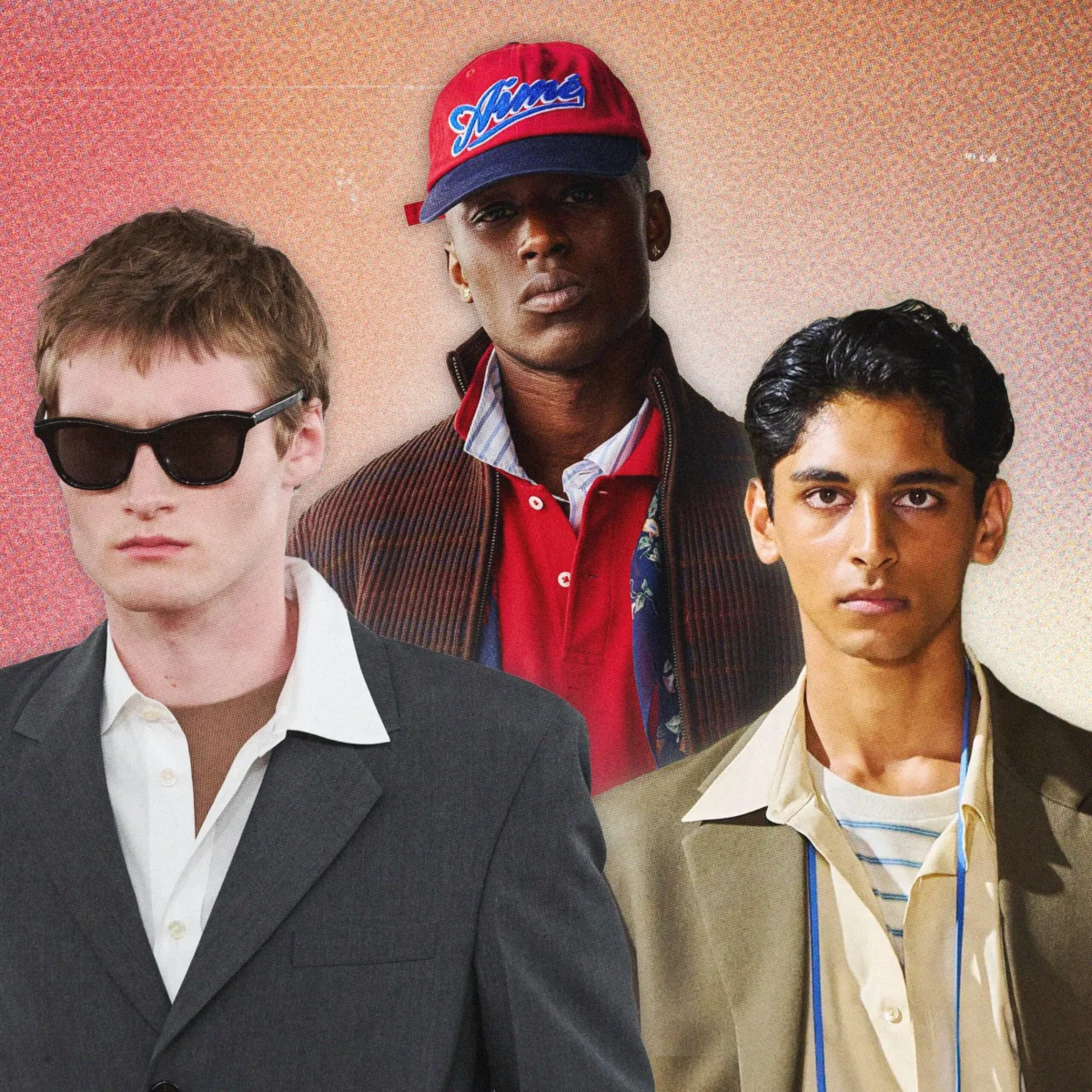
At the Auralee menswear presentation in Paris this past June, the fashion world witnessed a subtle but seismic shift in the geometry of the neckline. Collars were not merely an afterthought or a functional necessity; they were the focal point of a collection that redefined the boundaries of contemporary layering. Designer Ryota Iwai, the mastermind behind the Japanese label known for its obsessive dedication to textile development and muted color palettes, sent a parade of models down the runway where the traditional rules of haberdashery were intentionally discarded. Of the approximately 40 outfits showcased, a staggering 17 featured what has now been dubbed the "flyaway collar"—a styling maneuver where the shirt collar points anywhere but down, often with one wing conspicuously folded over the lapel of a blazer, the neck of a sweater, or the heavy gabardine of a trench coat.
This was not an isolated incident of sartorial rebellion but rather the climax of a trend that has been simmering in the higher echelons of luxury fashion for several seasons. To understand the flyaway collar is to understand the current state of menswear, which is currently caught in a tug-of-war between rigid traditionalism and a desperate, almost manic pursuit of "effortless" personality. The flyaway collar is the visual manifestation of this tension. It is a flourish that suggests the wearer was in such a hurry to look brilliant that they couldn’t be bothered to check a mirror, yet every fold is executed with the precision of a master architect.

The momentum for this look began to build last winter during Simone Bellotti’s sophomore outing for Jil Sander. Bellotti, who took the reins of the house with a mission to inject a sense of eccentric humanity into its minimalist DNA, utilized the flyaway collar as a recurring motif. In that Fall 2026 collection, the sheer frequency of the look was impossible to ignore. Models emerged in svelte, gray three-button suits—the kind of tailoring that usually demands absolute symmetry—only to have the entire silhouette disrupted by a crisp white shirt collar peering out and over the jacket’s notch lapel. It was a "glitch" in the matrix of high-end minimalism, a signal that the Jil Sander man was no longer a cold, architectural figure, but someone capable of a little messiness.
A few months later, the torch was passed to Michael Rider during his highly anticipated debut at Celine. Rider, whose pedigree includes a significant tenure under Phoebe Philo during her "Old Celine" heyday, brought a sense of lived-in luxury to the runway. His Spring 2027 collection picked up exactly where Bellotti’s left off, incorporating half-tucked collars and asymmetrical necklines that felt both nostalgic and radically modern. The message was clear: the era of the perfectly pinned, stiffly starched collar is over. In its place is a more fluid, chaotic approach to dressing that prioritizes "the vibe" over the rules.
This trend has quickly transcended the rarified air of Paris runways and entered the broader cultural lexicon through high-profile campaigns and lookbooks. Aimé Leon Dore, the New York-based brand that has become the de facto uniform for the modern urbanite, leaned heavily into this aesthetic for its Spring-Summer 2026 collection. Their lookbook featured models in baseball caps and shaggy V-neck sweaters, with shirt collars protruding jauntily over Harrington jackets and flecked blazers. Similarly, the Japanese brand A.Presse has embraced the "peekaboo" collar, using it to soften the formality of overcoats and formal wear.

The flyaway collar has even found a champion in the world of celebrity-driven fashion. Take, for instance, Connor Storrie’s recent campaign for Saint Laurent. In a series of images and video snippets shot by the legendary David Sims, Storrie—the actor currently enjoying a surge of "hunk" status following his role in Heated Rivalry—is seen bopping to Milli Vanilli in a striped button-up. The collar of the shirt is yanked askew, tilting gravity-defyingly upwards as if caught in a perpetual gust of wind. In other shots, he models a bicep-hugging crewneck sweater where the collar is tucked under on one side and flapped over the other, looking as though he had just been body-checked into a glass wall and emerged looking better for it.
To the uninitiated, this might look like a simple mistake. To the "extremely online" menswear enthusiast, however, it is a nod to a long-standing tradition of sprezzatura. Originally coined by Baldassare Castiglione in his 16th-century work The Book of the Courtier, sprezzatura is defined as "a certain nonchalance, so as to conceal all art and make whatever one does or says appear to be without effort and almost without any thought about it." In the mid-20th century, this concept was revitalized by figures like Gianni Agnelli, the Italian industrialist who famously wore his wristwatch over his shirt cuff. In the 2010s, it manifested as the "Ralph Tuck"—the art of tucking only half of one’s shirt into their trousers, a move championed by Ralph Lauren himself.
The flyaway collar is the 2026 evolution of this lineage. However, unlike the brash, haughtily popped collars of the Bruce Weber-era Abercrombie & Fitch catalogs, which signaled a certain collegiate arrogance, the flyaway collar is a more self-conscious affectation. It is a winking signifier that endeavors to telegraph a "this old thing?" energy. It is the commercialization of the "accidental" look. This is perhaps best exemplified by Phoebe Philo’s $1,200 "Upright Collar Shirt." The garment is engineered with a cut so specific that the collar remains in a state of half-up, half-down homeostasis. It is a pre-packaged version of cool, allowing the consumer to purchase the "accident" without having to actually experience the wind.

The rise of this trend also highlights a significant shift in the power dynamics of the fashion industry: the ascent of the stylist. The flyaway collar is, at its heart, a styling choice rather than a design innovation. The fact that designers like Iwai and Bellotti are increasingly reliant on superstar stylists to articulate their vision is no coincidence. Charlotte Collet, the stylist who has worked closely with both Auralee and Jil Sander, has become a celebrity in her own right for her ability to create these idiosyncratic, "off-kilter" looks. In an era where clothes are often designed to be basic and wearable, the "magic" happens in how they are put together on the body. The stylist is the one who decides that a $2,000 blazer looks better if the shirt underneath is a mess.
But what does this obsession with the "perfectly imperfect" say about our current culture? We live in a trend-flattening age where the internet allows everyone to see the same images and adopt the same quirks simultaneously. There is a fundamental irony at play: if every man on the streets of Soho or Tokyo is employing the same flyaway collar to communicate his "unique" personal style, how personal can that style really be? The pursuit of personal style has become a relentless, often wretched albatross for the modern consumer. There is a mounting pressure to ensure that no outfit looks "too right," because looking "too right" suggests you tried too hard.
The flyaway collar offers a solution to this anxiety. It provides a low-stakes way to signal that you are "in the know" without requiring a total wardrobe overhaul. It works with almost any layer imaginable: from scuzzy scoop-neck vests to airy striped tees and swishy mac coats. It is a democratic trend, accessible to anyone with a button-down shirt and a mirror, yet it remains rooted in the exclusionary world of high-fashion editorializing.

Despite its ubiquity, there is something undeniably charming about the look. It captures a moment of human frailty in an otherwise polished world. Rushing to a meeting or a dinner, catching a glimpse of oneself in the reflection of a parked car and seeing a collar losing its battle with the elements—there is a brief, flickering sense of cinematic cool in that image. It looks right precisely because it is wrong.
However, the moment we become aware of that coolness, the spell is often broken. The flyaway collar, when intentionally placed, is a performance. It is a costume of carelessness. As the trend continues to proliferate through 2026 and into 2027, we will likely see it reach its breaking point, moving from a subtle "insider" nod to a mainstream cliché. But for now, it remains the defining silhouette of the season—a small, tilted rebellion against the crushing weight of perfection. Whether it is a $1,200 engineered shirt or a frantic adjustment made in an elevator, the flyaway collar reminds us that in fashion, as in life, the most interesting things usually happen when things don’t go exactly according to plan. Just don’t be surprised if, after seeing your reflection, you find yourself instinctively tucking it back where it belongs. After all, the only thing more stylish than a calculated mess is the confidence to not care if you’re messy at all.
