
 By Rifan Muazin
To understand why this specific release is generating such buzz among enthusiasts, one must first look at the pedigree of Marathon. Founded in 1939 and headquartered in Ontario, Canada, Marathon has spent the better part of a century as the primary supplier of timekeeping instruments to the Canadian Armed Forces and the U.S. General Services Administration. Unlike many "military-inspired" brands that merely mimic the aesthetic of the battlefield, Marathon watches are built to MIL-SPEC (military specification) standards. They are tools designed to survive the cockpit of a fighter jet, the pressure of a deep-sea dive, and the extreme temperatures of the Arctic circle.
The Navigator line, in particular, carries a weight of history that few modern watches can match. The design of the current collaboration traces its DNA directly back to the Steel Navigator developed in 1986 in partnership with Kelly Air Force Base. At the time, pilots and paratroopers required a watch that could withstand the rapid pressure changes of high-altitude flight while remaining exceptionally lightweight and legible in total darkness. The original 1986 model was a response to these needs, and it became a cult classic for its asymmetrical case design—a functional choice intended to protect the crown from snagging on equipment or cockpit controls.
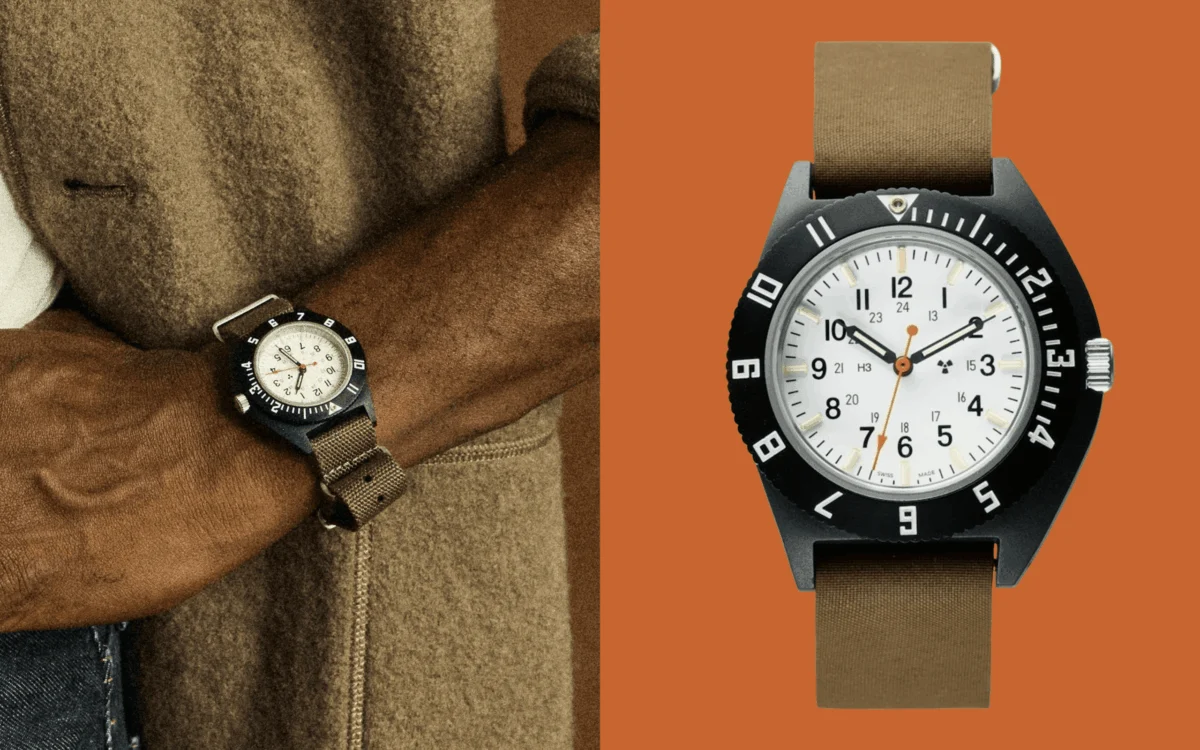
Huckberry’s role in this collaboration is that of the tasteful editor. Known for their "Flint and Tinder" line and a curation style that leans heavily into the "modern woodsman" aesthetic, Huckberry understands the nuances of heritage. They recognized that the Navigator didn’t need a total overhaul; it needed a refinement that would make it as suitable for a weekend in the Catskills as it is for a tactical mission. The most striking update is the introduction of the "Arctic" white dial to the CeraShell case—a first for this specific model line.

The dial choice is a significant departure from the traditional matte black found on most military-issued Navigators. In the world of horology, white-dial tool watches—often referred to as "Polar" dials—have a storied history of their own, most notably popularized by the Rolex Explorer II. They offer a high-contrast alternative that remains legible in low-light conditions where a black dial might swallow the hands. By pairing this crisp, stark white dial with Marathon’s signature matte-black CeraShell case, Huckberry has created a high-contrast "tuxedo" effect that is visually arresting without sacrificing the watch’s utilitarian roots.
The case itself is a marvel of modern material science. Marathon’s proprietary CeraShell material is a composite that blends bio-sourced plastic with ceramic powder. This isn’t your standard "plastic" watch case; the addition of ceramic provides a level of rigidity and scratch resistance that traditional polymers lack, while the bio-sourced plastic ensures the watch remains incredibly light on the wrist. At 41mm wide and only 11.5mm thick, the watch maintains a presence without the bulk. The asymmetrical geometry provides a natural crown guard, ensuring that the time-setting mechanism is shielded from impact.
One of the most defining characteristics of a Marathon Navigator is its use of Tritium gas tubes. While most modern watches rely on Super-LumiNova—a phosphorescent pigment that requires an external light source to "charge"—the Arctic Navigator utilizes Gaseous Tritium Light Sources (GTLS). These are tiny, self-contained glass tubes filled with a radioactive isotope of hydrogen. As the tritium decays, it emits electrons that cause a phosphor coating inside the tube to glow. The result is a constant, unyielding luminescence that does not require charging and will remain visible for up to 25 years. On this model, the tubes are placed at every hour marker, on the hour and minute hands, and even within the bezel pip. For those who find themselves in total darkness, whether in a tent or a cockpit, the reliability of tritium is unmatched.
Inside the 41mm shell beats the heart of a modern workhorse: the ETA F06.115 HeavyDrive quartz movement. While some purists may clamor for a mechanical movement, quartz is the logical and historically accurate choice for a true pilot’s watch. The F06.115 is part of ETA’s Trendline, featuring three jewels and "HeavyDrive" technology. This specialized integrated circuit allows the movement to detect and compensate for shocks. If the watch takes a hard hit, the system provides a counter-impulse to prevent the hands from jumping or becoming misaligned, maintaining accuracy in environments where a mechanical escapement might fail. Furthermore, the movement features an End-of-Life (EOL) indicator, where the seconds hand will jump in four-second increments to signal that the battery needs replacement—a critical safety feature for professional use.

Huckberry’s design flourishes are subtle but impactful. They have replaced the standard red seconds hand with their signature "Hunter Orange," a color synonymous with outdoor safety and Huckberry’s own brand identity. To keep the dial from becoming overly cluttered, the Huckberry "tree" logo is moved off the face and onto the crown. This preserves the sterile, military look of the dial while rewarding the owner with a hidden detail upon closer inspection. The dial retains the classic 12-hour and 24-hour scales, a nod to the military’s use of "Zulu" time.
The versatility of the watch is further enhanced by the inclusion of two distinct strap options. The first is an olive-green DEFSTAN nylon strap, built to United Kingdom Ministry of Defence standards. It is durable, washable, and evokes the classic "NATO" style that has defined military watches for decades. The second is a more modern innovation: the coyote-brown HANK strap. HANK (High Abrasion Neoprene Kevlar) is a material often used in tactical vests and specialized military gear. It is incredibly flame-resistant, cut-resistant, and offers a unique texture that bridges the gap between rubber and fabric. By providing both, Huckberry ensures the Navigator can adapt to different environments and style preferences.
From a market perspective, the $600 price point places the Huckberry x Marathon Navigator in a competitive but justified bracket. While there are cheaper field watches available, few offer the combination of a proprietary ceramic-composite case, Swiss-made high-torque quartz movements, and genuine tritium illumination. When compared to the luxury "tool" watches from brands like IWC or Bremont, the Marathon offers a more authentic, "no-frills" military experience at a fraction of the cost. It is a watch for the person who values the engineering over the status symbol.
The "fall-coded" nature of the watch, as the title suggests, comes from its rugged color palette and its readiness for the elements. As the seasons change and the wardrobe shifts toward heavy flannels, waxed canvas jackets, and leather boots, the Arctic Navigator serves as the perfect mechanical companion. Its white dial mirrors the coming frosts, while the orange accents evoke the changing foliage. However, to pigeonhole this watch as a mere seasonal fashion statement would be a disservice to its construction.

In conclusion, the Huckberry x Marathon 41mm CeraShell Arctic Navigator is a rare example of a collaboration that respects the past while utilizing modern technology to improve the user experience. It honors the 1986 Steel Navigator’s legacy of precision and durability while introducing a fresh aesthetic that feels contemporary and purposeful. For the collector who demands a watch with a story, or the adventurer who needs a timepiece that can survive a beating, this collaboration delivers on all fronts. It is a reminder that in the world of horology, the best designs are those born from necessity and refined by those who truly appreciate the craft. The Navigator is available now, exclusively through Huckberry, representing a unique opportunity to own a piece of modern military history with a distinct, civilian-ready edge.
