
 By admin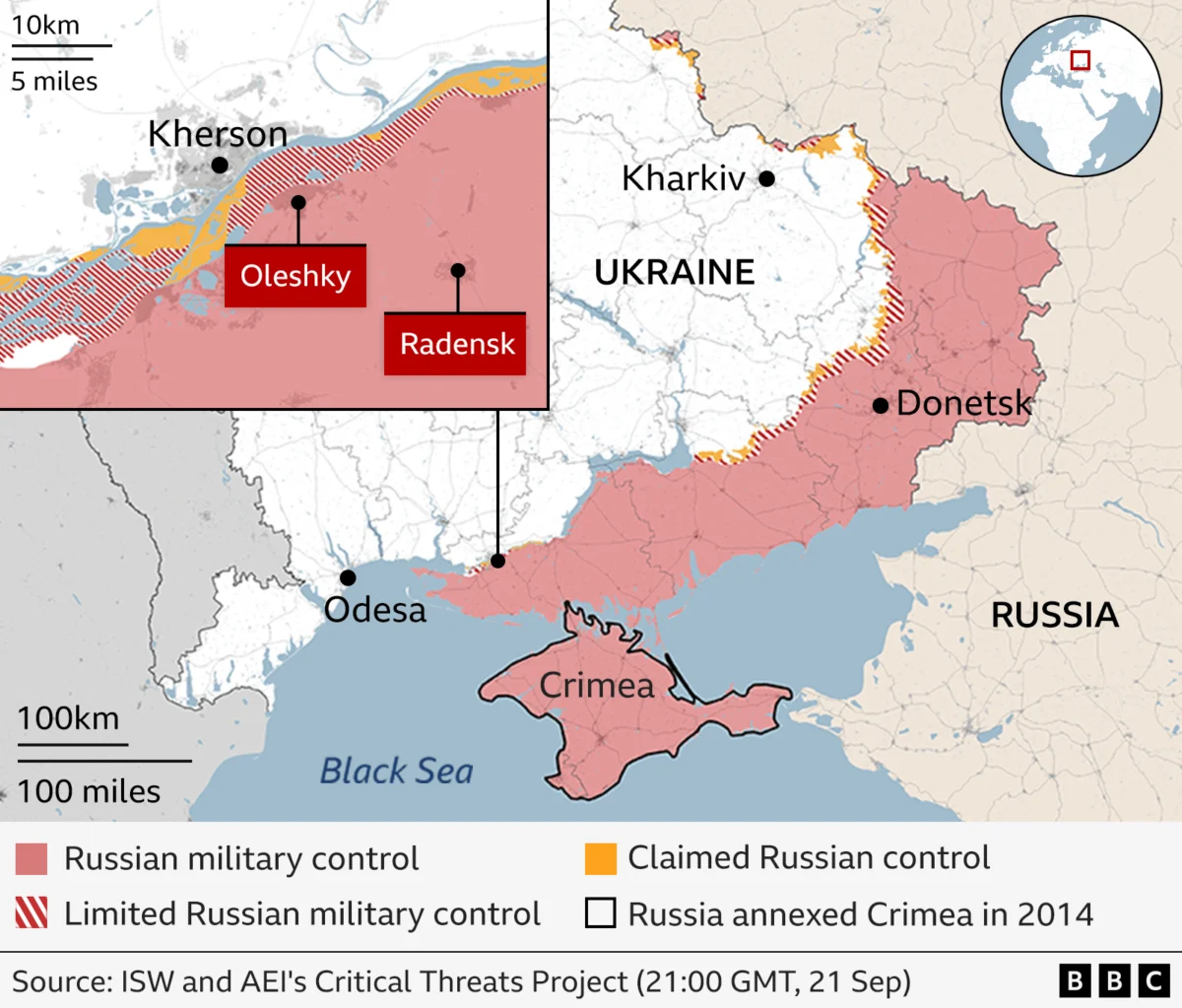
"Two more civilians died last night," says Halia, her voice strained before the phone connection crackles and dies. She is a resident of Oleshky, a Ukrainian city now under brutal Russian occupation, a place she describes as "constantly shelled" and completely cut off from essential supplies like food and water. Three agonizing days later, Halia managed to communicate again, her voice heavy with grief as she revealed the victims were a husband and wife, individuals she knew well. They had embarked on a perilous journey to Radensk, a neighboring town 23 kilometers (14 miles) away, in a desperate attempt to procure a bag of food. Tragically, they were unable to reach their home before a curfew, imposed by the Russian occupation authorities, came into effect. Their lives were brutally extinguished by a drone strike. The deaths of these two civilians, carrying sustenance, on September 20th have been corroborated by four independent sources. Halia, fearing for her safety and that of others, has requested that their names be withheld, and her own name has been changed to protect her identity. Her harrowing account is but one of many that the BBC has gathered in recent days from residents of this frontline city in southern Kherson Oblast. Occupied by Russian forces since 2022, Oleshky finds itself in a dire predicament, geographically trapped between the vast Dnipro River, which separates it from Ukrainian-controlled territory, and the occupying Russian military.

The strategic isolation of Oleshky is compounded by the devastating aftermath of the Nova Kakhovka Dam’s collapse in June 2023. This catastrophic event, which Ukraine and NATO attribute to Russia’s deliberate act of sabotage, while Russia claims Ukraine was responsible, submerged vast areas, including Oleshky, with floodwaters reaching rooftops. Before the full-scale Russian invasion, Oleshky was a vibrant city of 24,000 inhabitants. Today, the Ukrainian government estimates that only approximately 6,000 people remain within the city and its immediate surroundings, a stark figure that includes a vulnerable population of 200 children. The testimonies from residents paint a grim picture of their existence. Children are reportedly suffering from severe malnutrition, lacking access to basic medical care, and their development is "degrading" due to the absence of any educational facilities. Furthermore, multiple independent accounts shared with the BBC confirm the dire state of healthcare, with only one hospital reportedly functioning partially, open only a few days a week, and primarily for critical amputations. Despite Ukraine’s attempts to deliver vital supplies to the region, these efforts have been met with consistent failure in recent months, exacerbating the humanitarian crisis.
Earlier this week, the Kremlin itself acknowledged the gravity of the situation in Oleshky, admitting to a "critical situation" and "problems with supplies of food and medicine." However, they deflected responsibility, asserting that "Russia’s military was working to resolve them" and blaming Kyiv for the ongoing difficulties. The Ukrainian government, through its Foreign Minister Andriy Sybiha, has unequivocally described the local population as living under a "full blockade" orchestrated by Russian forces. Speaking at the United Nations General Assembly in New York on Tuesday, Minister Sybiha issued an urgent plea to the international community, imploring them to exert pressure on Russia to permit the unimpeded delivery of humanitarian aid into the besieged city.

Inside Oleshky, the daily existence for residents like Halia is a relentless struggle for survival. "There is no food here in the city," she states, adding that the last recorded food delivery took place in May. Her own dietary intake is severely restricted: "I eat once a day, a dinner only," she reveals. "I make some plain bread, sometimes I can have it with a tomato, or with some honey, and a tea. That’s it." The scarcity of food has forced many residents to resort to desperate measures. Halia explains that many have begun to forage for edible garden weeds, having exhausted the meager vegetables they managed to cultivate over the summer months. The knowledge of which weeds are safe to consume and how to prepare them has become a crucial topic of discussion within local Telegram messaging groups. These digital forums also serve as platforms for residents to arrange the sale, swap, or sharing of any minuscule food items they might possess.
The complete absence of functional shops in Oleshky means that residents are unable to source even basic necessities like clothing or hygiene products. The city has been without electricity, gas, and running water since the Kakhovka dam was attacked, a situation that has persisted for an agonizing period. While some residents have bravely attempted to escape the city on foot, navigating treacherous, mined roads in search of supplies, such journeys are now considered far too perilous.

The true scale of the human toll in Oleshky is difficult to ascertain with definitive precision. The United Nations Human Rights Monitoring Mission in Ukraine has officially recorded reports this year of at least 29 civilians killed and 54 injured in Oleshky and the nearby town of Hola Prystan, located approximately 24 kilometers to the east. However, local volunteers involved in humanitarian efforts believe this number to be a significant underestimation of the actual fatalities. Ksenia Arkhipova, a dedicated volunteer who managed to escape Oleshky in the summer of 2022, a few months after its occupation by the Russian army, has taken it upon herself to meticulously document the deceased. She is actively involved in the challenging attempts to deliver food and medicine and facilitate evacuations to Oleshky, and local residents have entrusted her with sensitive personal information due to their trust in her efforts. "I’ve been putting together a spreadsheet of all those who died as soon as I find out about it, with their names and dates of birth – I’ve got around 1,200 people now," she states, her voice a testament to the immense burden she carries. "Sometimes I don’t have time to update it, as the list grows one or two people longer every day: someone was killed by a drone, someone else stepped on the landmine." While the BBC cannot independently verify these figures, the harrowing reality is underscored by personal testimonies. Tetiana, another resident who has requested her real name be withheld for her safety, shared the devastating news that both her parents were killed in Oleshky this summer. She provided their dates of birth and photographs to the BBC as confirmation but pleaded for their identities to remain unpublished. "They were shot inside their home. Russian soldiers came there and wanted to take it," she recounted, her voice choked with emotion.
The process of burying the dead in Oleshky has been severely hampered by the Russian occupation authorities, according to residents. This restriction has made the grim task of counting the deceased even more challenging. Tetiana explains that authorities "do not allow us to bury the dead if they were killed by a drone, stepped on a landmine or were killed in any other way." The occupation administration reportedly mandates that such deaths must be confirmed through a post-mortem examination conducted by a Russian doctor, a procedure that is practically impossible to carry out in Oleshky. Only individuals who succumb to natural causes are permitted to be buried, a policy that has led to a grim consequence: "some bodies have been on the streets since December." Ksenia Arkhipova elaborates on the horrific fate of the deceased, stating that bodies are "either getting piled" in the local hospital morgue, which has been without power since winter, or are left to be consumed by stray dogs. The BBC has verified this disturbing detail through numerous photographs obtained from residents, images that are too graphic to be published. Ester Vrataryova, the co-founder of the charity Humanity, which provides assistance to individuals in Oleshky and other Russian-occupied territories of Ukraine, describes this situation as a deliberate "tool of psychological pressure." She adds, ominously, "If you try to bury a dead body, you’ll become the next one." This chilling statement encapsulates the pervasive atmosphere of fear and control that defines life in Oleshky.
