
 By admin
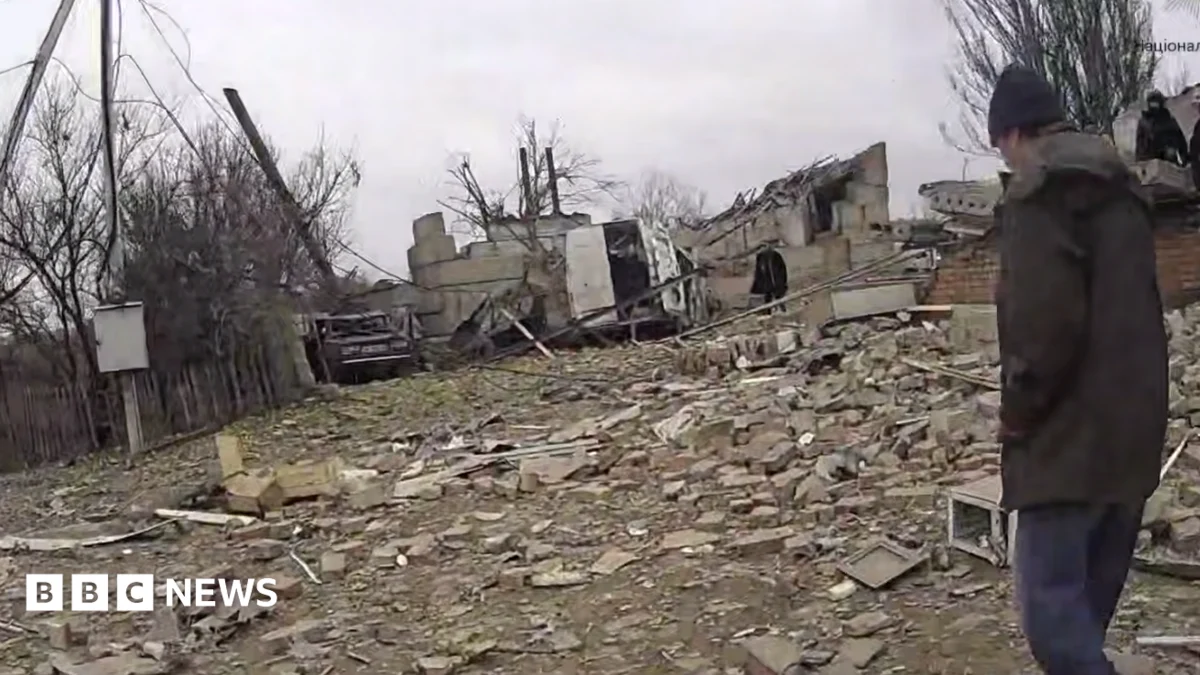
Ukraine’s national police on Wednesday unveiled deeply disturbing bodycam footage, offering a stark and visceral account of the devastating aftermath of a Russian aerial bombardment that struck the village of Kamyshuvakha in the Zaporizhzhia region. The released video, meticulously verified by BBC Verify as originating from the same location as prior footage from the Ukrainian State Emergency Service (DSNS), captures the immediate shock and chaos following the initial impact. Local residents, their faces etched with disbelief and trauma, are seen surveying the widespread destruction, their homes reduced to piles of rubble. The visual evidence starkly illustrates the immense devastation inflicted upon the once-peaceful community.
The footage then transitions to depict severely damaged buildings, testament to the destructive power of the ordnance. Amidst the wreckage, the chilling voice of a military official crackles over a two-way radio, issuing a grave warning to police officers on the ground. The official alerts them to the imminent arrival of more glide bombs, specifically targeting Kamyshuvakha. This urgent warning underscores the calculated nature of the attack, revealing an attempt to inflict maximum casualties by striking precisely when humanitarian efforts were underway and when first responders were present.
In response to the escalating threat, one of the police officers is heard directing local residents to seek immediate shelter. The video shows these individuals, their movements hurried and tinged with fear, descending into an underground shelter, at least two stories deep, designed to offer protection from aerial assault. Tragically, the harrowing footage reveals that this sanctuary was not spared. Mere seconds after the civilians and officers entered the shelter, the recording abruptly cuts out, implying that the shelter itself was struck. This abrupt cessation of the video leaves the viewer to confront the horrific implication of what transpired in the moments that followed, leaving no room for ambiguity about the targeted nature of the attack.
Ukrainian authorities have since confirmed that the now-destroyed shelter was situated near a local school. This school had been repurposed and was actively being utilized as a distribution point for vital humanitarian aid. This detail amplifies the barbarity of the Russian assault, demonstrating a deliberate targeting of a location where vulnerable civilians were seeking essential supplies and where dedicated individuals were working to alleviate suffering. The attack, therefore, represents a direct assault on those in need and those who serve them.
President Volodymyr Zelensky, in a forceful post on social media on Wednesday, provided a grim account of the incident. He stated unequivocally that "nine aerial bombs were dropped by the Russians." His words paint a picture of systematic destruction, not a random act of war. Zelensky went on to detail the tragic sequence of events: "First, they hit people who came to receive humanitarian aid, and then rescuers and police officers who arrived at the scene." This chilling revelation confirms that the attack was designed to maximize civilian and first-responder casualties, a tactic that constitutes a grave violation of international humanitarian law.
The Ukrainian President did not mince words in his condemnation of the international community’s response, or perceived lack thereof. He lamented that "unfortunately, there has been very little reaction from the world to this insane attack." Zelensky characterized this incident as yet another manifestation of "thousands" of war crimes perpetrated by Russia since its full-scale invasion of Ukraine in February 2022. His statement highlights a growing frustration within Ukraine regarding what is perceived as insufficient global solidarity and decisive action against Russia’s persistent violations of international norms.
Earlier on Wednesday, the Ukrainian State Emergency Service (DSNS) had released a separate video, offering a visual representation of the sheer destructive force unleashed on Kamyshuvakha. This footage showcased a massive crater, a gaping wound in the earth, left in the wake of the attack. The enormity of the crater serves as a stark reminder of the scale of the ordnance employed and the devastating impact it had on the village’s infrastructure.
The Russian military, as is their customary practice in such circumstances, has not offered any public comment or explanation regarding the bombing of Kamyshuvakha. This silence, coupled with the evidence presented by Ukraine, further fuels accusations of deliberate targeting and a disregard for civilian life. The lack of accountability and transparency from the aggressor nation continues to be a significant point of contention in the ongoing conflict.
The full-scale invasion of Ukraine, initiated by Russian President Vladimir Putin in February 2022, has plunged the region into a protracted and devastating conflict. The attack on Kamyshuvakha is not an isolated incident but rather a grim continuation of a pattern of alleged war crimes and violations of human rights that have characterized Russia’s military campaign. The systematic targeting of civilian infrastructure, humanitarian aid distribution points, and first responders represents a deliberate strategy to terrorize the population and undermine Ukraine’s ability to function.
In a separate but significant development on Wednesday, President Zelensky revealed details of his engagements with influential figures in the international arena. He stated that he had engaged in a "great detail for an hour-and-a-half" discussion with Steve Witkoff and Jared Kushner, identified as peace envoys for former US President Donald Trump. This meeting preceded trilateral negotiations scheduled between Ukraine, Russia, and the United States. These crucial talks are slated to take place on November 10th and 11th in Abu Dhabi, the capital of the United Arab Emirates. The involvement of former US presidential advisors suggests a potential, albeit perhaps indirect, avenue for de-escalation or negotiation, though the effectiveness of such engagements remains to be seen.
President Zelensky, who is currently undertaking a surprise visit to Spain, also disclosed that his team had participated in a separate "meaningful" meeting in Brussels. This gathering involved representatives from key international players, including the United States, the European Union, France, Britain, Germany, as well as NATO and the World Bank. The focus of this high-level discussion was on "post-war reconstruction" efforts for Ukraine. This indicates a proactive approach by Ukraine and its allies to plan for the eventual rebuilding of the nation, even amidst the ongoing hostilities.
Furthermore, Zelensky added that the deliberations in Brussels, Belgium’s capital, were scheduled to continue on Thursday. The agenda for the subsequent sessions included a critical discussion on "security guarantees" for Ukraine. This highlights the ongoing efforts to solidify Ukraine’s long-term security and its integration into Western security frameworks, a key demand from Kyiv to ensure its future sovereignty and territorial integrity.
The context for these diplomatic engagements is crucial. Since the suspension of trilateral talks aimed at achieving a ceasefire and ending the war in February, Moscow has demonstrably intensified its attacks across Ukraine. This escalation has coincided with a critical shortage of Western-supplied interceptors for Ukraine, leaving its air defense systems severely depleted. This strategic shift by Russia suggests a deliberate attempt to gain military advantage while Ukraine’s defensive capabilities are strained.
Analysts, however, anticipate no major breakthroughs when the peace talks resume in Abu Dhabi. The deep-seated disagreements between Ukraine and Russia, coupled with Russia’s continued aggression, present formidable obstacles to any immediate resolution. The expectation is that these talks will likely serve as a platform for dialogue and perhaps the exploration of limited de-escalation measures, rather than a decisive step towards ending the conflict. The ongoing violence and the humanitarian crisis underscore the urgent need for sustained international pressure and a unified approach to hold perpetrators of war crimes accountable. The bodycam footage from Kamyshuvakha serves as a grim and potent reminder of the human cost of this conflict and the imperative for justice and lasting peace.
The release of this bodycam footage by Ukraine’s national police, corroborated by BBC Verify, provides irrefutable evidence of the brutality of the Russian assault on Kamyshuvakha. It paints a picture not of collateral damage, but of a deliberate and calculated attack designed to inflict maximum suffering on civilians and those attempting to aid them. The international community’s response, or the perceived lack thereof, as lamented by President Zelensky, continues to be a critical issue. As Ukraine perseveres in its defense, and its leaders engage in vital diplomatic efforts, the horrors witnessed in Kamyshuvakha serve as a stark reminder of the stakes involved and the urgent need for a comprehensive and just resolution to this devastating war. The narrative of civilian targeting and the obstruction of humanitarian aid must be central to all future discussions and actions aimed at holding Russia accountable for its actions and preventing further atrocities. The ongoing diplomatic maneuvers, while important, must be accompanied by robust measures to ensure the safety and security of the Ukrainian people and to uphold the principles of international law.
