
 By admin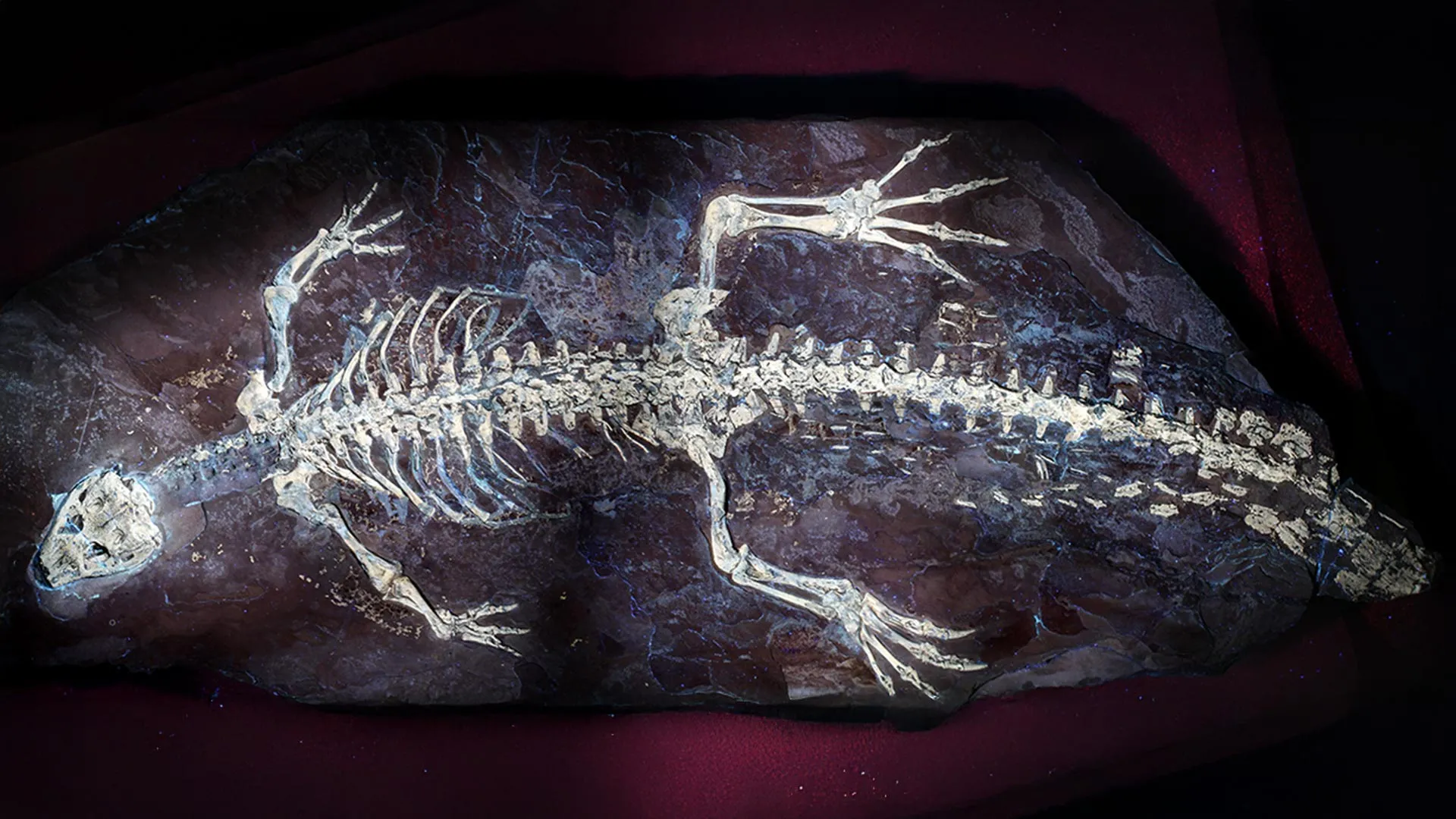
The Unveiling Technology: Ultraviolet Light as a Paleontological Tool
The key to unlocking these hidden details lay in the strategic use of ultraviolet light. While traditional paleontological examination relies heavily on visible light and morphological analysis of bones, UV light offers a non-destructive method to reveal structures that remain completely invisible to the naked eye. This is because fossilized tissues, even those incredibly delicate and poorly preserved, often retain minute traces of organic compounds or mineral replacements that fluoresce or absorb UV light differently than the surrounding rock matrix. This differential response causes otherwise indistinct features to "pop out," creating a stark contrast that highlights soft tissues, skin impressions, and even internal structures.
"UV light allows us to see details that would otherwise remain completely hidden in the rock," explains Oscar Castillo-Visa, the first author of the groundbreaking work. This technique has revolutionized paleontology in recent years, enabling scientists to discern intricate details like feather filaments in dinosaurs, melanosomes that hint at ancient coloration, or the delicate structures of internal organs, opening up new avenues for understanding the biology and ecology of extinct organisms. For Montsecosuchus depereti, UV light proved indispensable, transforming a seemingly unremarkable fossil into a treasure trove of biological information.
A Glimpse into the Past: The Ancient Environment of Pedrera de Meià
Approximately 125 million years ago, during the early stages of the Cretaceous period, a small crocodylomorph met its end in a tranquil karstic lake nestled near the coast of what would one day become the Catalan Pre-Pyrenees. The Cretaceous was a time of significant global change, marked by the breakup of supercontinents, rising sea levels, and the diversification of flowering plants, birds, and various reptile groups, including the ancestors of modern crocodiles. The conditions within this ancient lake were unusually favorable, a critical factor for the exceptional preservation of the creature. Its body gently settled into anoxic (oxygen-poor) fine lake sediments, where the absence of scavengers and bacterial decomposition allowed for the meticulous preservation of not only its skeletal structure but also its delicate soft tissues.
Over millions of years, these fine sediments underwent lithification, transforming into the renowned lithographic limestones of the Pedrera de Meià. Lithographic limestones are famous for their extremely fine grain size, which allows for the capture of minute details, much like a photographic plate. This geological peculiarity has earned Pedrera de Meià the designation of a Konservat-Lagerstätte, a German term meaning "conservation deposit" – a rare type of fossil site where extraordinary conditions lead to the preservation of soft tissues that are typically lost during the fossilization process. Today, this globally significant site is recognized as part of the UNESCO Orígens Global Geopark, underscoring its immense scientific and cultural value.
The Fossil Itself: MGB-512 and its Journey Through Time
The fossil specimen, cataloged as MGB-512, is a remarkably complete skeleton, measuring approximately 50 centimeters in length – roughly the size of a modern-day house cat, indicating it was a juvenile or a relatively small adult of its species. It is now housed and cared for at the Museum of Natural Sciences of Barcelona. The specimen itself has a long history, having been discovered more than a century ago. While it received some initial scientific attention in the 1990s, the full extent of its preserved soft tissues remained hidden, awaiting the advent of modern investigative techniques.
The recent breakthrough came about serendipitously. Paleontologists Oscar Castillo and Jesús Serrano were engaged in the meticulous task of building a comprehensive database of fossils from the lithographic limestones of Montsec, examining specimens held in various Catalan and European museums. It was during this systematic review that they turned their UV light on the holotype of Montsecosuchus depereti. To their astonishment, previously unseen structures emerged from the rock, revealing themselves as undeniable remnants of soft tissue. This discovery underscores the enduring value of museum collections and the potential for new technologies to re-contextualize and enrich our understanding of long-studied specimens.
Revealing the Integument: Skin and Scales
The application of UV light allowed the research team to document several types of soft tissue, most prominently the epidermal scales that once covered Montsecosuchus depereti. While the species has been known to science since the early 20th century, this new analysis provides the first truly detailed picture of its integumentary system – its skin. The scales exhibited considerable variation in both shape and size across different regions of the body, a common feature in many reptiles, where scale morphology can be adapted to specific functions, such as protection, flexibility, or sensory perception.
A particularly interesting finding was the absence of the prominent, high caudal fin typically seen in modern, highly aquatic crocodilians. This suggests that Montsecosuchus likely had a different mode of aquatic locomotion compared to its modern relatives, perhaps relying less on powerful, laterally compressed tail propulsion for sustained swimming and more on other adaptations for its semi-aquatic lifestyle. This detail provides crucial information for reconstructing its paleoecology and behavior.
Sensory Windows to the World: Integumentary Sensory Organs
Beyond mere scales, the fossil may also preserve direct evidence of ancient sensory organs embedded within the skin. These possible structures appeared within certain scales, particularly concentrated around the neck, limbs, and along the sides of the trunk and tail. In living crocodiles, similar structures, known as integumentary sensory organs (ISOs), are highly sophisticated mechanoreceptors. These dome-shaped organs are incredibly sensitive to changes in water pressure, allowing modern crocodilians to detect even the slightest ripples caused by prey or predators, even in murky water. They also play roles in detecting touch, temperature fluctuations, and chemical signals, making them vital for hunting, navigation, and social interaction.
In Montsecosuchus, these potential sensory structures were not uniformly distributed but appeared to be confined to smaller scales located predominantly around the edges of the body. This specific distribution offers a compelling hypothesis regarding the evolutionary trajectory of these vital organs. It suggests that such sensory structures might have initially evolved in specific, localized areas of the body, perhaps at the interfaces between the animal and its aquatic environment, before gradually becoming more widespread across the entire skin surface in later crocodylomorph lineages. This provides a rare snapshot into the incremental evolution of a complex sensory system, shedding light on the adaptive pressures that drove its development.
Breathing Life into an Ancient Creature: The Respiratory System
The ultraviolet analysis also brought to light delicate cartilaginous structures within the chest cavity of Montsecosuchus. The preservation of cartilage, a soft tissue that rarely fossilizes, is in itself a remarkable feat. Its presence indicates that Montsecosuchus already possessed a remarkably efficient respiratory system, one that shared surprising similarities with the advanced systems found in modern crocodiles. Modern crocodilians are renowned for their highly efficient respiratory system, which includes a hepatic piston diaphragm that actively pulls air into the lungs, allowing for unidirectional airflow – a trait also found in birds, which maximizes oxygen uptake.
The discovery of these sophisticated thoracic anatomical traits in a relatively primitive crocodylomorph like Montsecosuchus suggests that such advanced respiratory adaptations evolved surprisingly early in the group’s evolutionary history. An efficient respiratory system would have been a significant advantage for a semi-aquatic animal, enabling longer dive times, higher metabolic rates, and sustained activity both in and out of the water. "These traits indicate that, despite being a primitive animal, it was already very well adapted to a semi-aquatic lifestyle," concludes Castillo-Visa, highlighting the evolutionary success of these early adaptations.
The Colors of Time: A Possible Camouflage Pattern
Perhaps the most visually striking discovery to emerge from the UV analysis involves the animal’s tail. Under ultraviolet light, some of the scales in the caudal region displayed distinct alternating light and dark bands running transversely across the tail. Researchers interpret these bands as possible evidence of the animal’s original coloration, a finding of immense rarity and significance in paleontology.
This pattern, if confirmed as original coloration, likely served as a form of disruptive camouflage. Disruptive coloration works by breaking up the animal’s body outline, making it harder for predators or prey to recognize its shape against a complex background, such as dappled light filtering through water or dense vegetation along a shoreline. Such a pattern would have provided an excellent advantage for an ambush predator lurking in the shallow waters of its ancient lake habitat. If this interpretation holds true, Montsecosuchus would become the oldest known crocodylomorph with preserved evidence of its external color pattern, pushing back the timeline for understanding the evolution of coloration in this lineage.
While the pattern is clear, scientists cannot yet definitively determine the exact colors that produced these light and dark bands. Fossilized coloration can be inferred from the preservation of melanosomes (pigment-containing organelles) or chemical residues of pigments, but UV light primarily reveals structural differences. "At the moment we cannot say for sure what color the crocodile’s tail was, but it would be expected that it was not so different from current species, which also show different coloration patterns," explains Albert G. Sellés, a co-author of the article. Modern crocodilians display a variety of cryptic colorations, from mottled greens and browns to banded patterns, all adapted to their specific environments.
Broader Implications and the Catalan Legacy
The findings from Montsecosuchus depereti offer invaluable new clues about the early evolution of crocodylomorph skin, sensory systems, respiration, and external anatomy. They significantly enrich our understanding of how these ancient crocodile relatives adapted to their environments and evolved the complex traits that characterize their modern descendants. The study also powerfully underscores the scientific importance of the Catalan fossil record, particularly the Konservat-Lagerstätte of Pedrera de Meià, for reconstructing the intricate evolutionary history of vertebrates.
The interdisciplinary research team included Oscar Castillo-Visa and Albert G. Sellés, alongside Àngel Galobart (Institut Català de Paleontologia Miquel Crusafont and director of the Conca-Dellà Museum), and Phil Bell from the University of New England, an expert in fossilized integument. This collaborative effort highlights the global nature of modern paleontological research. The project received substantial funding from several sources, including the VEBPI, PLEC2021-007903, and ARQ001SOL-173-2022 projects, with crucial support from the Ministry of Science, Innovation and Universities, the NextGenerationEU/PRTR program, the Department of Culture of the Generalitat de Catalunya, and the CERCA program, ensuring the continuation of such vital scientific endeavors.
Pedrera de Meià: A Window to the Lower Cretaceous
The Pedrera de Meià is justly celebrated as a Konservat-Lagerstätte, a designation reserved for fossil sites with truly extraordinary preservation. The unique geological and environmental conditions prevalent 125 million years ago at this location allowed for the meticulous retention of not only robust bones and other hard tissues but also delicate soft structures that typically vanish without a trace during the fossilization process. This exceptional preservation makes Pedrera de Meià an indispensable site for studying the diverse life forms of the Lower Cretaceous, offering unparalleled insights into ancient ecosystems.
To date, more than 8,000 fossil specimens have been recovered from Pedrera de Meià, painting a vivid picture of its ancient biodiversity. The fossil record includes a stunning array of invertebrates, such as spiders, flies, wasps, beetles, various insect larvae, and crustaceans. Vertebrates are equally well-represented, with numerous species of fish, amphibians, and reptiles, including this remarkable Montsecosuchus. The site is also globally famous for its diverse flora, including Montsechia, which holds the distinction of being the first known angiosperm (flowering plant) in the world, revolutionizing our understanding of plant evolution.
The importance of Pedrera de Meià extends beyond scientific research. Fossils from the site are proudly displayed at the Montsec de Meià Interpretation Center in the town of Vilanova de Meià, where over 100 exceptionally preserved specimens captivate visitors. The UNESCO Orígens Geopark has also developed a dedicated website (pedrerademeia.geoparcorigens.cat/ca/) showcasing many of the site’s most representative fossils, making this rich paleontological heritage accessible to a global audience. The center is also an integral part of the "Dinosaurs of the Pyrenees" project, a network of museums and interpretation centers dedicated to highlighting the incredibly rich paleontological record of the Catalan Pyrenees, solidifying Pedrera de Meià’s place as a cornerstone of both scientific discovery and public engagement.
