
 By admin
Ketchikan’s identity is inextricably linked to its geography and its original inhabitants, the Lingít (Tlingit) people, specifically the Saanya Kwaan and Tongass Kwaan tribes. For millennia, these communities flourished in the temperate rainforest, developing a complex social structure and a sophisticated artistic tradition that remains visible today in the city’s world-renowned collection of standing totem poles. However, the modern history of Ketchikan is often told through the lens of the late 19th-century gold rush, the booming canned salmon industry, and the colorful, albeit checkered, history of Creek Street. Creek Street, a historic boardwalk built on stilts over Ketchikan Creek, once served as the city’s red-light district during its frontier days. Today, it stands as a picturesque landmark, but for those who look closer, it represents the site where the natural world and human ambition have long collided.
The arrival of Evita Robinson, the visionary founder of the Nomadness Travel Tribe, in Ketchikan signifies a burgeoning alliance between Indigenous Alaskan leaders and the broader movement for diversity in travel. Robinson, who has spent over a decade dismantling barriers for travelers of color and advocating for "decolonized" travel experiences, found a kindred spirit in Joe Williams Jr. Williams, a Tlingit elder and the former Mayor of Ketchikan, operates "Where the Eagle Walks," a tour company that rejects the standardized scripts of corporate shore excursions. Instead, Williams leads visitors through the winding paths of Ketchikan, sharing the oral histories of his ancestors, the spiritual significance of the Eagle and Raven moieties, and the harsh realities of the Tlingit experience under Western colonization.
This partnership is more than a simple photo opportunity; it is a strategic alignment that addresses a growing demand in the global travel market. According to recent data from the Adventure Travel Trade Association (ATTA), modern travelers are increasingly prioritizing "impact travel"—experiences that contribute to the preservation of local cultures and provide direct economic benefits to Indigenous communities. In Alaska, where tourism is a vital economic pillar contributing over $4.5 billion in total economic impact annually, the shift toward Indigenous-led initiatives is crucial for long-term sustainability. By centering the Tlingit perspective, "Where the Eagle Walks" ensures that the revenue generated by Ketchikan’s nearly 1.5 million annual cruise passengers does not merely flow into the coffers of international conglomerates, but rather supports the revitalization of local heritage.
Walking with Joe Williams Jr. along Creek Street is an exercise in temporal layering. To the average tourist, the creek is a place to watch salmon struggle upstream to spawn, a natural spectacle of endurance and biological necessity. To Williams, the creek is a classroom. He explains that the very name "Ketchikan" is derived from the Tlingit word "Kitschk-hin," which translates roughly to "the creek of the thundering wings of an eagle." This linguistic connection underscores the Tlingit belief that humans are not separate from nature but are integrated components of a living, breathing ecosystem. As the "Eagle" in the tour’s name suggests, Williams belongs to the Eagle moiety, and his storytelling is imbued with the responsibilities and protocols associated with his lineage.
The presence of Evita Robinson highlights the "Black Travel Movement’s" expanding footprint in unconventional destinations like the Arctic and Subarctic. Robinson’s work with Nomadness has highlighted that the "great outdoors" has historically been marketed as a monochromatic space, often excluding the narratives and safety of Black and Brown travelers. Her collaboration with Williams in Ketchikan serves as a powerful testament to the shared values of resilience and storytelling between Black and Indigenous communities. It challenges the "frontier" mythos of Alaska—a narrative that often erases Indigenous presence in favor of a "wild, untamed wilderness" waiting to be conquered. Instead, through the lens of "Where the Eagle Walks," Alaska is presented as a sophisticated cultural landscape with a history that predates the arrival of the first European explorers by thousands of years.
The ecological context of Ketchikan further enriches this narrative. The Tongass National Forest, which surrounds the city, is the largest intact temperate rainforest on Earth. It serves as a massive carbon sink, playing a critical role in global climate regulation. However, the forest is also at the center of ongoing political and environmental battles regarding logging rights and land use. For the Tlingit, the Tongass is not just a resource; it is a relative. The health of the forest is directly tied to the health of the salmon runs, which in turn sustains the bald eagle populations that Williams monitors with a watchful eye. During the peak of the salmon run, it is not uncommon to see dozens of eagles perched in the trees lining the creek, a sight that reinforces the spiritual and physical interdependence of the region’s inhabitants.
Analyzing the economic data of Southeast Alaska reveals the precariousness of a tourism industry reliant on massive volume. Before the global shifts of the early 2020s, Ketchikan often struggled with the logistical strain of hosting up to six or seven massive cruise ships simultaneously. The resulting "over-tourism" threatened to dilute the very authenticity that visitors traveled thousands of miles to find. The model provided by "Where the Eagle Walks" offers a solution: high-value, low-impact cultural tourism. By limiting group sizes and focusing on deep-dive historical narratives, Williams provides a premium experience that justifies a higher price point while reducing the physical footprint on the city’s infrastructure.
Furthermore, the role of Joe Williams Jr. as a cultural ambassador extends into the realm of linguistic preservation. The Tlingit language, Lingít, is currently classified as endangered, with a dedicated core of elders and educators working tirelessly to pass it on to the next generation. Every time Williams uses a Tlingit word to describe a plant, an animal, or a geographic feature, he is performing an act of resistance against the historical efforts to suppress Indigenous tongues. For travelers like Robinson, hearing these words spoken on the land to which they belong provides a sense of place that no guidebook can replicate.
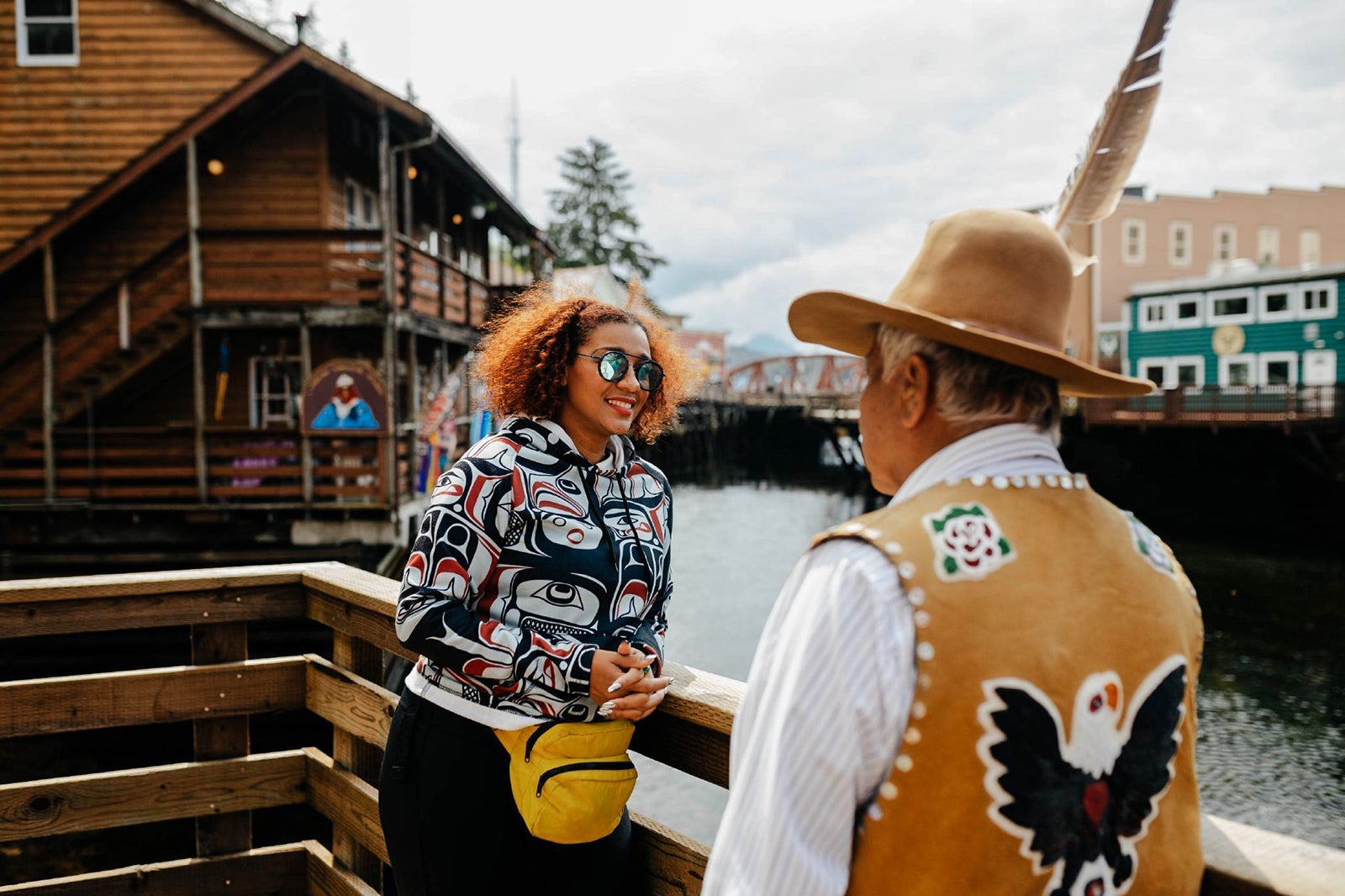
As the travel industry looks toward the late 2020s, the "Ketchikan Model" of Indigenous and diverse-led collaboration serves as a blueprint for other destinations. It suggests that the future of travel lies in the "triple bottom line": social equity, environmental integrity, and economic viability. The featured image of Robinson and Williams outside Creek Street is a symbol of this new era. It represents a bridge between the traditional knowledge of the Tlingit elders and the modern, globalized reach of the digital age.
In conclusion, "Where the Eagle Walks" is not merely a walking tour; it is a reclamation of space and story. In the rain-slicked streets of Ketchikan, amidst the smell of cedar smoke and the cry of the gulls, Joe Williams Jr. and Evita Robinson are demonstrating that the most profound journeys are those that lead us to a deeper understanding of our shared humanity and our collective responsibility to the earth. As the eagles continue to circle above the thundering wings of the creek, the stories of the Tlingit people remain anchored in the soil, the water, and the hearts of those who take the time to walk, to listen, and to learn. The legacy of Ketchikan is being rewritten, one step at a time, ensuring that the eagle will always have a place to walk, and the people will always have a story to tell.
