
 By admin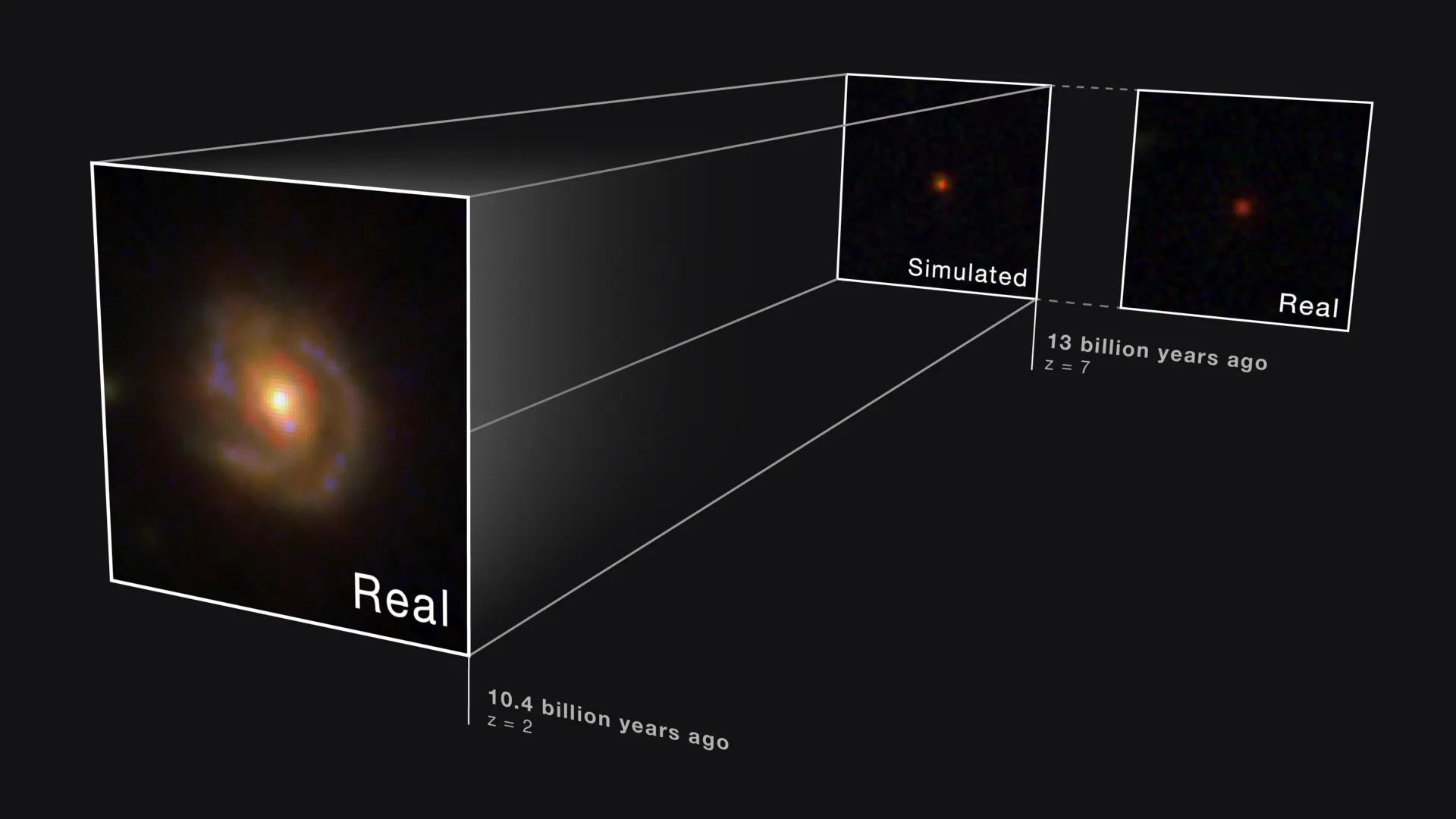
One leading hypothesis posits that these little red dots are supermassive black holes in their most active phases, known as active galactic nuclei (AGN). In this scenario, the black hole at the center of a galaxy is voraciously accreting matter, emitting immense amounts of energy across the electromagnetic spectrum. However, LRDs do not behave quite like the archetypal AGN astronomers observe in the nearby, more mature universe. A striking discrepancy lies in their distribution: LRDs are remarkably common at high redshifts, signifying immense distances and observations far back in cosmic time, but their numbers fall sharply at lower redshifts, closer to the present day. Redshift, a phenomenon where light from distant objects is stretched to longer, redder wavelengths as the universe expands, serves as a cosmic clock and ruler. The higher the redshift, the greater the distance the light has traveled, and thus, the earlier in the universe’s history we are observing. This dramatic decline in LRD prevalence with decreasing redshift has raised an important and pressing question: What happens to these mysterious objects as the universe grows older, and why do they seemingly vanish from our cosmic neighborhood?
Unveiling a Possible Evolutionary Path for Little Red Dots
A breakthrough in understanding this cosmic vanishing act may have been achieved by a dedicated research team led by Pierluigi Rinaldi, formerly of the University of Arizona’s Steward Observatory and now at the Space Telescope Science Institute (STScI) in Baltimore. Building on earlier foundational research, the team published a groundbreaking new study on July 29 in The Astrophysical Journal. Their findings suggest a compelling new narrative: little red dots may not represent an entirely separate or distinct population of galaxies, as some theories had proposed. Instead, their peculiar and isolated appearance could, at least in part, be a consequence of observational bias, a cosmic illusion brought about by the limitations of current telescopic technology when peering into the most distant reaches of space. At extreme distances, the fainter, surrounding structures of a galaxy – its arms, disks, and stellar halos – become too dim and diffuse for even the most powerful telescopes to detect. This leaves only the extraordinarily bright and compact central source, likely powered by an active supermassive black hole, visible to our instruments, creating the impression of a solitary "little red dot."
The researchers arrived at this significant conclusion through a meticulous investigation of a lower-redshift spiral galaxy designated WISEA J123635.56+621424.2. They affectionately nicknamed this galaxy the "Saguaro" because its prominent, sprawling spiral arms bear a striking resemblance to the majestic Saguaro cactus, an iconic sentinel of the Sonoran Desert in the Southwestern United States. The Saguaro galaxy resides at a redshift of 2, a cosmic distance that means astronomers observe it as it appeared roughly 3.3 billion years after the Big Bang – a time when the universe was still relatively young, but significantly more evolved than the epoch where most high-redshift LRDs are found. Crucially, at its very heart, the Saguaro harbors a compact, intensely red source that closely mirrors the defining characteristics of a little red dot, even evoking the vibrant, ruby-red fruit that adorns the desert cactus.
"Everything created in the early universe must evolve into something around us today," explained co-author George Rieke of the University of Arizona, emphasizing the fundamental principle of cosmic evolution. "For a long time, we have had little idea of what LRDs become or how they fit into the larger cosmic narrative, but these results finally show us how to find their progeny and understand their evolutionary lineage." This statement underscores the profound implications of the Saguaro discovery: it provides a tangible link, a "missing link" if you will, between the enigmatic early universe LRDs and the galaxies we observe in the more mature cosmos.
Earlier observations from NASA’s retired Spitzer Space Telescope, a pioneering infrared observatory, had already provided an early, tantalizing glimpse of a population of dust-obscured, compact galaxies residing in the lower-redshift universe, a population that includes the Saguaro. These initial findings, though limited in detail, were instrumental in setting the stage for the more detailed, high-resolution observations that would later be conducted with NASA’s powerful Hubble Space Telescope and the revolutionary James Webb Space Telescope. Spitzer’s ability to penetrate dust clouds with its infrared vision hinted at the hidden activity within these compact objects, paving the way for Webb’s deeper insights.
"The Saguaro is exceptionally important because it serves as a prototypical little red dot, yet it is one of the very few we have managed to locate at a lower redshift," stated Fabio Pacucci of the Harvard-Smithsonian Center for Astrophysics in Cambridge, Massachusetts, and a co-author of the study. "Its relatively closer proximity allows us to scrutinize it with unprecedented detail, making it an invaluable cosmic laboratory. It can therefore be used to study the evolutionary pathway of these mysterious dots throughout vast stretches of cosmic time, offering a bridge across billions of years of cosmic history."
Webb and Hubble Reveal the Saguaro in Unprecedented Detail
Rinaldi’s team embarked on a painstaking search, examining thousands of astronomical sources across numerous surveys. The Saguaro, however, stood out not only for its striking appearance but also because researchers happened to possess an unusually rich and useful set of observational data for it. Fortuitously, one of Webb’s microshutter arrays was precisely positioned directly over the galaxy’s core, a stroke of observational luck that allowed the telescope to collect highly detailed spectroscopic data from its very center. This spectroscopic information is crucial, as it provides a cosmic fingerprint of the light, revealing the composition, temperature, velocity, and other physical properties of the gas and stars within the core. Furthermore, the galaxy’s lower redshift provided astronomers with an exceptionally clearer, less obscured, and more resolved look at its larger, intricate spiral structure, a luxury not afforded for the truly distant LRDs.
To comprehensively examine the Saguaro spiral galaxy across as much of the electromagnetic spectrum as possible, the team meticulously combined archival observations from both the Hubble Space Telescope and the James Webb Space Telescope. Hubble, renowned for its unparalleled vision in ultraviolet and visible light, supplied crucial ultraviolet imaging data, allowing the team to probe the energetic, star-forming regions and the immediate environment around the active nucleus. In parallel, Webb, with its superior infrared capabilities, provided both infrared imaging and the invaluable spectroscopic data, essential for peering through the dust that often shrouds active galactic nuclei and for detecting the redshifted light from distant objects. This synergistic approach, leveraging the unique strengths of both observatories, painted a more complete picture of the Saguaro than either telescope could achieve alone.
"Because the Saguaro is situated at a lower redshift, we are fortunate to be able to resolve and see the very beautiful and bright host galaxy in exceptionally high resolution and exquisite detail with both Webb and Hubble," explained Zihao Wu of the Harvard-Smithsonian Center for Astrophysics and a co-author of the study. "Webb’s unparalleled infrared observations, in particular, are helping us to profoundly understand how the overall galaxy and its little red dot-like nucleus are intimately connected and how they interact in a complex dance of co-evolution." This connection between the central black hole and its host galaxy is a cornerstone of modern astrophysics, as it’s believed that black hole activity can both fuel and quench star formation in a galaxy.
The researchers employed several rigorous methods to confirm whether the Saguaro’s compact, red central region truly matched the defining characteristics of a typical LRD. The combined Hubble and Webb observations unequivocally showed that the nucleus of the Saguaro shines more strongly in ultraviolet and infrared wavelengths than in visible light, a hallmark signature also consistently observed in the most distant, high-redshift little red dots. This spectral similarity was a key piece of evidence.
Beyond spectral analysis, the team also meticulously separated the light originating from the galaxy itself – its stars, gas, and dust – from the intense light produced by its active nucleus. This intricate photometric decomposition allowed them to isolate the properties of the central engine. Furthermore, they investigated whether the object emitted X-rays, a crucial diagnostic for identifying and characterizing active black holes.
Most little red dots observed at high redshift cannot be detected in X-ray light, a puzzling absence if they are indeed powerful AGN. The Saguaro, however, produced a weak, yet discernible, X-ray emission that was successfully detected by NASA’s Chandra X-ray Observatory, another of NASA’s Great Observatories specializing in high-energy astrophysics.
"What these X-ray light observations unequivocally show is that this galaxy indeed hosts an active galactic nucleus, and a very obscured one at that," commented Carys Gilbert, a Master’s student at the University of Cape Town in South Africa and a co-author of the paper. "It’s not only significantly obscured by vast amounts of dust and gas, but it is also X-ray weak, meaning its X-ray output is lower than what might be expected for its overall luminosity. That specific kind of combination – heavy obscuration coupled with X-ray weakness – could provide a compelling explanation for the puzzling lack of X-ray emission that we typically see from virtually all other high-redshift little red dots. It fits the puzzle of little red dots very nicely, adding a critical piece to our understanding."
Simulating the Saguaro in the Early Universe
Armed with this robust evidence, the researchers then performed another incredibly revealing and innovative test. After firmly establishing that the Saguaro’s compact red nucleus indeed matched the defining characteristics of a little red dot, they digitally shifted the galaxy to a significantly higher redshift. This computational exercise was designed to simulate precisely how the Saguaro would appear if observers were to view it much farther back in cosmic history, at distances comparable to where the enigmatic LRDs are most prevalent.
The result of this digital redshift experiment was nothing short of striking and profoundly impactful. As the simulated Saguaro was progressively moved to greater and greater distances in cosmic time, the fainter, surrounding host galaxy became increasingly difficult to discern, eventually becoming too faint to see altogether. Its beautiful spiral structure effectively vanished from view, succumbing to the limitations of detection at extreme distances, while the bright, LRD-like central source remained stubbornly and prominently visible.
This compelling result provides powerful, direct support for the central idea that at least some, and potentially many, of the distant little red dots observed in the early universe may appear isolated and devoid of surrounding galactic structure simply because astronomers, even with Webb’s extraordinary capabilities, cannot detect the much fainter, more diffuse galaxies that actually surround them. The host galaxies are there; they are simply hidden from our view due to the vast cosmic distances and the observational challenges inherent in studying the early universe.
"Our theory is that the appearance of most of these distant sources is significantly affected by this cosmological effect, creating a profound observational bias," explained Pierluigi Rinaldi. "We are simply not able to sufficiently sample or resolve the immediate environment of high-redshift little red dots because their surrounding structures are just too faint to be observed, even with the unprecedented sensitivity of Webb. This means that little red dots are far more complex than just being a singular dot; they are merely the tip of the iceberg – the visible manifestation of a supermassive black hole vigorously interacting with its nearby, yet hidden, galactic surroundings."
A Hidden Phase of Supermassive Black Hole Growth
Based on this meticulous Saguaro case study, the researchers propose a compelling new framework: little red dots may not constitute a unique, distinct class of galaxy unto themselves. Instead, they could represent a specific, temporary, and highly active phase in the life cycle of supermassive black holes and their host galaxies. During this phase, the central black hole is particularly energetic and obscured, making its compact, red nucleus the dominant visible feature.
If this hypothesis holds true, the Saguaro galaxy could offer an incredibly important and tangible link between the large population of little red dots that Webb consistently observes at high redshift and the more evolved, less active galaxies that populate the more recent and local universe. It provides a crucial bridge, illustrating how these early, compact, and active systems evolve into the more familiar galactic structures we see today. This concept aligns well with theories of galaxy and black hole co-evolution, where the growth of a central black hole is intimately tied to the growth and star formation activity of its host galaxy.
However, the researchers wisely caution that the Saguaro, while highly illustrative, cannot singularly represent every single LRD observed across the vast cosmos. Instead, they propose that it vividly illustrates one plausible and significant stage in the complex evolutionary journey of these compact red sources. The universe is diverse, and it is likely that different LRDs follow different evolutionary paths or represent slightly different physical conditions.
To strengthen this groundbreaking interpretation and to explore the full spectrum of LRD evolution, more extensive observations will undoubtedly be needed. The team is already planning to continue their in-depth study of the Saguaro, aiming to gather even more data to refine their understanding of its properties and evolution. Furthermore, they intend to embark on a systematic search for additional Saguaro-like galaxies at lower redshifts, seeking out other "missing links" that can illuminate the LRD evolutionary sequence. Researchers also plan to delve deep into Webb’s extensive and ever-growing archive, leveraging its wealth of data to create a broader, more comprehensive census of little red dots. This large-scale survey will allow them to investigate how their surrounding environments – the density of matter, the presence of neighboring galaxies, and the availability of gas – influence their growth and evolution over cosmic time.
Collectively, these concerted efforts could profoundly help astronomers reconstruct the intricate family tree of little red dots, ultimately determining how these mysterious and prevalent early universe sources develop, transform, and integrate into the larger tapestry of cosmic evolution over billions of years. This research represents a significant step forward in understanding one of the most intriguing puzzles revealed by the James Webb Space Telescope.
Webb and Hubble Continue Probing Cosmic History
The James Webb Space Telescope (JWST) stands as the world’s premier space science observatory, a technological marvel pushing the boundaries of human understanding. Operating primarily in the infrared, Webb is uniquely designed to pierce through cosmic dust and gas, allowing it to observe the most distant and ancient objects in the universe, including the very first galaxies and stars. It is actively solving mysteries in our solar system, looking beyond to distant worlds around other stars in the search for exoplanetary habitability, and probing the mysterious structures and origins of our universe and our place within its grand narrative. Webb is an international program of unprecedented scope, led by NASA with its vital partners, ESA (European Space Agency) and CSA (Canadian Space Agency), embodying a global collaborative spirit in scientific discovery.
The Hubble Space Telescope, a testament to enduring scientific achievement, has been operating for over three decades, far exceeding its initial design lifetime. Despite its age, Hubble continues to make groundbreaking discoveries that profoundly shape our fundamental understanding of the universe, often complementing Webb’s infrared observations with its sharp vision in ultraviolet and visible light. Hubble is a project of international cooperation between NASA and ESA. NASA’s Goddard Space Flight Center in Greenbelt, Maryland, manages the telescope and mission operations, ensuring its continued productivity. Lockheed Martin Space, based in Denver, also provides crucial support for mission operations at Goddard. The Space Telescope Science Institute (STScI) in Baltimore, which is operated by the Association of Universities for Research in Astronomy, diligently conducts Hubble’s complex science operations for NASA, facilitating its continuous stream of invaluable data to the global scientific community. The synergistic use of these two iconic telescopes, alongside others like Spitzer and Chandra, is paramount to unraveling the deepest mysteries of our cosmos.
