
 By Rifan Muazin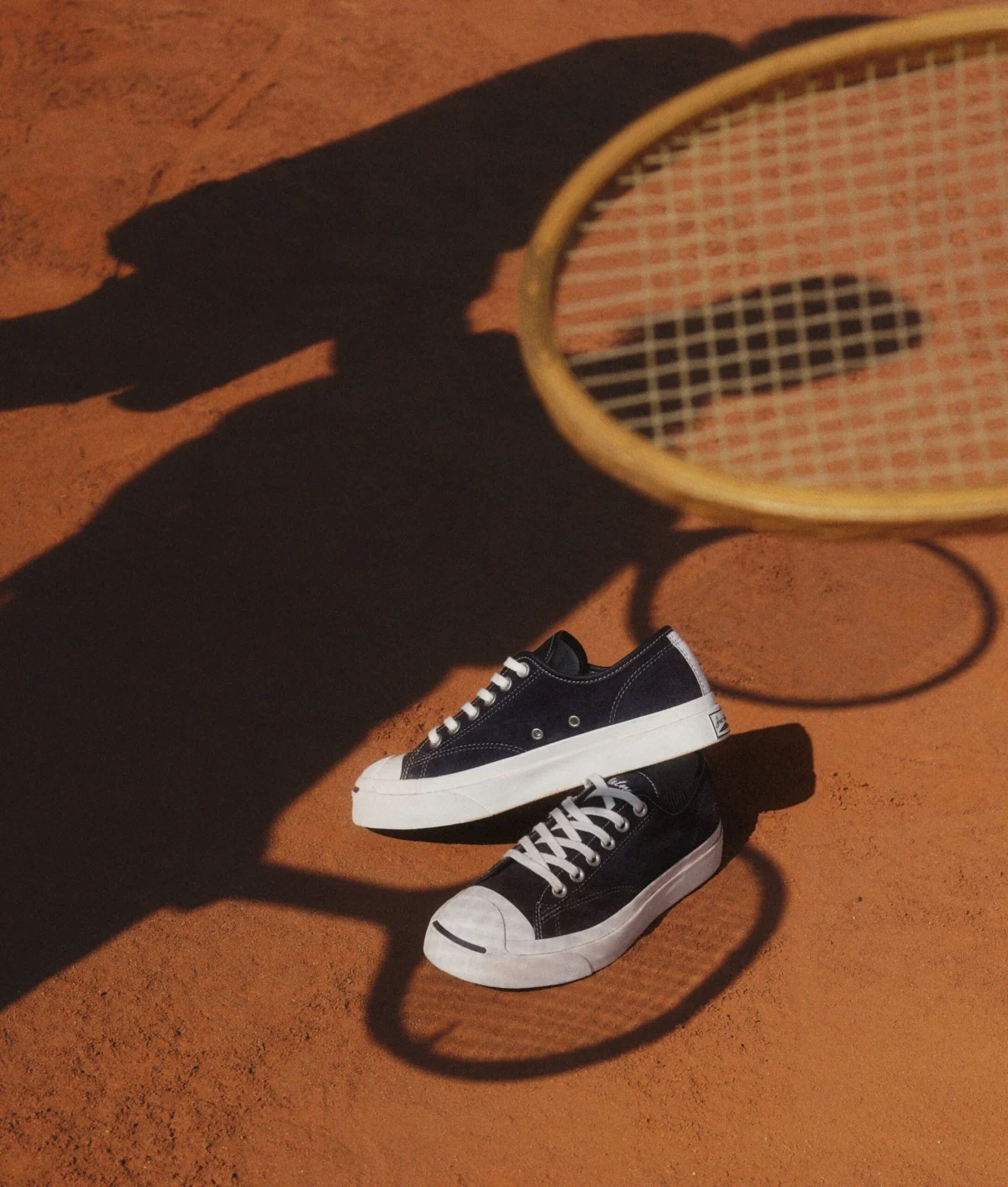
When the world remembers Kurt Cobain, the mental image is often a grain-heavy photograph or a flickering MTV clip of the man who defined a generation’s angst. He is typically draped in a thrift-store flannel or a mohair cardigan that looks as though it might disintegrate at any moment. His jeans are perpetually "beat-to-shit," shredded at the knees and stained by the grit of Pacific Northwest dive bars. If you look down at his feet, your mind likely fills in the blanks with the iconic silhouette of the Converse Chuck Taylor All Star—the quintessential sneaker of the disaffected youth. However, if you zoom in on some of the most historic captures of Nirvana—specifically their legendary 1993 appearance at the MTV Video Music Awards—you will find a subtle, subversive detail on the toecap of Cobain’s footwear. It isn’t the flat, rubberized toe of a Chuck Taylor; instead, it features a distinct, curved indigo line known affectionately as the "smile."
This was the Jack Purcell, Converse’s "other" canvas lace-up, a shoe that has spent decades oscillating between the worlds of elite racket sports and countercultural rebellion. While the Chuck Taylor was born on the basketball court and eventually migrated to the mosh pit, the Jack Purcell took a more circuitous route through high society and Hollywood before finding a home on the feet of grunge royalty. For many, the realization that Cobain favored these "yuppie court shoes" is a revelation. In the early 2000s, the Jack Purcell was marketed primarily as a preppier, sleeker alternative to the Chuck Taylor—a "nice" shoe for family dinners or office-casual Fridays. Yet, Cobain’s adoption of the silhouette proves that the shoe’s DNA has always contained a streak of quiet defiance.
Matt Sleep, Converse’s global design director, notes that Cobain’s choice was far from accidental. "The way it’s been told to me is that he loved the smile," Sleep explains. He suggests that Cobain, who was famously ahead of his time in his gender-bending and expectations-subverting style, appreciated the visual dissonance. "I think he liked how that little weird detail looked juxtaposed with his ripped jeans and printed shirts." This juxtaposition is the hallmark of Cobain’s aesthetic: the mixing of the high and the low, the polished and the discarded. By wearing a shoe originally designed for the badminton courts of the 1930s alongside shredded denim, Cobain was engaging in a form of sartorial irony that remains influential in fashion today.
To understand why the Jack Purcell resonates so deeply, one must look back at the man who gave the shoe its name. Long before it was a staple of the grunge movement, the sneaker was a performance powerhouse. Jack Purcell was a Canadian badminton champion from Guelph, Ontario, who dominated the sport in the 1930s. He was declared the world champion in 1933 and held the title until his retirement in 1945. But Purcell wasn’t just a gifted athlete; he was a figure of immense charisma and "notoriety," as Sleep puts it. In an era of stiff upper lips and rigid etiquette, Purcell was the Andre Agassi of his day—a player with "bags of personality" who brought a certain "rizz," to use modern parlance, to the court.
The shoe itself was originally designed by B.F. Goodrich in 1935 to provide better support and traction on the slippery wooden floors of badminton courts. The signature "smile" on the toe was actually a functional design element intended to protect the front of the shoe during the lunging movements inherent to the sport. When Converse acquired the trademark rights to the Jack Purcell name in the 1970s, they preserved this detail, turning a functional necessity into a cult-classic design trademark.
The Jack Purcell’s history is a "who’s who" of 20th-century icons, many of whom utilized the shoe to signal a relaxed, effortless cool. James Dean, the ultimate symbol of teenage rebellion, was frequently photographed in Jack Purcells, pairing them with chinos and a white tee in a look that defined the "rebel without a cause" aesthetic. Elvis Presley, the King of Rock and Roll, favored them during his more casual moments, and George Harrison famously wore a pair during the Beatles’ final live performance on the Apple Corps rooftop in 1969. These men didn’t choose the Jack Purcell because it was the most popular shoe on the market; they chose it because it was a "hidden gem"—a choice that indicated they knew something the general public didn’t.

Despite this rich history of rebellion, the Jack Purcell spent much of the late 20th and early 21st centuries being pigeonholed as a "lifestyle" shoe for the country club set. It became the sneaker you wore when you wanted to look like you weren’t wearing sneakers. It was the companion to the linen suit and the oxford button-down. However, the fashion world is currently undergoing a massive shift that is bringing the Jack Purcell back to its roots.
The resurgence of "tenniscore"—a fashion trend characterized by pleated skirts, sweater vests, and heritage court footwear—has placed the Jack Purcell back in the spotlight. As racket sports like tennis, pickleball, and padel surge in global popularity, consumers are looking for authentic heritage brands that speak to the history of these games. "We’re seeing fashion and other subcultures really look to tennis and court sports again," Matt Sleep says. "And we’ve got a hugely legitimate heritage within that world. We’d be doing ourselves a disservice if we didn’t get to tell that story."
To capitalize on this moment, Converse is in the midst of a major relaunch of the Jack Purcell, aimed at restoring its countercultural bonafides while honoring its athletic origins. The revival began with the release of the "First String" iteration, an ultra-luxe version of the shoe featuring premium materials and elevated construction. But for the true sneaker historians—the "real heads"—the main event is the unveiling of the Jack Purcell PDM.
The PDM (which stands for "Product Data Management" in a nod to the archival process) is a remastered silhouette that draws on design elements from nine decades of the shoe’s history. It is a "definitive take" that seeks to correct the drift the shoe has experienced over the years. By looking back at the original 1935 blueprints and the various iterations worn by Dean, Harrison, and Cobain, Sleep and his team have created a version of the Jack Purcell that feels both nostalgic and modern. It features a slightly more substantial sole, a refined "smile," and a silhouette that balances the shoe’s athletic past with its status as a fashion icon.
The importance of this relaunch cannot be overstated in the current sneaker market. For years, the industry has been dominated by chunky "dad shoes" and high-tech basketball silhouettes. The return to the Jack Purcell represents a craving for simplicity, durability, and a story. In an age of fast fashion and fleeting trends, the Jack Purcell offers a sense of permanence. It is a shoe that looks better the more it is worn—a quality that Kurt Cobain understood intimately.
For the modern consumer, the Jack Purcell serves as a bridge. It is a shoe that can be worn to a high-stakes board meeting or a sweaty basement show. It carries the "smile" of a champion and the grit of a rock star. As Converse reintroduces the world to the "other" canvas sneaker, they aren’t just selling a piece of footwear; they are selling a piece of cultural history. Whether you are a fan of the 1930s badminton circuit, a devotee of 1950s cinema, or a child of the 90s grunge explosion, the Jack Purcell has a place in your wardrobe.
Ultimately, the Jack Purcell remains a testament to the power of the "little weird detail." In a world of conformity, that indigo line on the toe remains a subtle signal of individuality. It is a reminder that even the most "preppy" items can be subverted and reclaimed by those with the vision to see them differently. As the Jack Purcell PDM hits the shelves, it invites a new generation to step into the shoes of rebels, champions, and icons—and perhaps to add a few scuffs of their own to that famous smile.
