
 By admin
As the aviation industry moves deeper into the latter half of the 2020s, United Airlines has solidified its position as a global leader in narrow-body efficiency and passenger comfort, largely on the wings of its massive investment in the Boeing 737 MAX family. The 737 MAX 8, a cornerstone of the ambitious "United Next" strategy, represents more than just a replacement for aging airframes; it is a fundamental shift in how the Chicago-based carrier approaches the domestic and short-haul international market. By November 2026, the integration of these aircraft has transformed the United fleet, offering a standardized, high-tech experience that bridges the gap between the budget-conscious traveler and the premium flyer.
The "United Next" initiative, first announced in 2021, was the largest order in the airline’s history and arguably the most significant in the history of commercial aviation at the time. The plan centered on the acquisition of 500 new narrow-body aircraft, including a heavy mix of Boeing 737 MAX 8, MAX 9, and MAX 10 models, alongside the Airbus A321neo. The goal was twofold: to increase total seats per departure across the North American network by almost 30% and to replace smaller, less efficient regional jets with larger "mainline" narrow-body aircraft. As of late 2026, this vision has largely come to fruition, with the MAX 8 serving as the versatile workhorse of the fleet, capable of operating everything from short hops between Newark and Boston to longer, thin routes like Houston to Bogota.
One of the most significant aspects of the United 737 MAX 8 is the "United Signature Interior." For decades, domestic air travel was often criticized for its lack of consistency; a passenger might fly on a brand-new aircraft one day and a twenty-year-old plane with no power outlets the next. The MAX 8 changed that narrative. Every United MAX 8 is equipped with seatback entertainment at every single seat. In an era where some competitors moved toward a "bring your own device" model, United doubled down on the embedded screen experience. These screens are not the low-resolution displays of the past; they are high-definition touchscreens ranging from 10 inches in United Economy to 13 inches in United First, featuring thousands of hours of movies, live television, and interactive flight maps.
Complementing the visual experience is the industry-leading integration of Bluetooth technology. Passengers on the MAX 8 can pair their own wireless headphones—such as AirPods or Bose QuietComforts—directly with the seatback screen, eliminating the need for wired adapters or the use of cheap, disposable airline earbuds. This feature, once a luxury reserved for long-haul international wide-bodies, is now a standard expectation for United’s domestic narrow-body fleet. Furthermore, the aircraft features the largest overhead bins in the industry. These "Space Bins" allow every passenger in the cabin to store a roller bag on its side, significantly reducing the need for gate-checked bags and speeding up the boarding and deplaning processes.
From a technical and environmental perspective, the 737 MAX 8 is a marvel of modern engineering. Powered by CFM International LEAP-1B engines, the aircraft is roughly 15% to 20% more fuel-efficient than the Previous Generation 737s it replaced. In the context of 2026, where carbon offset programs and sustainable aviation fuel (SAF) are at the forefront of corporate responsibility, the MAX 8 plays a vital role in United’s goal to be 100% green by 2050 without relying on traditional carbon offsets. The reduced fuel burn translates directly to a lower carbon footprint per passenger mile. Additionally, the Advanced Technology (AT) winglets and aerodynamic refinements contribute to a quieter cabin experience, with the noise footprint of the aircraft being approximately 40% smaller than that of its predecessors.
The cabin configuration of the United 737 MAX 8 is designed to maximize yield while maintaining a competitive product across all classes. The aircraft typically features 16 United First seats, 54 Economy Plus seats with extra legroom, and 96 standard Economy seats. The United First cabin utilizes a cradle-style seat with enhanced privacy wings, a granite-topped cocktail table, and multiple power sources, including USB-C and traditional AC outlets. In the main cabin, the seats are designed with an ergonomic contour that provides more knee room, even at standard pitch. High-speed Wi-Fi, powered by Viasat and other next-generation satellite providers, ensures that "dead zones" over the ocean or remote areas are a thing of the past, allowing for seamless streaming and productivity at 35,000 feet.
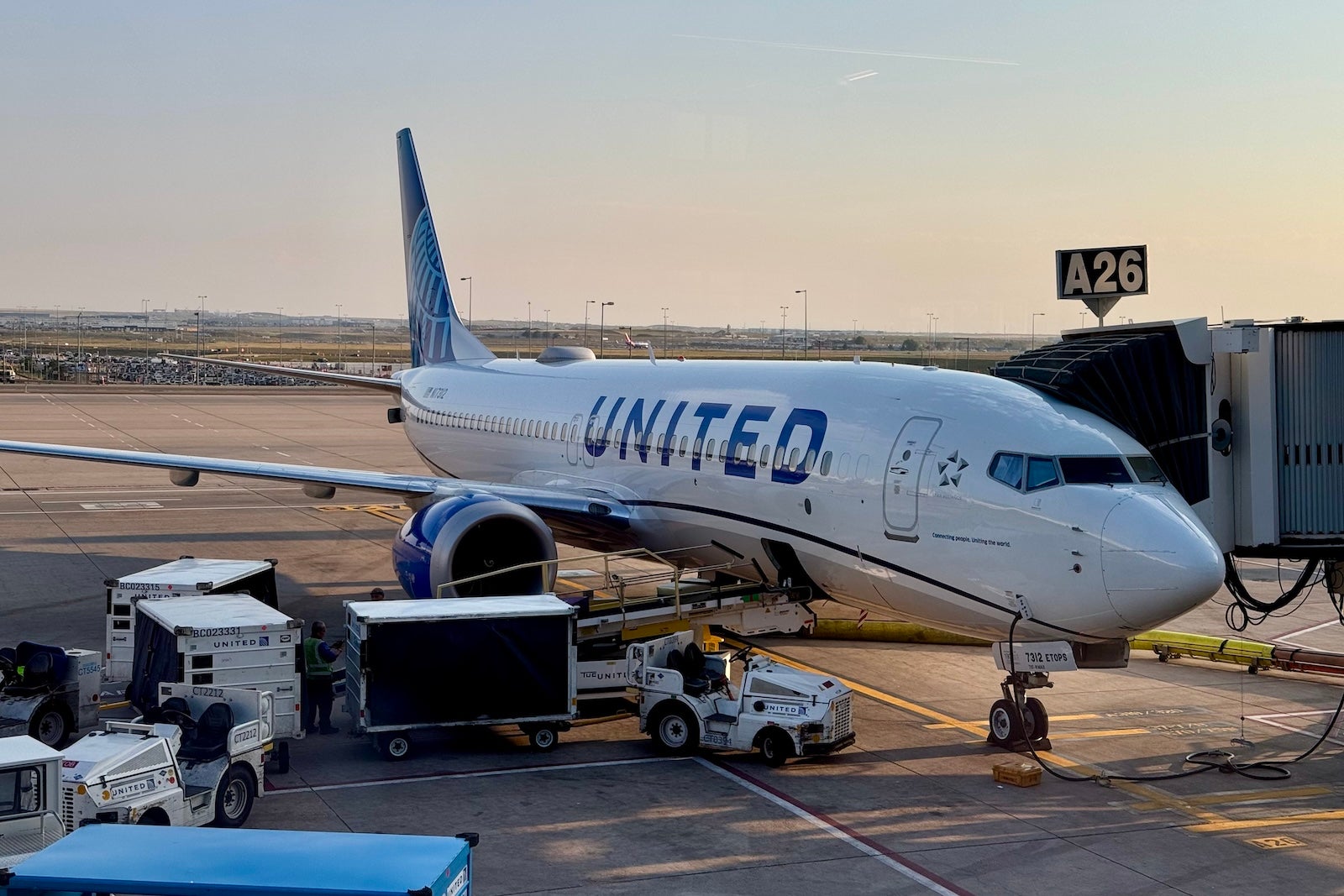
Safety remains a paramount topic when discussing the 737 MAX. Following the exhaustive recertification process by the FAA, EASA, and other global regulators in 2020 and 2021, the aircraft has become one of the most scrutinized and, subsequently, one of the most reliable planes in the sky. By 2026, the MAX has flown millions of hours with an exemplary safety record. United’s commitment to pilot training has been a key factor in this success. The airline’s Flight Training Center in Denver, the largest of its kind in the world, utilizes state-of-the-art MAX-specific full-flight simulators to ensure that every captain and first officer is prepared for the unique handling characteristics of the aircraft’s fly-by-wire systems and Maneuvering Characteristics Augmentation System (MCAS) redundancies.
The economic impact of the 737 MAX 8 on United’s bottom line cannot be overstated. By upgauging routes—moving from a 76-seat regional jet to a 166-seat MAX 8—United has significantly lowered its Cost per Available Seat Mile (CASM). This efficiency allows the airline to remain competitive in a market where low-cost carriers (LCCs) and ultra-low-cost carriers (ULCCs) frequently pressure margins. Moreover, the commonality between the various MAX variants allows for "pilot pooling," where flight crews can easily transition between the MAX 8, 9, and 10, providing United with immense operational flexibility during weather disruptions or maintenance events.
For the frequent flyer, the 737 MAX 8 is deeply integrated into the MileagePlus ecosystem. The value of United’s loyalty program is often realized through the use of co-branded credit cards, primarily issued by Chase. As mentioned in the editorial notes of modern travel reviews, these financial products play a crucial role in how travelers access the premium features of the MAX 8. For instance, holders of the United Quest℠ Card or the United Club℠ Infinite Card often find themselves at the top of the upgrade list for those coveted 16 First Class seats. Furthermore, the ability to use "Money + Miles" for bookings on these new aircraft has made travel more accessible for the casual flyer. The airline’s digital transformation, via the award-winning United app, allows passengers to track their bags in real-time, pre-order meals for their MAX 8 flight, and even navigate the hubs where these planes congregate.
When comparing the United 737 MAX 8 to its peers, such as Delta Air Lines’ Airbus A321neo or American Airlines’ refreshed 737-800s, the "United Next" product stands out for its technological consistency. While Delta has long been praised for its service, United’s decision to install identical interiors across its entire new fleet has removed the "fleet roulette" that once plagued the airline. Whether a passenger is flying a MAX 8 out of San Francisco (SFO), Denver (DEN), Chicago (ORD), or Newark (EWR), the experience is identical. This brand reliability is a cornerstone of United’s strategy to capture a larger share of the corporate travel market, which demands a predictable and productive environment.
Looking toward the future, the 737 MAX 8 will continue to be the backbone of United’s domestic growth. As the airline continues to expand its "hub-to-hub" connectivity and explores more "long-and-thin" international routes, the MAX 8’s range of approximately 3,500 nautical miles makes it an ideal candidate for expansion into secondary markets in Central America, the Caribbean, and even parts of northern South America. The aircraft is not just a tool for today’s schedules but a flexible asset that can adapt to the changing geography of global travel.
In conclusion, the United Airlines 737 MAX 8 represents a successful marriage of engineering efficiency and passenger-centric design. By prioritizing the onboard experience with seatback screens, Bluetooth audio, and ample bin space, United has redefined what it means to fly a narrow-body aircraft in the mid-2020s. For the traveler, it offers a comfortable, connected, and environmentally conscious way to reach their destination. For the airline, it provides the operational hardware necessary to compete in a complex global economy. As the "United Next" order continues to be delivered, the MAX 8 remains the shining example of United’s resurgence as a premier global carrier, proving that the future of flight is as much about the experience inside the cabin as it is about the technology under the wing. Through strategic financial partnerships and a relentless focus on modernization, United has ensured that the 737 MAX 8 will remain a fixture of the skies for decades to come, providing a reliable and elevated journey for millions of passengers annually.
